
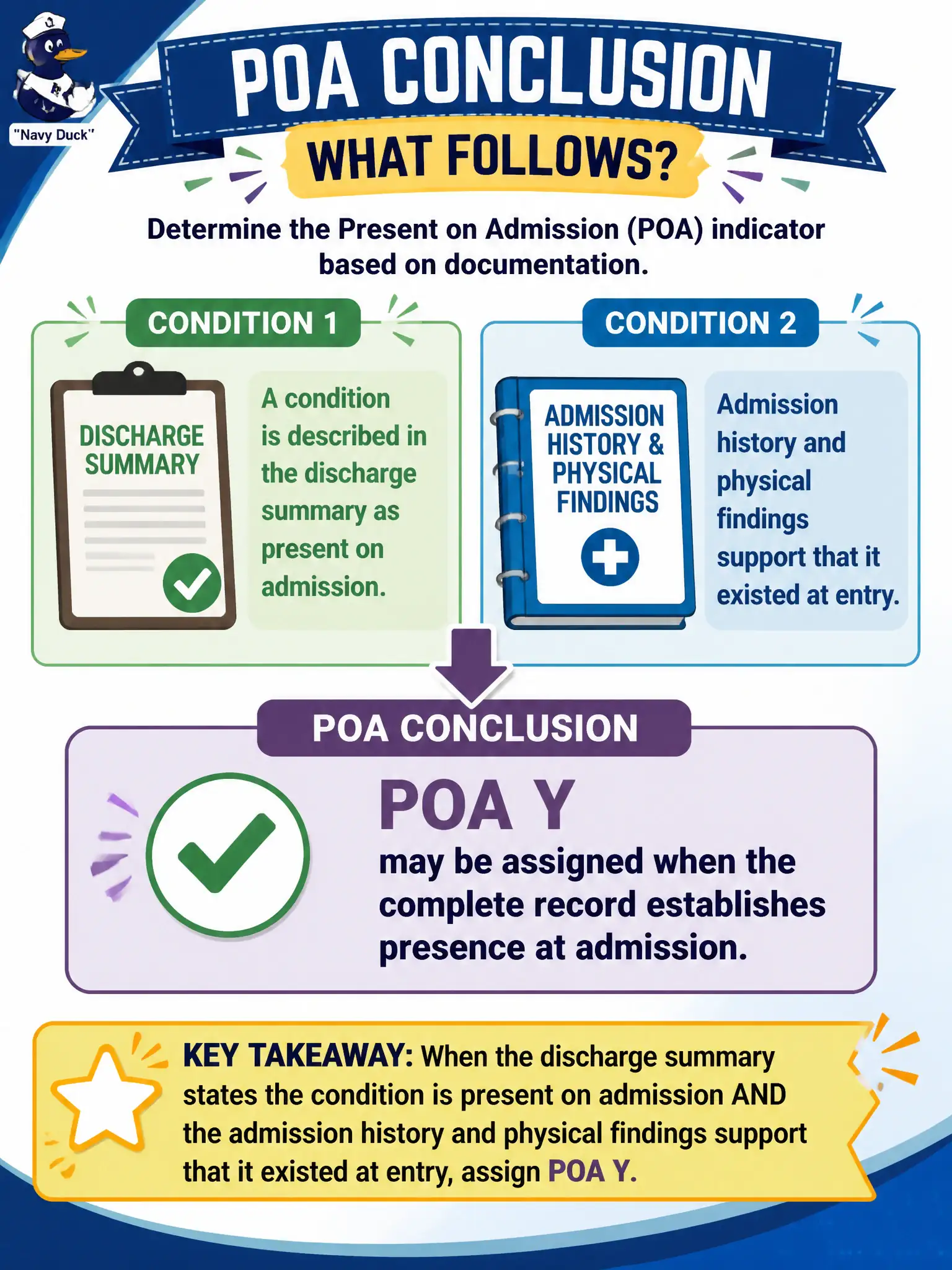
A condition is described in the discharge summary as present on admission, and admission history and physical findings support that it existed at entry. Which POA conclusion follows?
Select an answer to reveal the explanation.
Short Explanation
You get to read the whole chart. If the discharge summary and the admit notes agree the problem was there on arrival, POA Y is fair game—discharge summaries aren't banned from the POA conversation.
Full Explanation
When the discharge summary describes a condition as present on admission and admission H&P findings support that it existed at entry, POA Y may be assigned because the complete record establishes presence at admission. POA is determined from the entire inpatient record, not from a single note type in isolation. Using the complete record yields defensible civic POA assignments that withstand audit when admission and discharge documentation align.
Requiring POA N because discharge summaries “cannot be used for POA” fails by concept—the discharge summary is part of the health record and may corroborate admission presence alongside H&P and ED notes. Forcing POA U merely because two documents mention the condition fails—consistent multi-document support for admission presence supports Y, not undetermined. Omitting POA whenever the discharge summary repeats admission findings fails because repetition does not create an exemption from POA reporting.
Exam caveat: if discharge claims POA Y but admission sources contradict or show clear post-admission onset, weigh the complete record and query conflicts rather than automatically trusting one sentence in the discharge summary. Operational check: corroborate discharge POA statements with H&P/ED/admission notes; assign Y when the complete record establishes admission presence; query unresolved contradictions before finalizing POA.