
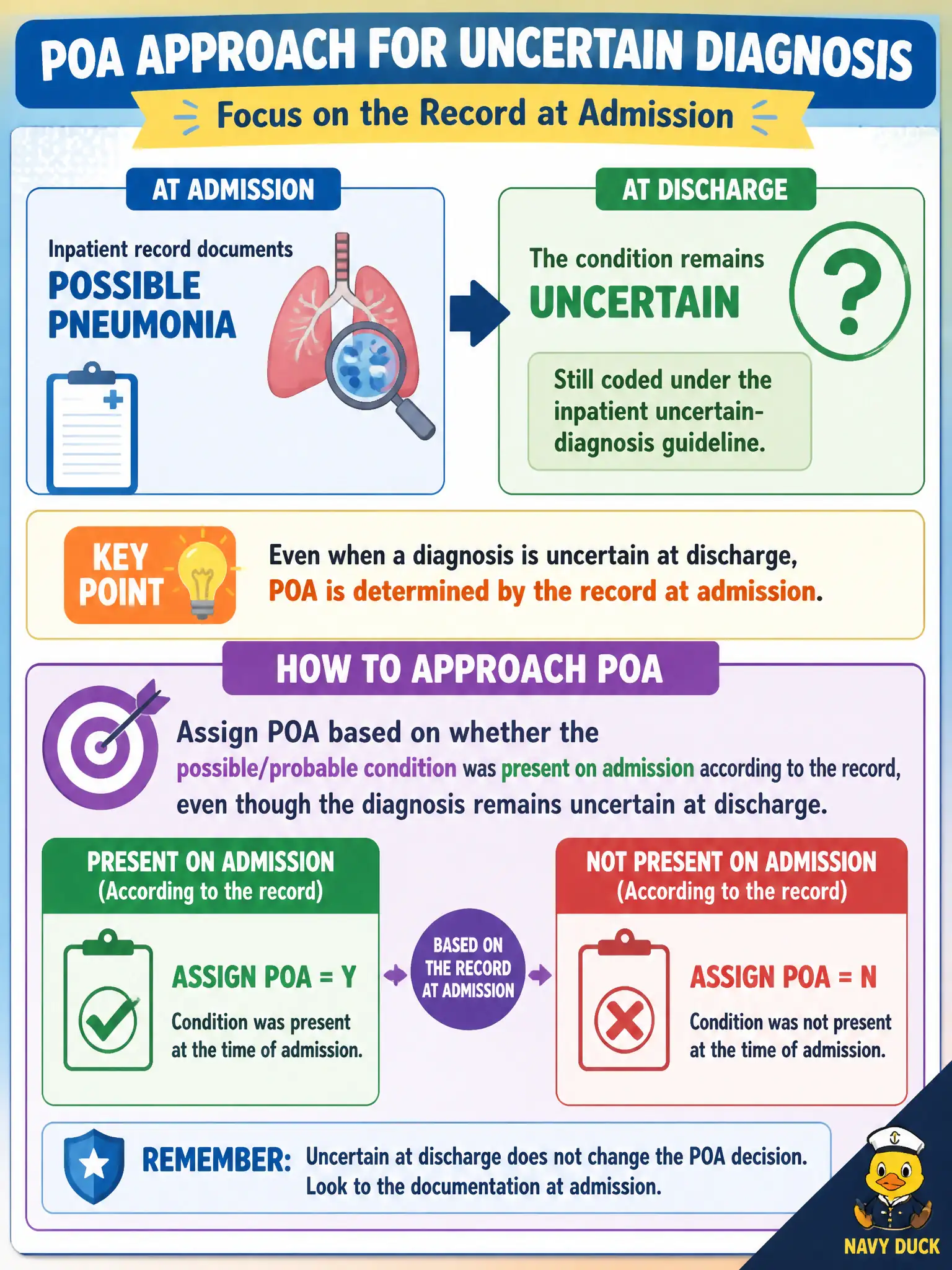
An inpatient record documents possible pneumonia at admission. At discharge the condition remains uncertain but is still coded under the inpatient uncertain-diagnosis guideline. How should POA be approached?
Select an answer to reveal the explanation.
Short Explanation
Uncertain inpatient coding and POA are two different levers. If you code possible pneumonia because it was in play by discharge, you still ask: was that possibility already on board at admission? Timing drives POA; uncertainty alone doesn't auto-pick N or blank.
Full Explanation
When possible pneumonia is documented at admission and remains uncertain at discharge but is coded under the inpatient uncertain-diagnosis guideline, POA is still assigned based on whether that possible/probable condition was present on admission according to the record. Uncertain diagnosis coding and POA assignment are parallel obligations: you may code the uncertain inpatient diagnosis and still indicate whether it was present at admission. This prevents skipping POA whenever “possible” language appears in civic inpatient pneumonia cases and keeps admission-timing data intact for quality programs.
Skipping POA entirely whenever an uncertain diagnosis is coded fails by concept—uncertain diagnoses still need POA when the code is not exempt. Forcing POA N because uncertain diagnoses are “never present on admission” fails; a possible pneumonia noted at admission is typically POA Y if that possible condition was present at entry. Changing the diagnosis to a confirmed symptom code only so that POA rules can be ignored fails as documentation distortion and may understate clinical severity allowed under inpatient uncertain guidelines.
Exam caveat: if the uncertain condition clearly began after admission, POA is N even though inpatient uncertain coding may still allow reporting at discharge when guideline criteria are met. Operational check: determine from admission documentation whether the possible pneumonia was present at entry; assign POA accordingly (often Y when listed at admission); retain inpatient uncertain coding if criteria are met; query when timing and uncertainty conflict.