
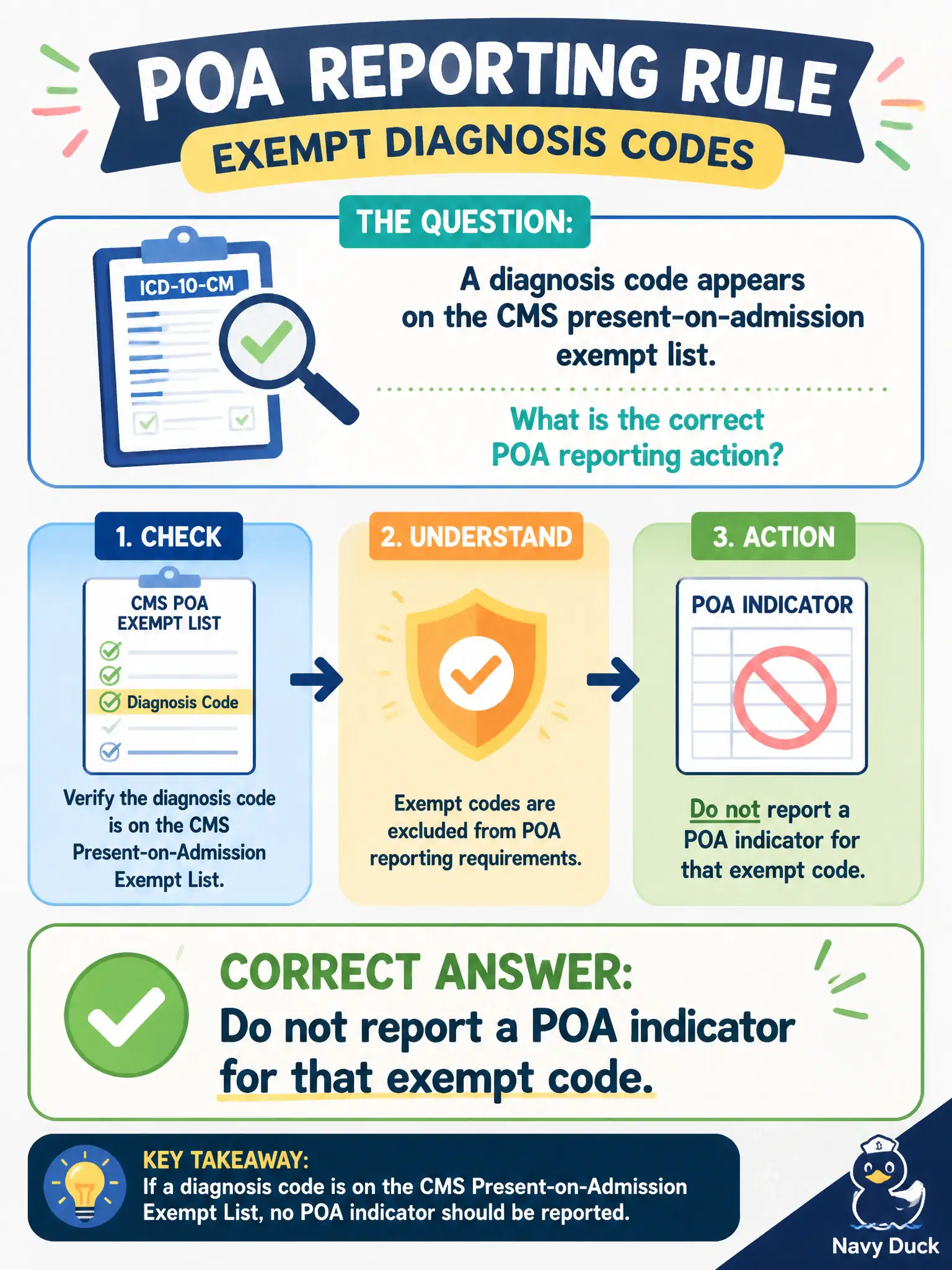
A diagnosis code appears on the CMS present-on-admission exempt list. What is the correct POA reporting action?
Select an answer to reveal the explanation.
Short Explanation
Exempt means skip the POA bubble for that code—not force a Y or N. The exempt list is the 'no indicator needed' lane.
Full Explanation
When a diagnosis code appears on the CMS present-on-admission exempt list, the correct action is not to report a clinical POA indicator for that exempt code; electronic claims use the designated exempt reporting character as required. Exempt status means POA collection is not applicable for that code. Honoring the exempt list prevents false Y/N assignments that confuse civic POA analytics and create spurious HAC or quality signals on codes never intended to carry POA.
Always reporting POA Y for exempt codes fails by concept—exempt codes should not carry clinical Y/N POA values merely for completeness. Always reporting POA N for exempt codes likewise fails and can falsely imply hospital acquisition for codes outside POA scope. Reporting both Y and N on the same exempt diagnosis line fails as invalid duplicate POA signaling and is not a recognized reporting pattern.
Exam caveat: the exempt list is updated; verify current CMS POA exempt codes rather than relying on outdated memory or departmental folklore about “all Z codes” being exempt. Operational check: check each coded diagnosis against the current exempt list; omit clinical POA (use exempt reporting procedure) for listed codes; assign Y/N/U/W only to non-exempt diagnoses; educate staff not to force Y on exempt codes.