
For acute inpatient claims subject to POA reporting, which statement is correct?
Select an answer to reveal the explanation.
Short Explanation
Inpatient POA isn't a principal-only hobby or an outpatient-only chore. Principal and secondaries get indicators unless the code sits on the exempt list—encoders don't make POA optional.
Full Explanation
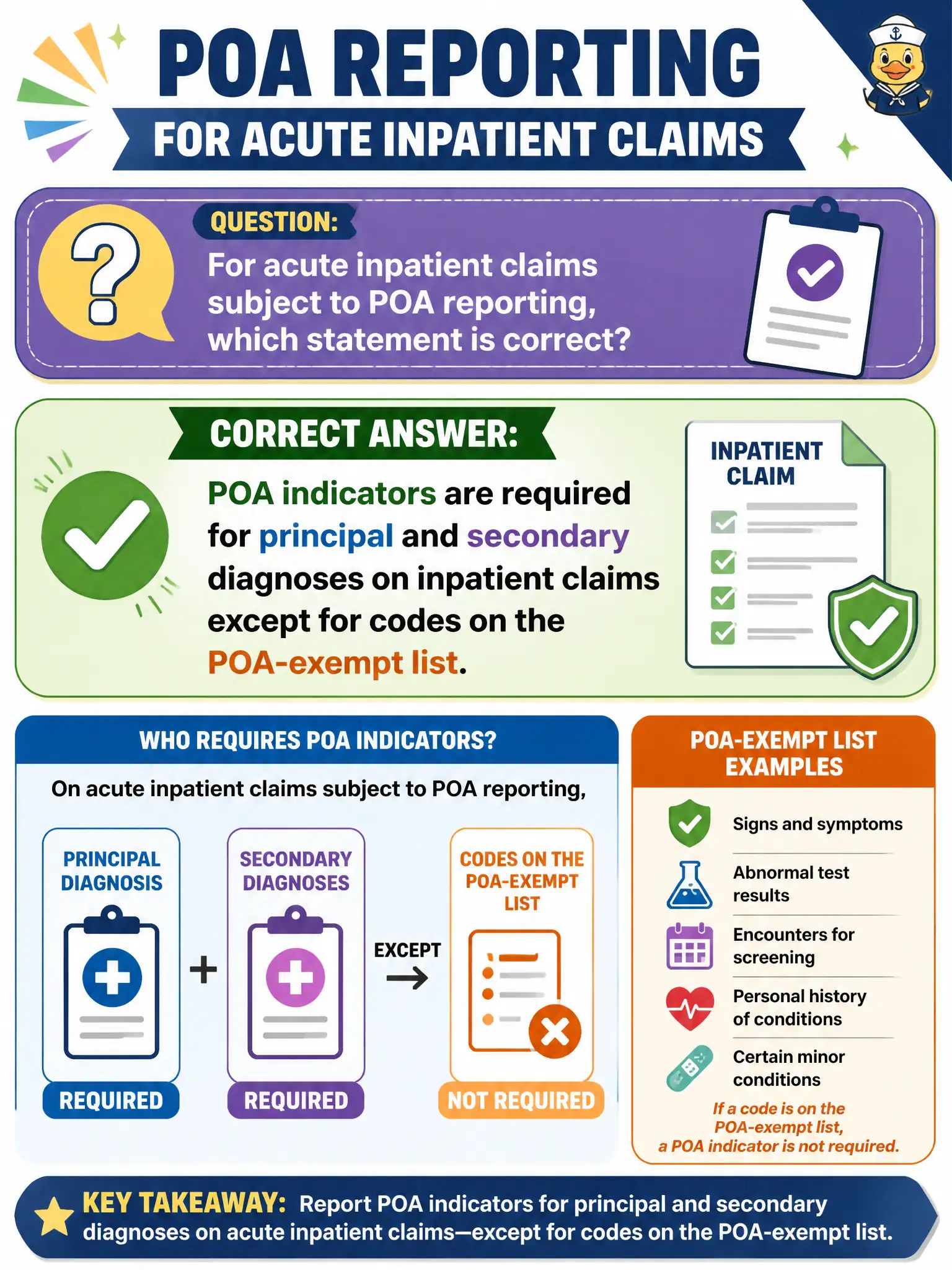
For acute inpatient claims subject to POA reporting, POA indicators are required for principal and secondary diagnoses except for codes on the POA-exempt list. POA is not optional window dressing and is not limited to a single diagnosis field. Comprehensive POA reporting underpins hospital-acquired condition policy, quality measurement, and payment integrity for civic inpatient facilities that serve public beneficiaries. Coders must treat every non-exempt diagnosis—principal or secondary—as requiring a valid POA value before the bill is released.
Saying POA is required only for outpatient APCs and never for inpatient diagnoses reverses reality—POA is an inpatient reporting construct tied to acute inpatient claims, not a substitute for outpatient APC logic. Saying POA applies solely to the principal diagnosis fails because secondary diagnoses also require POA unless they appear on the exempt list; omitting secondary POA silently corrupts comorbidity and HAC analysis. Claiming POA is optional whenever a hospital uses an encoder fails—encoders facilitate capture and edits, but they do not waive CMS or payer POA requirements, and blank POA on non-exempt codes remains a compliance defect.
Exam caveat: exempt codes should not receive Y/N/U/W POA indicators; electronic formats use the designated exempt reporting character (commonly “1”) for those codes—do not invent clinical POA values for exempt entries. Operational check: assign POA on each non-exempt principal and secondary diagnosis; apply exempt reporting for codes on the current CMS POA-exempt list; audit abstracts for blank or invalid POA before bill drop; educate that encoder presence never makes POA optional.