
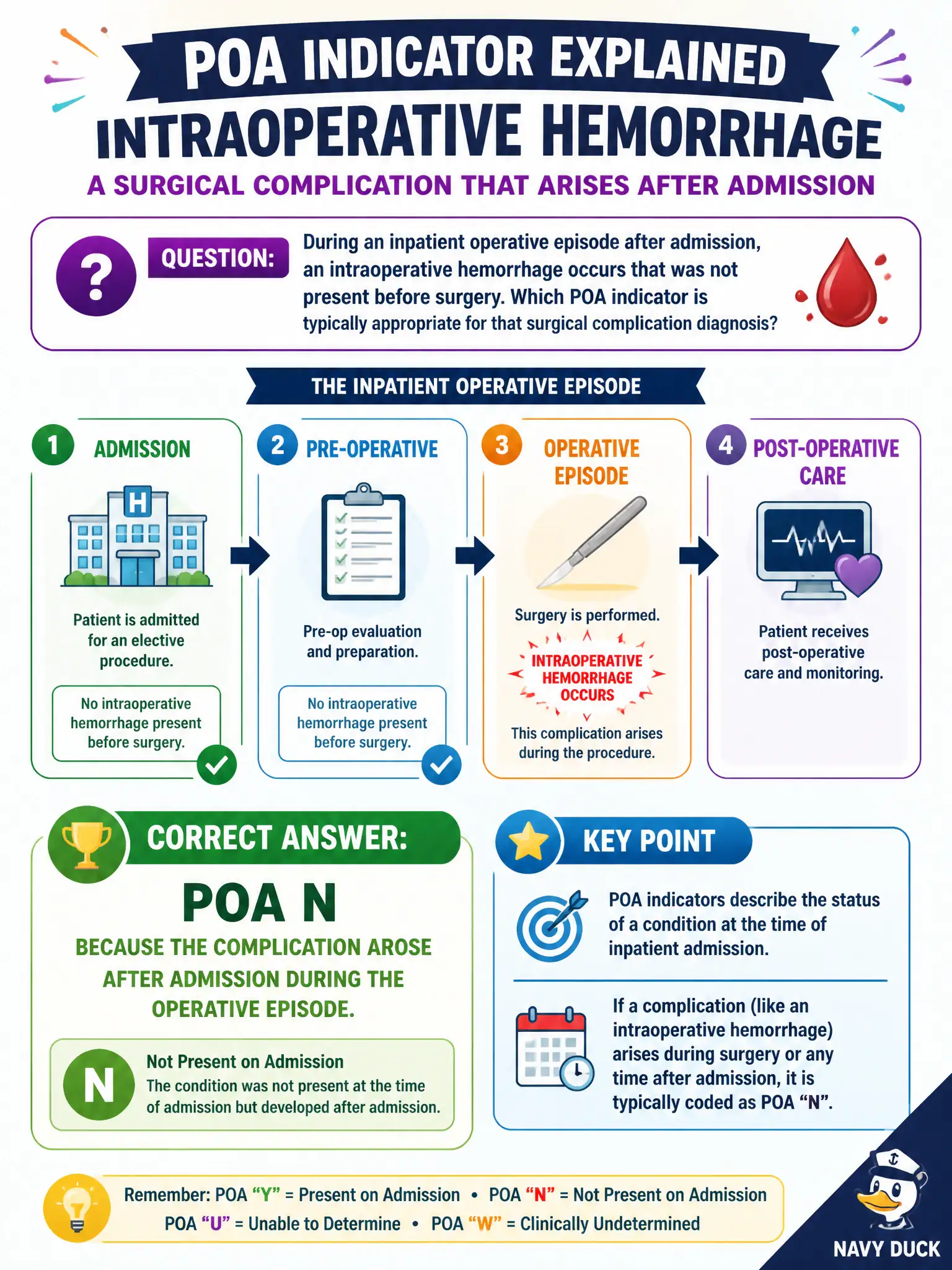
During an inpatient operative episode after admission, an intraoperative hemorrhage occurs that was not present before surgery. Which POA indicator is typically appropriate for that surgical complication diagnosis?
Select an answer to reveal the explanation.
Short Explanation
Bleed that starts in the OR after the patient was already admitted? That's POA N—it wasn't riding in with them. Still code the complication when it's documented and significant; just mark the timing right.
Full Explanation
An intraoperative hemorrhage that occurs during an inpatient operative episode after admission and was not present before surgery typically receives POA N. The complication arose after admission. Correct N assignment for intraoperative complications supports transparent civic surgical quality reporting and avoids falsely marking post-admission events as present on arrival, which would distort HAC and surgical complication surveillance.
Assigning POA Y because all operating-room events are deemed present on admission fails by concept—OR timing after admission generally indicates not present on admission when the complication begins intraoperatively. Inventing POA E as a special exempt indicator only for intraoperative bleeding fails—that is not a standard POA value in the Y/N/U/W/exempt framework. Omitting both POA and the diagnosis because intraoperative events are “never coded” fails; clinically significant intraoperative hemorrhage is coded with appropriate complication codes and POA.
Exam caveat: conditions that existed before surgery and were merely encountered or addressed intraoperatively may be Y; the stem’s new intraoperative hemorrhage that began during surgery is N. Operational check: confirm the hemorrhage began during post-admission surgery without pre-op presence; code the complication per Tabular instructions; assign POA N; link procedure and complication documentation for QI and peer-review pathways.