
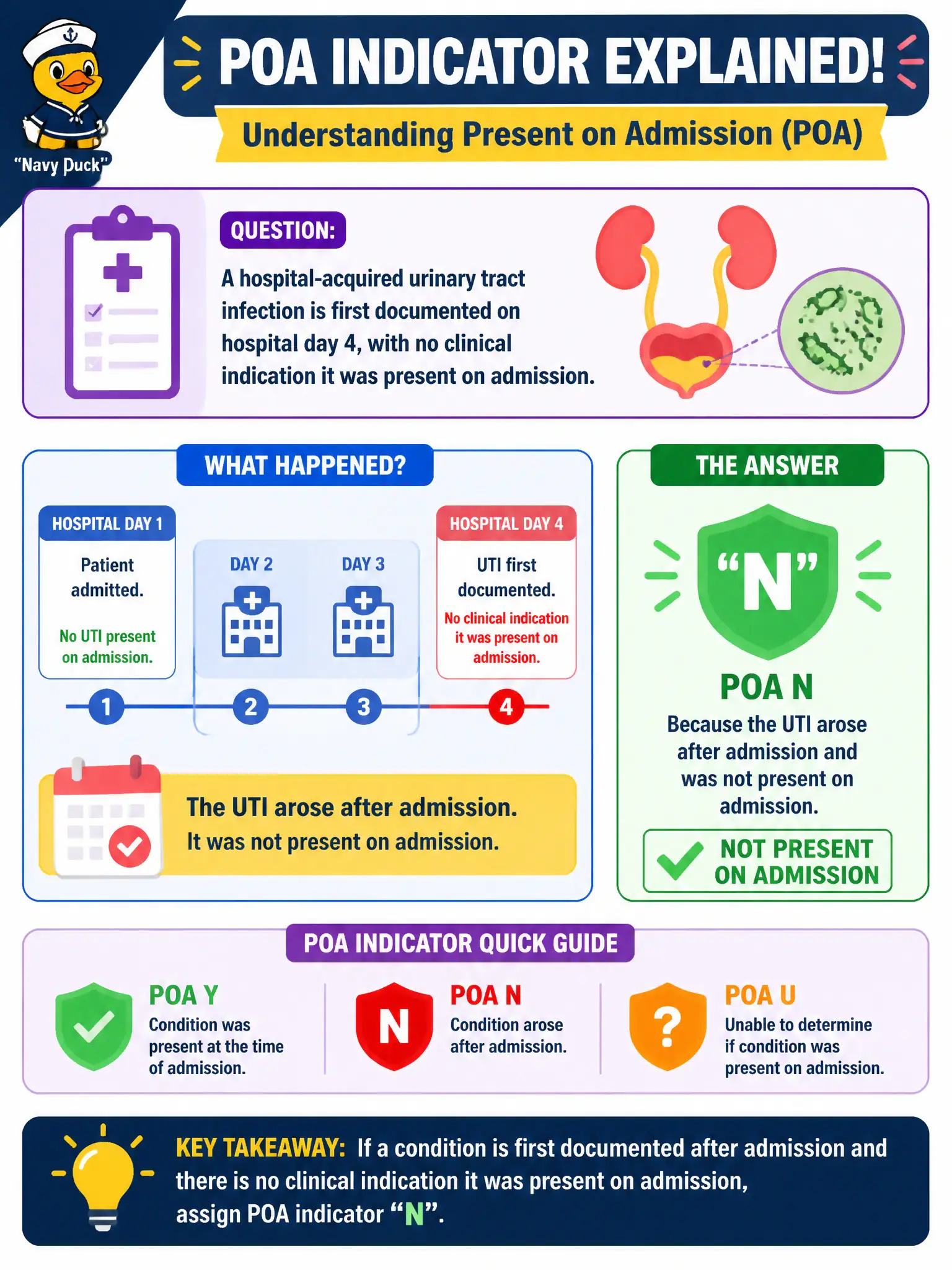
A hospital-acquired urinary tract infection is first documented on hospital day 4, with no clinical indication it was present on admission. Which POA indicator should be assigned?
Select an answer to reveal the explanation.
Short Explanation
Day-four new UTI with nothing pointing to it on arrival? That's POA N—hospital-onset, not baggage from home. You still code the infection; you just mark that it wasn't there at the front door.
Full Explanation
A hospital-acquired urinary tract infection first documented on hospital day 4 with no clinical indication it was present on admission should receive POA N. POA N means the condition was not present on admission. Accurate N assignment for post-admission UTI onset is essential for civic infection surveillance and HAC-sensitive payment integrity.
Assigning POA Y because any infection coded during a stay is considered present on admission fails by concept—timing and clinical evidence determine POA, not merely the fact that the infection appears on the claim. Using POA 1 as an “outpatient-only indicator for all inpatient secondary diagnoses” fails; that is not the inpatient POA value set (Y/N/U/W/1 has specific meanings—1 is exempt reporting on electronic formats for exempt codes, not a generic secondary-diagnosis flag). Omitting the UTI entirely whenever POA would be N fails because reportable hospital-onset infections must still be coded with the correct POA.
Exam caveat: if documentation later clarifies the UTI was incubating/present at admission, POA may change—code from the complete record, not from first mention alone when clarification exists. Operational check: verify day-4 onset without admission evidence; assign POA N; report the UTI diagnosis; align infection-control and coding timelines.