
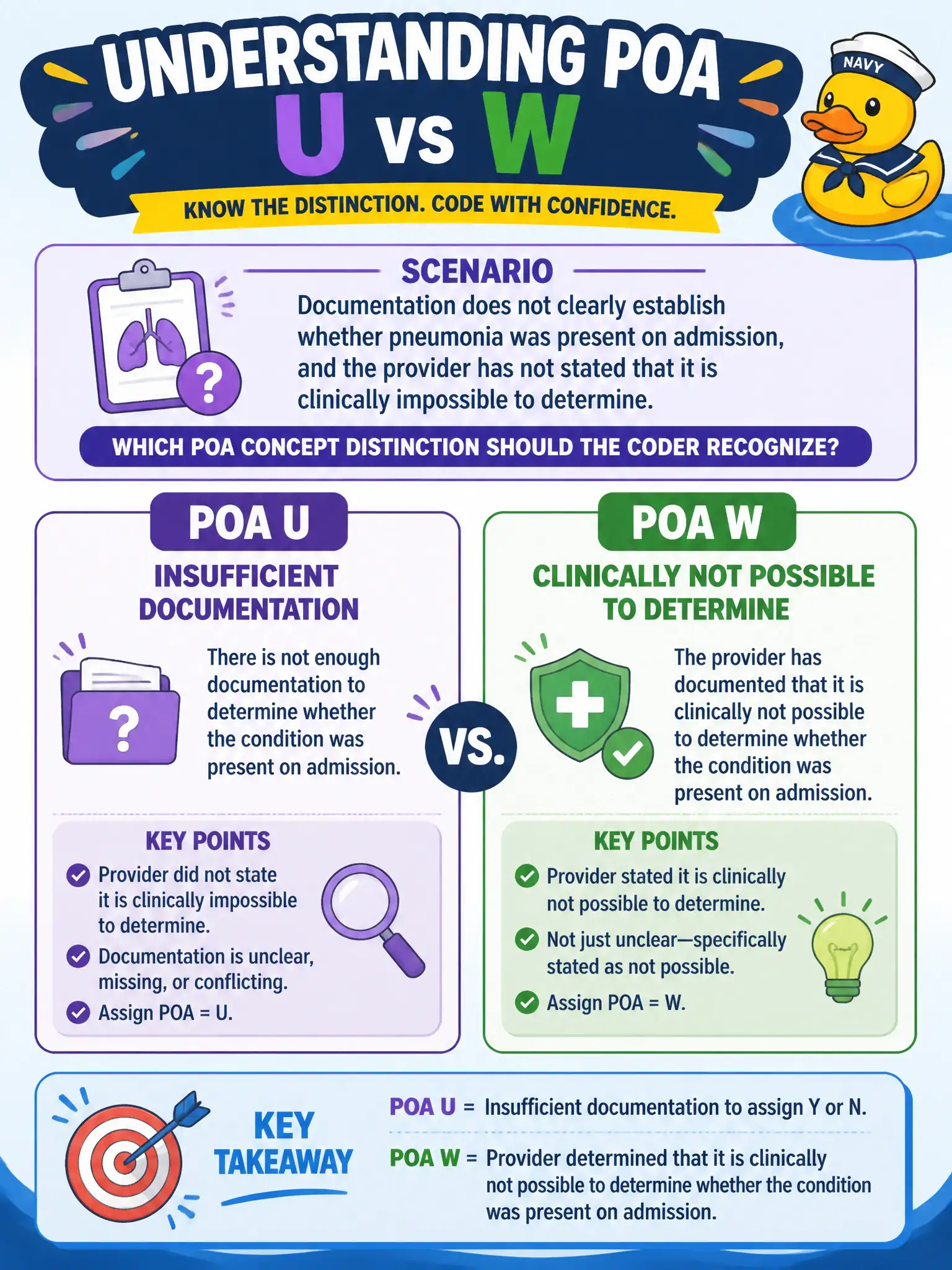
Documentation does not clearly establish whether pneumonia was present on admission, and the provider has not stated that it is clinically impossible to determine. Which POA concept distinction should the coder recognize?
Select an answer to reveal the explanation.
Short Explanation
U and W aren't twins. U means the chart didn't give enough to say yes or no; W means the clinician says even they can't tell if it was there on arrival. Don't treat them like coin-flip synonyms.
Full Explanation
POA U and POA W are not interchangeable. POA U indicates insufficient documentation to assign Y or N; POA W indicates the provider determined it is clinically not possible to determine whether the condition was present on admission. When pneumonia POA is unclear and the provider has not stated clinical impossibility to determine, the coder must recognize that U addresses documentation insufficiency, whereas W requires a provider determination of clinical indeterminacy. That distinction prevents casual misuse of W as a documentation shortcut in municipal pneumonia abstracts.
Treating Y and N as interchangeable whenever pneumonia appears fails by concept—Y/N are opposites with payment and quality consequences. Automatically using W for every pulmonary diagnosis without reading the record fails because W is a specific provider determination, not a pulmonary default. Choosing U and W at random because they “mean the same thing” fails—they encode different reasons for undetermined POA.
Exam caveat: query the provider when documentation is insufficient before defaulting to U if facility policy requires clarification attempts; do not assign W unless the provider documents clinical inability to determine. Operational check: search admission sources for pneumonia evidence; if still unclear and no provider W statement, follow facility policy for query versus U; never randomize U/W.