
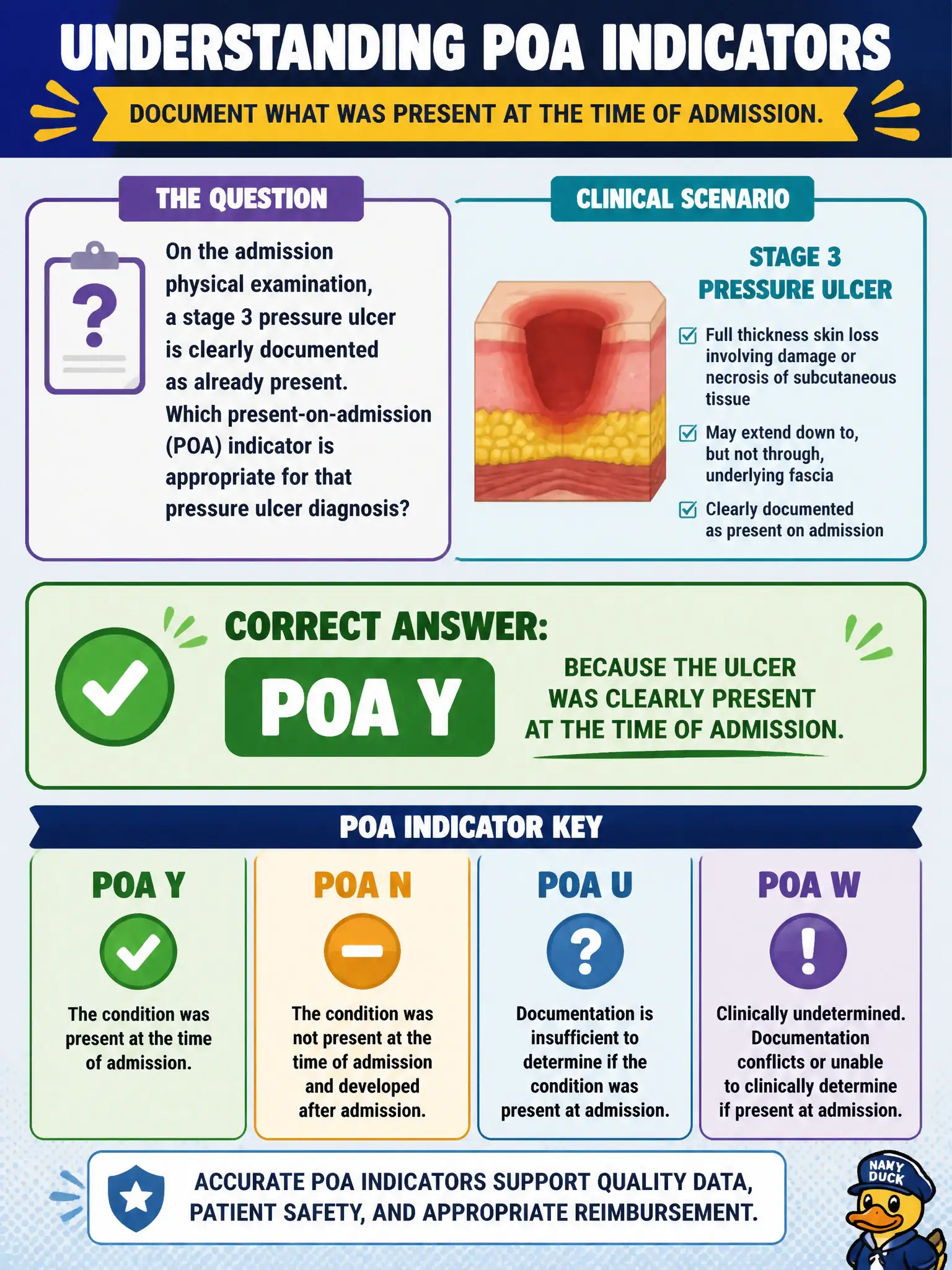
On the admission physical examination, a stage 3 pressure ulcer is clearly documented as already present. Which present-on-admission (POA) indicator is appropriate for that pressure ulcer diagnosis?
Select an answer to reveal the explanation.
Short Explanation
If the admit exam already shows the ulcer, that's a yes—POA Y. Hospital-acquired is for things that show up after the patient is already in the bed, not for what walked in with them.
Full Explanation
Present-on-admission (POA) indicators report whether a diagnosis was present at the time of inpatient admission. When the admission physical examination clearly documents a stage 3 pressure ulcer as already present, the appropriate POA indicator is Y. Assigning Y for conditions present at entry protects civic hospitals from incorrectly labeling community-acquired pressure injuries as hospital-acquired and preserves fair HAC-related measurement.
Assigning POA N because all pressure ulcers are treated as hospital-acquired by default fails by concept—POA is case-specific documentation, not a diagnosis-wide default. Claiming pressure ulcers are POA-exempt fails because pressure ulcer codes generally require POA reporting and are central to HAC programs. Using only POA W because “chronic skin findings cannot be Y or N” fails—W is reserved for provider determination that it is clinically not possible to determine POA, not a blanket for chronic skin conditions that were clearly present on admission.
Exam caveat: staging and laterality still must be coded correctly; POA Y does not reduce the need for accurate pressure-ulcer diagnosis coding. Operational check: confirm admission exam/H&P documents the stage 3 ulcer at entry; assign POA Y; ensure staging matches provider documentation; never default pressure ulcers to N without evidence they developed after admission.