
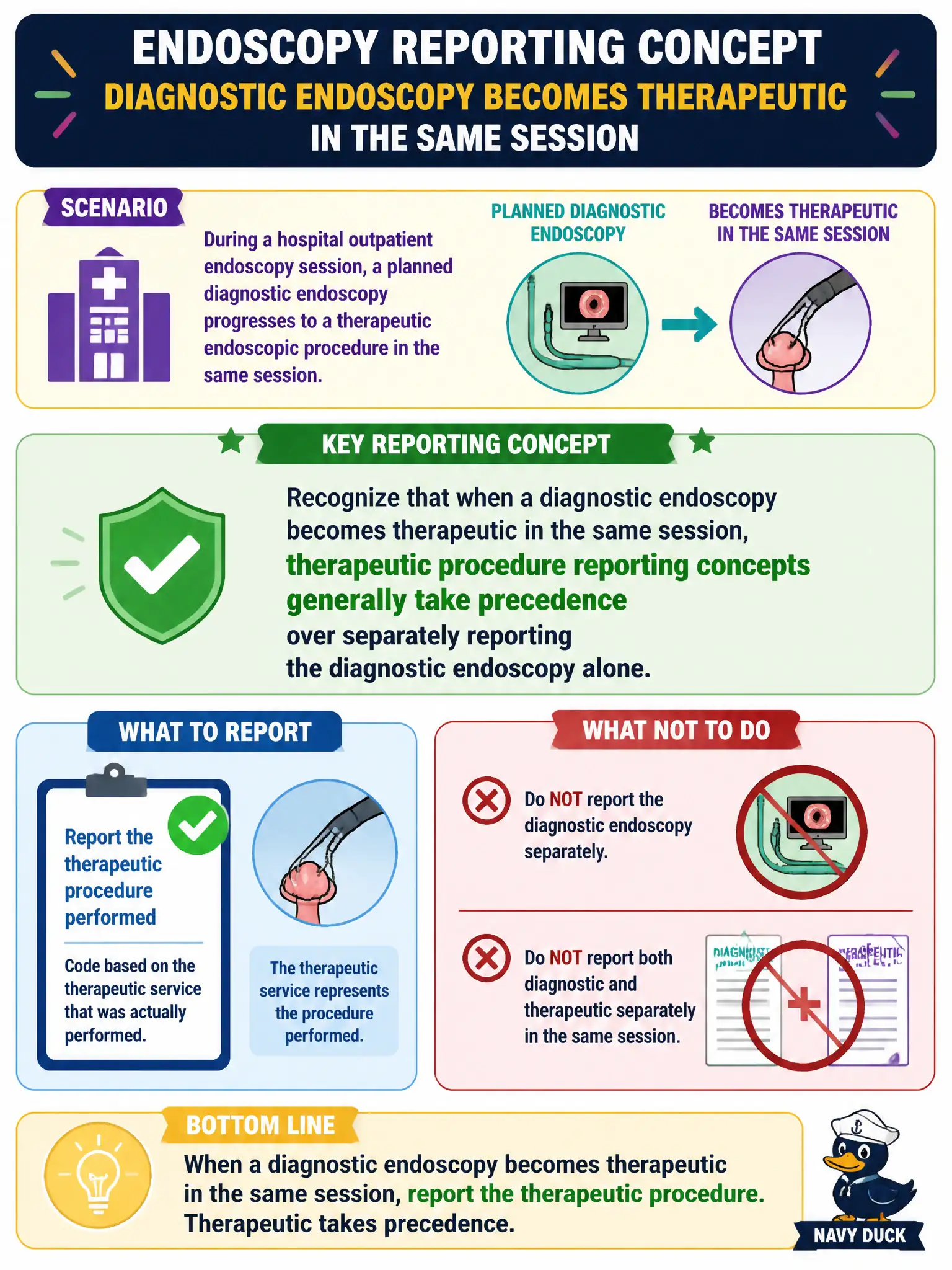
During a hospital outpatient endoscopy session, a planned diagnostic endoscopy progresses to a therapeutic endoscopic procedure in the same session. Which reporting concept should the coder apply?
Select an answer to reveal the explanation.
Short Explanation
Same scope, same sitting: once the team moves from look-and-see to treat, the therapeutic procedure is the star. You don't pretend only the diagnostic happened, and you don't ignore how same-session endoscopy reporting works.
Full Explanation
During a hospital outpatient endoscopy session, when a planned diagnostic endoscopy progresses to a therapeutic endoscopic procedure in the same session, therapeutic procedure reporting concepts generally take precedence over separately reporting the diagnostic endoscopy alone. Same-session diagnostic-to-therapeutic progression is a classic bundling/precedence scenario. Applying therapeutic precedence prevents double billing diagnostic-plus-therapeutic scopes for one continuous session in municipal GI labs.
Reporting only the diagnostic endoscopy and never the therapeutic procedure fails by concept when therapy was performed—the therapeutic service is what should be reported. Reporting both full diagnostic and therapeutic endoscopic codes without considering same-session precedence/bundling fails because it typically over-reports. Deleting the encounter because mixed diagnostic and therapeutic endoscopy “cannot be coded” fails—there is a clear reporting pathway favoring the therapeutic procedure.
Exam caveat: specific CPT endoscopy hierarchies and NCCI pairs matter; always check current CPT instructional notes for that endoscopic family. Operational check: confirm diagnostic intent converted to therapeutic treatment in one session; report the therapeutic endoscopic procedure per CPT/NCCI guidance; do not separately bill the diagnostic endoscopy that became therapeutic without a supported distinct-services basis.