
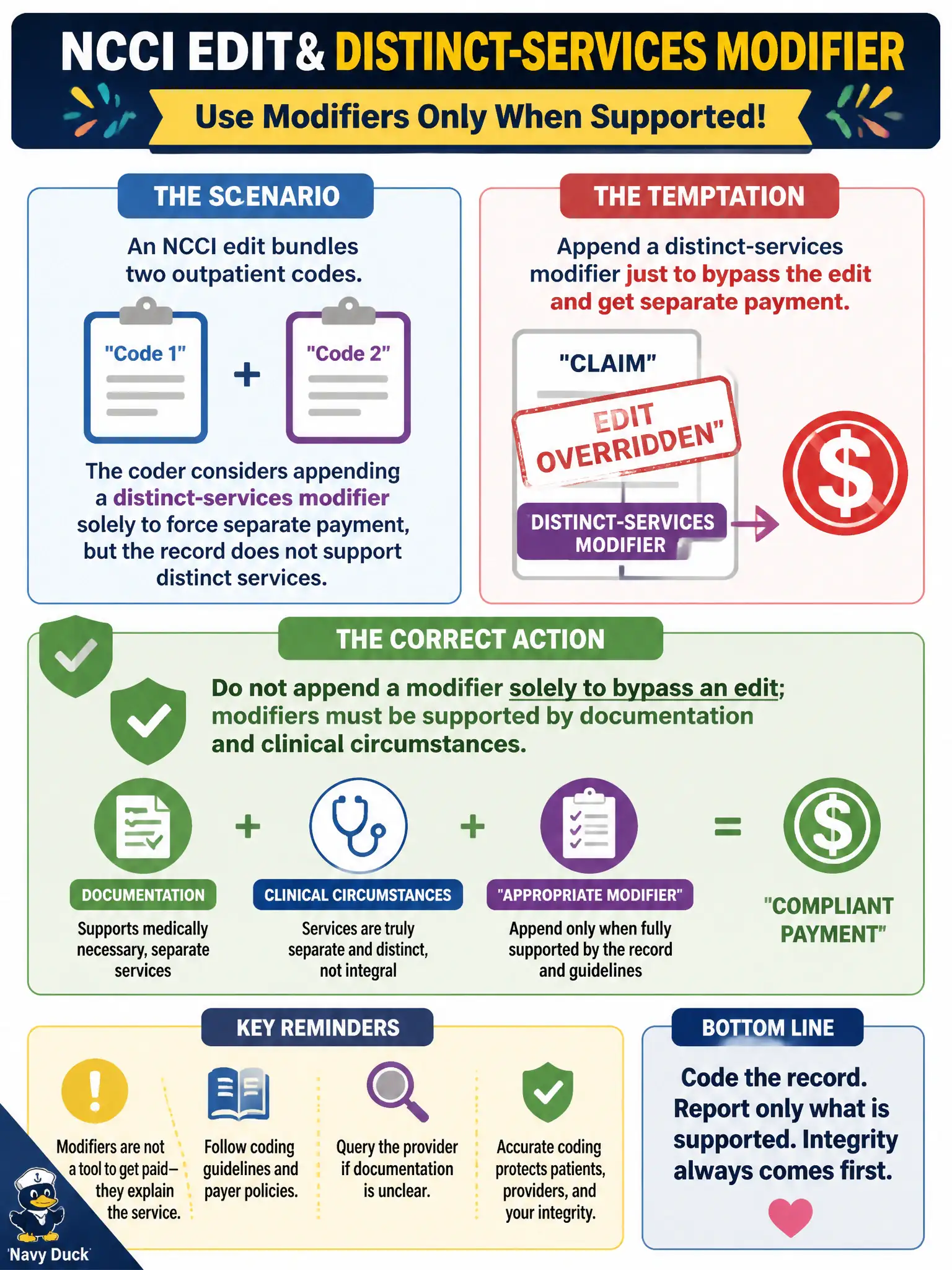
An NCCI edit bundles two outpatient codes. The coder considers appending a distinct-services modifier solely to force separate payment, but the record does not support distinct services. What is the correct action?
Select an answer to reveal the explanation.
Short Explanation
Modifiers are truth-tellers, not crowbars. If the chart does not show distinct services, you do not slap on a bypass flag just to chase dollars. Fix the coding to match the record—or leave the edit alone.
Full Explanation
If an NCCI edit bundles two outpatient codes and the record does not support distinct services, the coder must not append a distinct-services modifier solely to force separate payment. Modifiers require documentation and clinical circumstances; using them as edit-bypass keys is noncompliant. Ethical restraint here protects public trust and municipal revenue-cycle integrity under NCCI while still allowing legitimate distinct-service reporting when the operative facts truly qualify.
Always appending the modifier whenever any edit appears and awaiting denial fails by concept—it is intentional unbundling dressed up as a workflow. Deleting the primary procedure so the edit disappears fails because it under-reports the comprehensive service actually performed and may understate clinical care. Changing diagnosis codes until the edit clears without reviewing operative facts fails because diagnosis gamesmanship does not create clinical distinctness between procedures and can create medical-necessity or fraud risk.
Exam caveat: when services truly are distinct (separate sites, sessions, lesions, or other recognized criteria), a supported distinct-services modifier may be appropriate—and the PTP modifier indicator must allow override. Operational check: read the operative facts against NCCI distinctness criteria and the pair’s modifier indicator; if unsupported, report only the appropriately payable code(s) without a bypassing modifier; if supported, document distinctness clearly and then append the modifier.