
A hospital outpatient coder is finalizing a claim that already uses CPT modifiers where appropriate. When might HCPCS Level II modifiers also be needed?
Select an answer to reveal the explanation.
Short Explanation
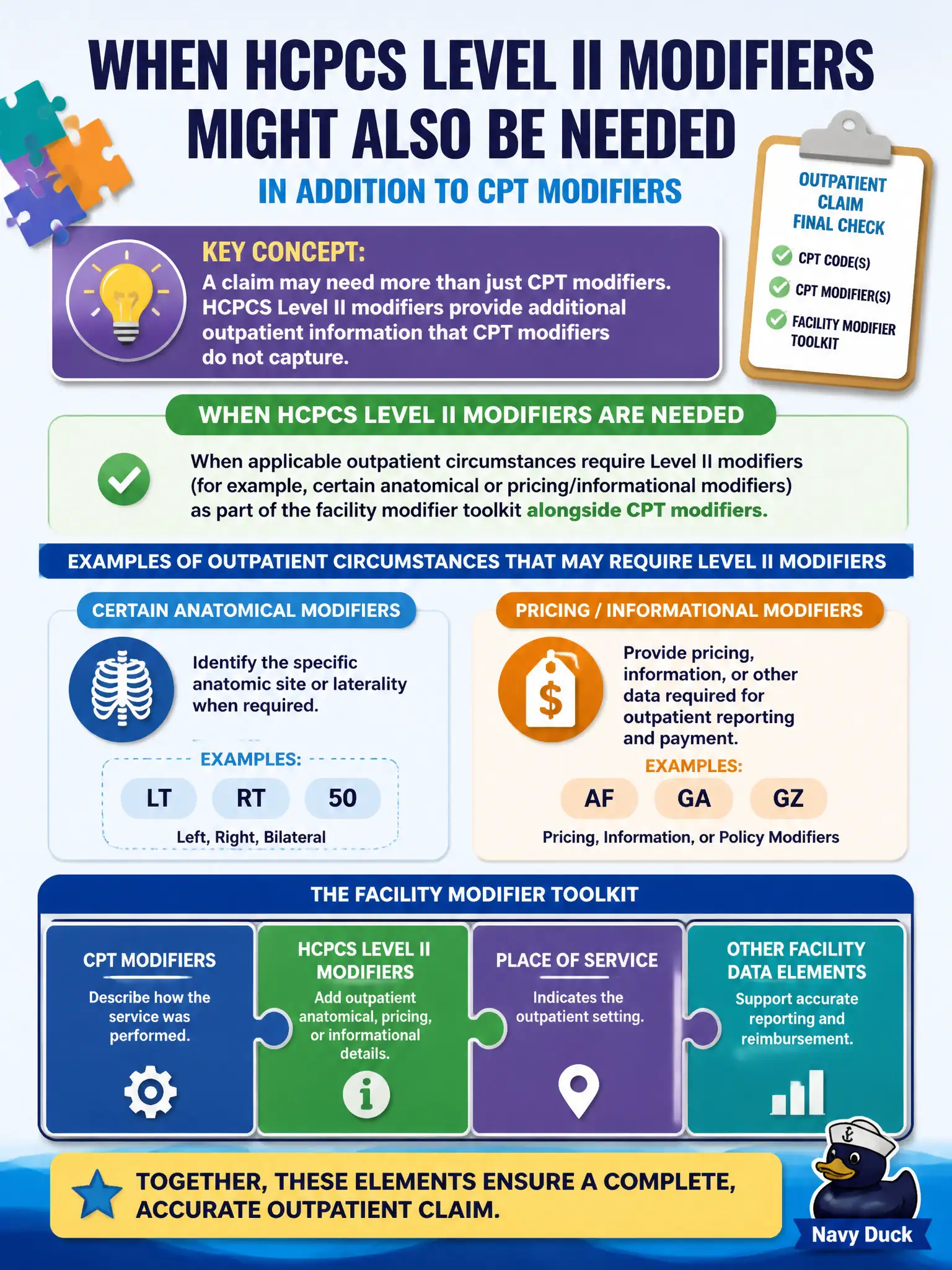
CPT modifiers are not the whole toolbox. Outpatient hospital claims also lean on HCPCS Level II modifiers when the situation calls for them—think certain side, ambulance, or pricing/informational flags. Facility coders keep both kits handy.
Full Explanation
Hospital outpatient claims may need HCPCS Level II modifiers in addition to CPT modifiers when outpatient circumstances call for Level II anatomical, pricing, or informational modifiers. CPT modifiers and HCPCS Level II modifiers form a shared facility toolkit; one set does not abolish the other. Knowing when Level II modifiers apply keeps civic outpatient claims compliant with Medicare and commercial modifier expectations.
Never using Level II modifiers because CPT modifiers “fully replace” them fails by concept—many required outpatient modifiers live in the Level II set. Restricting Level II modifiers to inpatient ICD-10-PCS root operations fails because PCS inpatient coding is a different system and Level II modifiers are outpatient/HCPCS constructs. Using Level II modifiers only when replacing the CPT procedure code itself fails—modifiers amend reporting circumstances; they do not replace the procedure code as their primary purpose.
Exam caveat: some modifiers exist in both CPT and HCPCS forms or have payer-specific preferences—follow current payer and CMS guidance for the setting. Operational check: after applying needed CPT modifiers, review whether anatomical (e.g., E1–E4, FA–F9, TA–T9), ambulance, or other Level II modifiers are also required; append only those supported by documentation.