
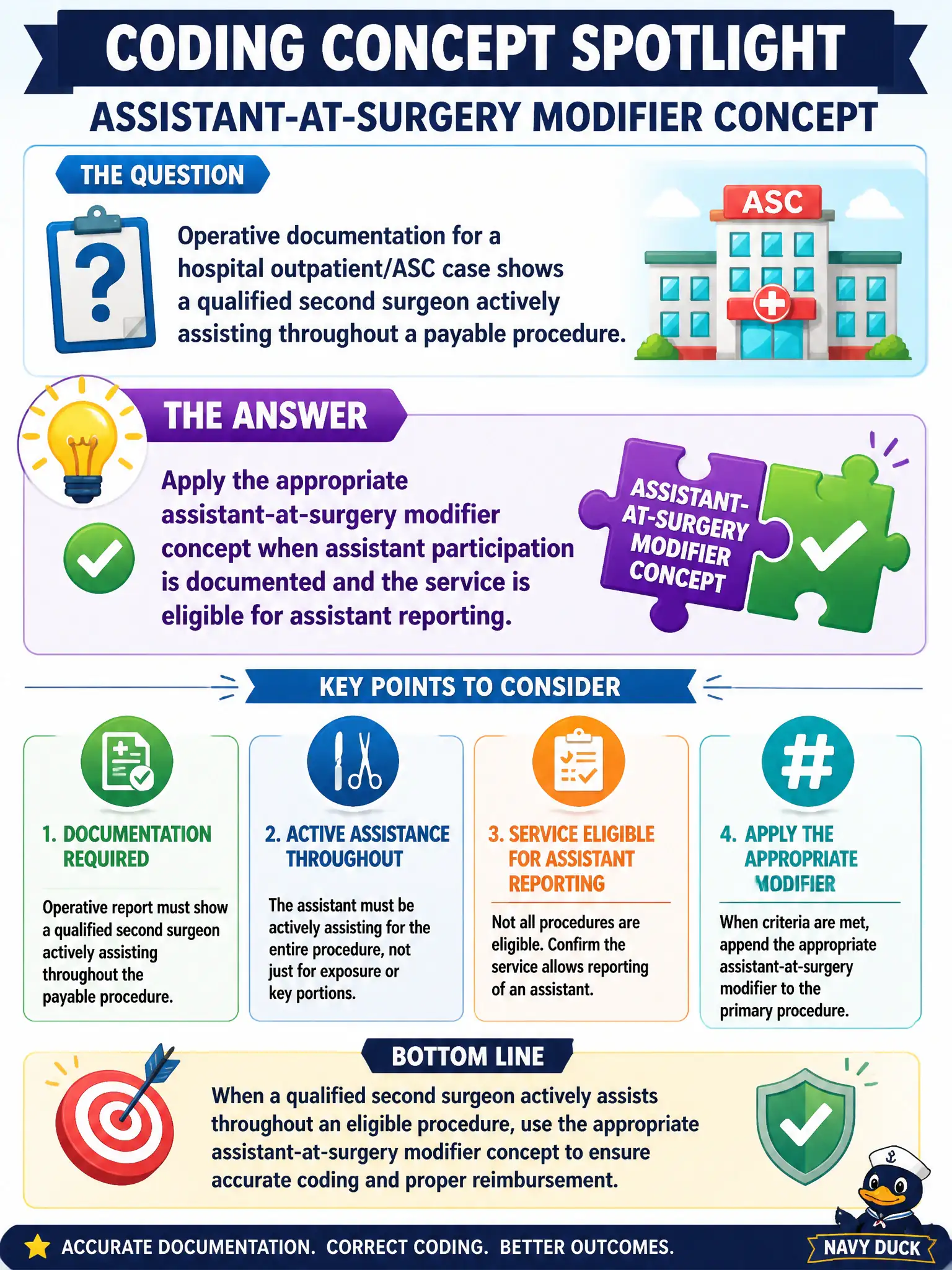
Operative documentation for a hospital outpatient/ASC case shows a qualified second surgeon actively assisting throughout a payable procedure. What coding concept should be considered?
Select an answer to reveal the explanation.
Short Explanation
If a second surgeon is truly assisting—not just watching—and the service allows assistant billing, there is a specific assistant-at-surgery modifier family for that. Presence in the room alone is not enough; the record has to show the assist role.
Full Explanation
When operative documentation for a hospital outpatient/ASC case shows a qualified second surgeon actively assisting throughout a payable procedure, apply the appropriate assistant-at-surgery modifier concept if the service is eligible for assistant reporting. Assistant modifiers communicate the second surgeon’s role for physician billing constructs tied to the case. Accurate assistant reporting depends on documentation of assistance and payer/CPT eligibility—not on informal presence alone.
Always omitting assistant reporting because “facility claims never recognize assistants” fails by concept as a blanket rule; assistant-at-surgery is a recognized reporting concept when criteria are met (noting physician versus facility claim nuances). Reporting the assistant with only an E/M modifier fails because E/M modifiers do not identify assistant surgical role. Using a bilateral modifier to indicate two surgeons fails—bilateral modifiers address paired organs, not personnel count.
Exam caveat: many procedures are not payable with assistants per CMS physician fee schedule indicators; eligibility matters as much as documentation. Operational check: confirm documented active assistance by a qualified second surgeon; verify the procedure allows assistant billing; append the correct assistant-at-surgery modifier concept; do not invent assistance from “two names on the schedule” without operative support.