
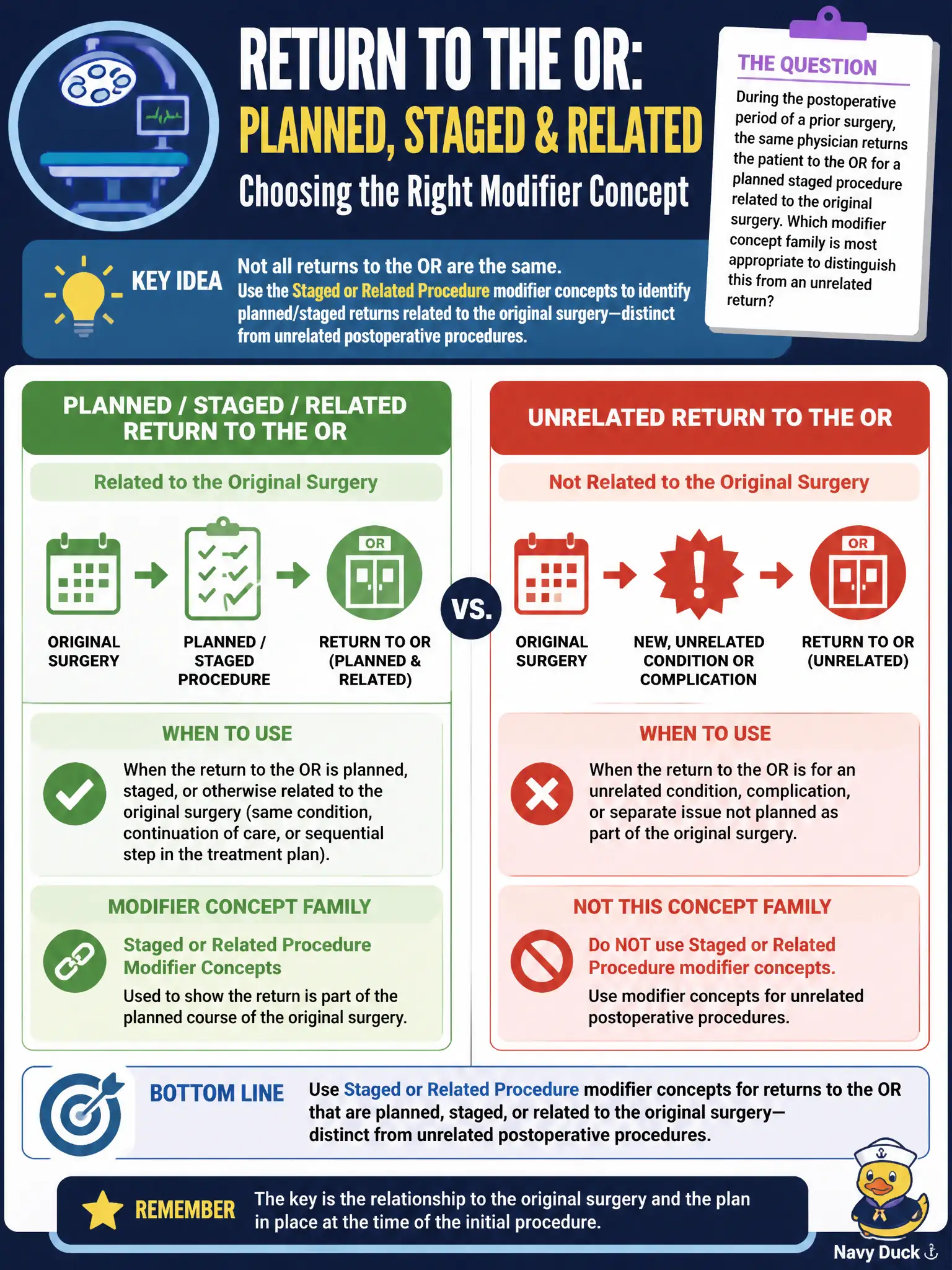
During the postoperative period of a prior surgery, the same physician returns the patient to the OR for a planned staged procedure related to the original surgery. Which modifier concept family is most appropriate to distinguish this from an unrelated return?
Select an answer to reveal the explanation.
Short Explanation
A planned encore operation related to the first surgery is a staged/related return—not a random new adventure. Unrelated postoperative problems get a different flag. Match the modifier family to whether the comeback was part of the original plan or something else entirely.
Full Explanation
When, during the postoperative period of a prior surgery, the same physician returns the patient to the OR for a planned staged procedure related to the original surgery, staged/related procedure modifier concepts distinguish that return from an unrelated postoperative procedure. Global surgical package rules treat related staged returns differently from unrelated returns, so the modifier family must match the clinical relationship. Correct modifier choice keeps civic postoperative claims compliant with global-period logic.
Using only “repeat by another physician” modifiers because any return voids the global package fails by concept—relationship and same-versus-different physician pathways differ, and staged/related returns have their own concepts. Laterality modifiers alone fail because side designation does not explain staged postoperative timing/relationship. Claiming no modifier is ever used for postoperative returns fails—modifiers are commonly required to explain returns during global periods.
Exam caveat: unrelated returns (e.g., different problem) use a different modifier concept than staged/related returns—read the operative indication carefully. Operational check: confirm the return is planned/staged or related to the original surgery by the same physician; apply staged/related modifier concepts; document the staging plan; do not use unrelated-return modifiers for true staged procedures.