
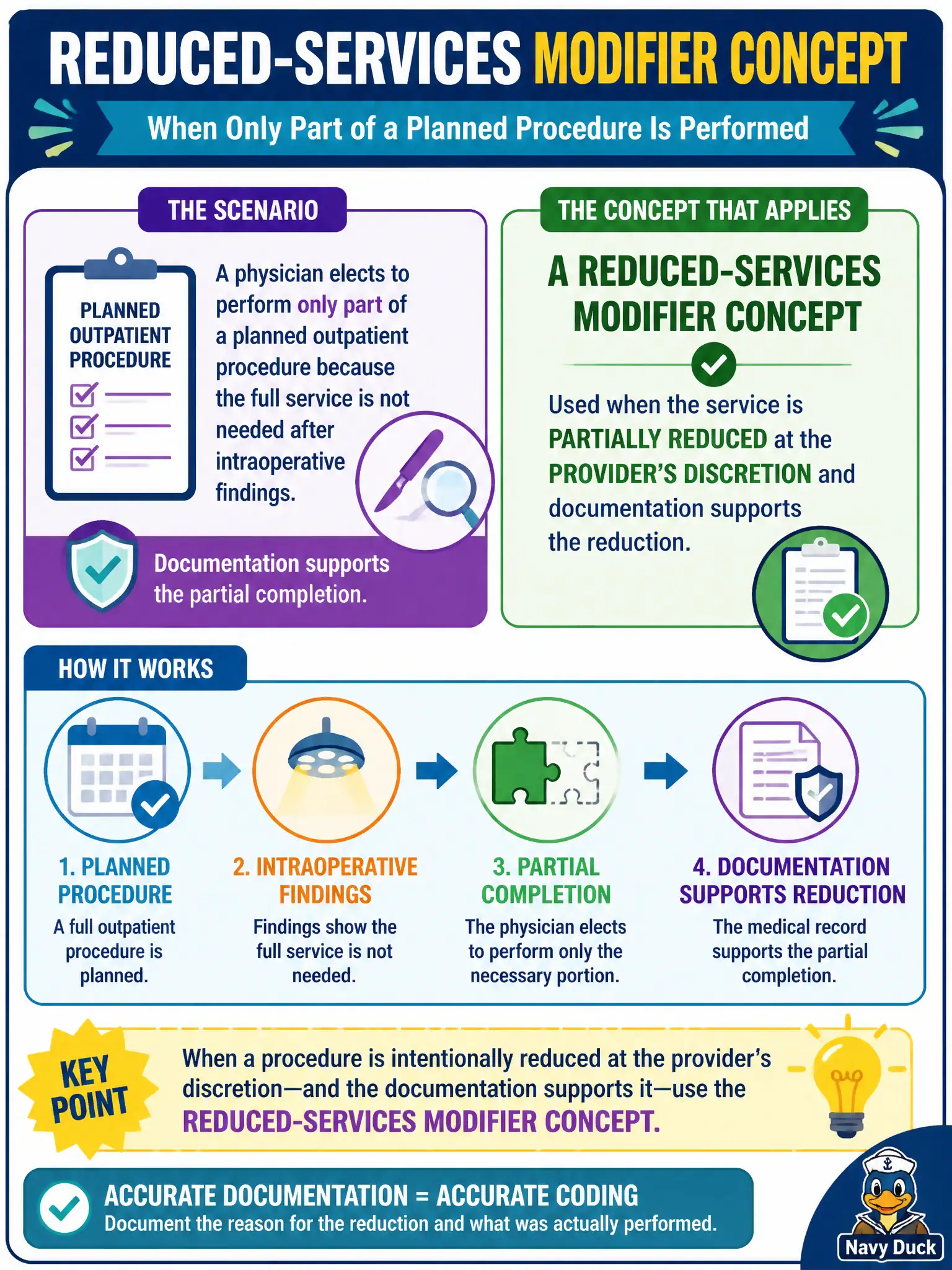
A physician elects to perform only part of a planned outpatient procedure because the full service is not needed after intraoperative findings. Documentation supports the partial completion. Which modifier concept applies?
Select an answer to reveal the explanation.
Short Explanation
Sometimes the surgeon starts with a full plan and then dials it back on purpose—findings say the complete service is not needed. That is reduced services, not “we crashed mid-case.” Different story, different modifier family.
Full Explanation
When a physician elects to perform only part of a planned outpatient procedure because intraoperative findings show the full service is unnecessary, and documentation supports partial completion, a reduced-services modifier concept applies. Reduced services reflect provider discretion to decrease the service, distinct from discontinuation due to threat to patient well-being after start. Correct reduced-service reporting charges fairly for partial work in public outpatient surgery.
Using only discontinued-after-anesthesia concepts regardless of physician discretion fails by concept when the reduction is elective/discretionary based on findings rather than an instability-driven stop. Assistant-at-surgery modifiers fail because fewer steps do not equal assistant reporting. Increased procedural services modifiers fail because increased complexity modifiers address greater-than-usual service, not partial reduction.
Exam caveat: choose discontinued versus reduced versus other modifiers from the clinical reason in the operative note—instability/threat versus elective reduction versus other incomplete scenarios. Operational check: read why the full planned service was not completed; if reduced at provider discretion with supporting documentation, apply reduced-services modifier concept; document findings that justified reduction; code what was actually performed.