
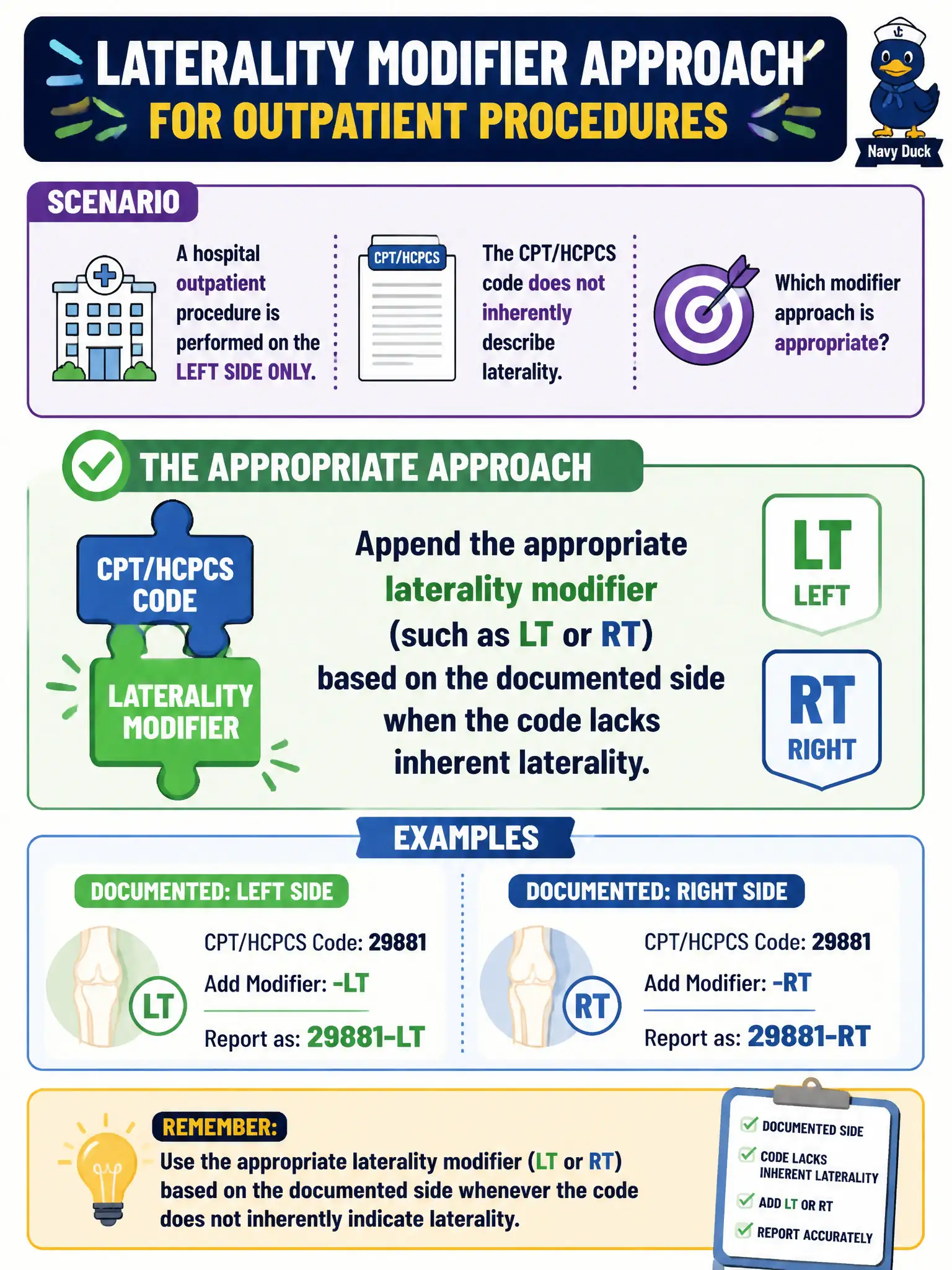
A hospital outpatient procedure is performed on the left side only, and the CPT/HCPCS code does not inherently describe laterality. Which modifier approach is appropriate?
Select an answer to reveal the explanation.
Short Explanation
When the code itself is silent about left versus right, LT and RT are the name tags that say which side was done. If the chart says left, hang the left tag—do not invent bilaterality.
Full Explanation
When a hospital outpatient procedure is performed on the left side only and the CPT/HCPCS code lacks inherent laterality, append the appropriate laterality modifier (such as LT or RT) based on the documented side. Laterality modifiers communicate which paired structure was treated when the base code is silent. Accurate LT/RT use improves claim clarity and civic utilization analytics by side, and it prevents payers from guessing which organ or limb was addressed in municipal ambulatory surgery and clinic procedure claims.
Saying no laterality modifier is ever used in facility outpatient reporting fails by concept—facility outpatient claims commonly require laterality modifiers when codes lack inherent laterality. Always using a bilateral modifier for a single-sided procedure fails because bilateral means both sides, not “some laterality,” and it misstates the clinical service. Reporting two units instead of identifying the side fails—it misstates quantity rather than communicating laterality and can trigger Medically Unlikely Edits or incorrect bilateral payment logic.
Exam caveat: do not append LT/RT when the CPT code already includes laterality in its descriptor or when the anatomic site is not a paired structure requiring those modifiers; likewise, do not use anatomic HCPCS digit/eyelid modifiers interchangeably with LT/RT unless the code and payer rules call for that family. Operational check: confirm documented left-side procedure; verify the code lacks inherent laterality; append LT (for left) as appropriate; avoid bilateral modifiers and unit inflation as laterality substitutes; retain operative laterality language that supports the modifier on audit.