
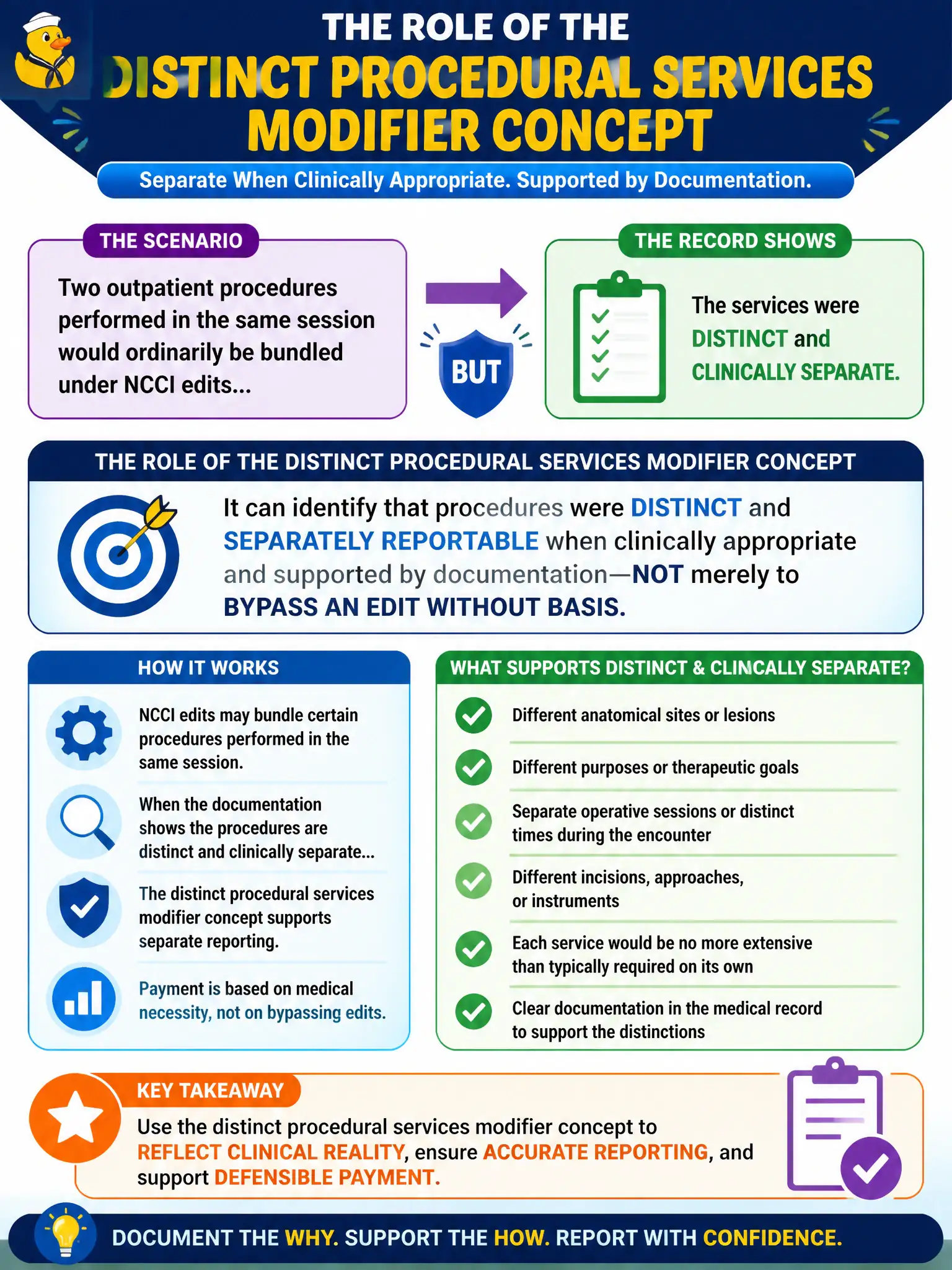
Two outpatient procedures performed in the same session would ordinarily be bundled under NCCI edits, but the record documents that the services were distinct and clinically separate. What is the role of the distinct procedural services modifier concept?
Select an answer to reveal the explanation.
Short Explanation
NCCI edits are the “these usually travel as a set” rules. When two procedures truly were separate clinical jobs—and the chart proves it—the distinct procedural services modifier concept is the honest flag. It is not a cheat code to smash every edit.
Full Explanation
The distinct procedural services modifier concept identifies that procedures ordinarily bundled under NCCI were distinct and separately reportable when clinically appropriate and supported by documentation. It is an integrity tool for true distinct services—not a switch to bypass edits without clinical basis. Used correctly, it allows accurate payment for genuinely separate work in municipal outpatient departments while preserving NCCI’s anti-unbundling purpose.
Claiming it permanently turns off all NCCI edits for a patient for one year fails by concept—the modifier is claim-line and encounter specific, not a year-long edit vacation. Saying it converts inpatient PCS into outpatient CPT fails—the modifier does not transmute code sets. Restricting it to procedures by different hospitals in different states fails; distinctness is about clinical separateness of services, not geography.
Exam caveat: documentation should show separate sites, sessions, lesions, or other recognized distinctness criteria; modifier use without support is a compliance risk. Operational check: review NCCI bundling pair; confirm documentation of distinct procedural services; append the distinct-services modifier only when justified; retain operative detail that proves separateness for audit.