
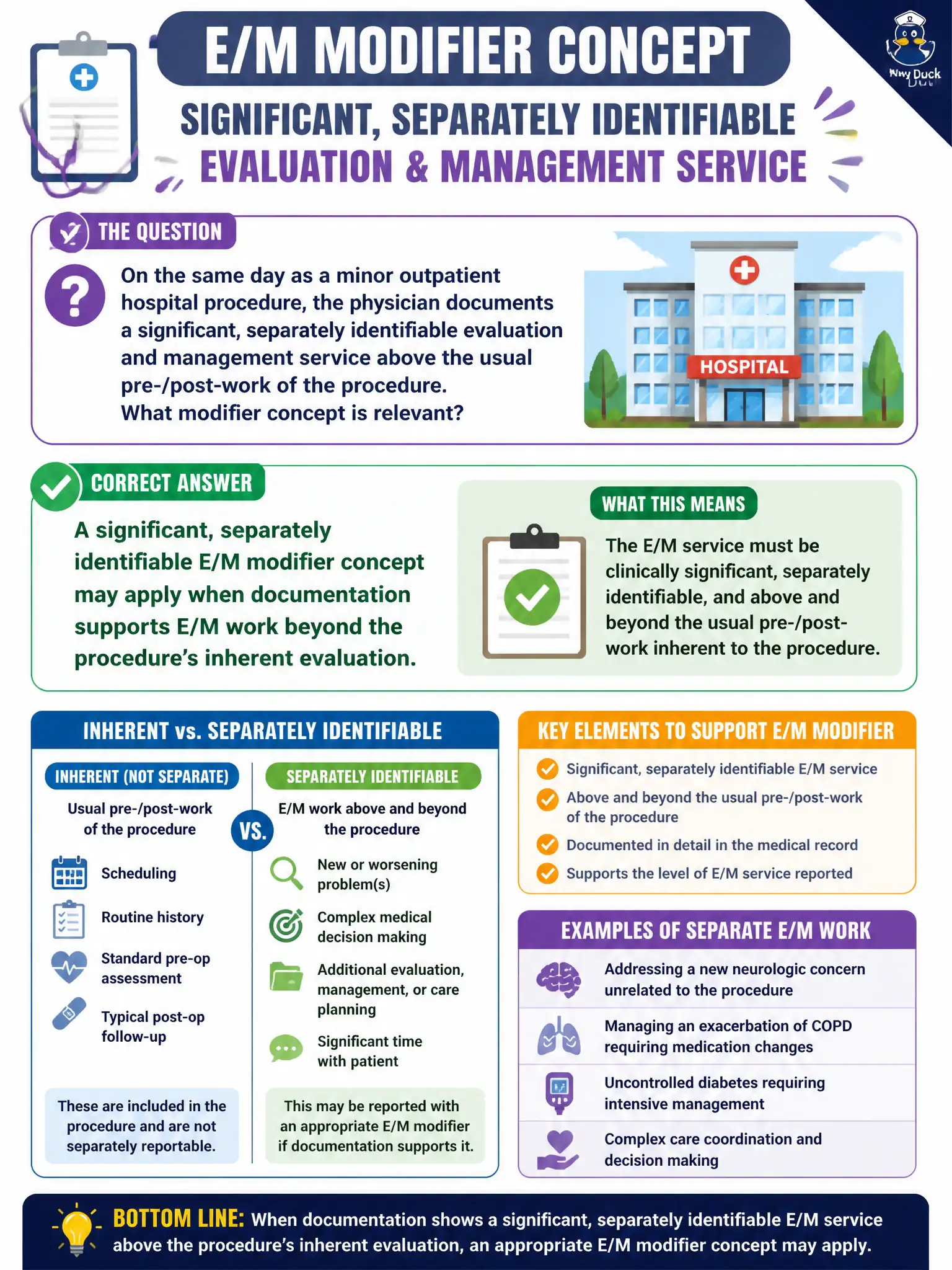
On the same day as a minor outpatient hospital procedure, the physician documents a significant, separately identifiable evaluation and management service above the usual pre-/post-work of the procedure. What modifier concept is relevant?
Select an answer to reveal the explanation.
Short Explanation
Same-day E/M plus a minor procedure is allowed only when the note clearly shows extra cognitive work—not the usual “check the site and go” stuff. If that separate story is in the chart, the distinct E/M modifier concept is how you signal it.
Full Explanation
When, on the same day as a minor outpatient hospital procedure, the physician documents a significant, separately identifiable E/M service beyond the usual pre-/post-work of the procedure, a significant separately identifiable E/M modifier concept may apply. The key is documentation of E/M work above and beyond the inherent procedural evaluation. Correct use supports legitimate civic clinic/hospital outpatient E/M reporting without unbundling routine procedural assessment.
Claiming no E/M may ever be reported on the same day as any procedure fails by concept—separately identifiable E/M is a recognized exception when supported. Using an anesthesia discontinued-procedure modifier to “replace” E/M evaluation fails because that modifier family addresses incomplete procedures, not E/M separability. Asserting a bilateral modifier automatically covers same-day E/M fails—bilateral modifiers address paired-organ procedures, not E/M.
Exam caveat: minor versus major procedure global packages and payer-specific E/M-with-procedure rules vary; documentation must show separate identifiable work, often with a separate diagnosis or distinctly documented MDM. Operational check: compare documented E/M content to inherent pre-/post-procedure work; if significant and separate, apply the appropriate E/M modifier concept; ensure diagnoses support both services; never append the modifier to bypass documentation gaps.