
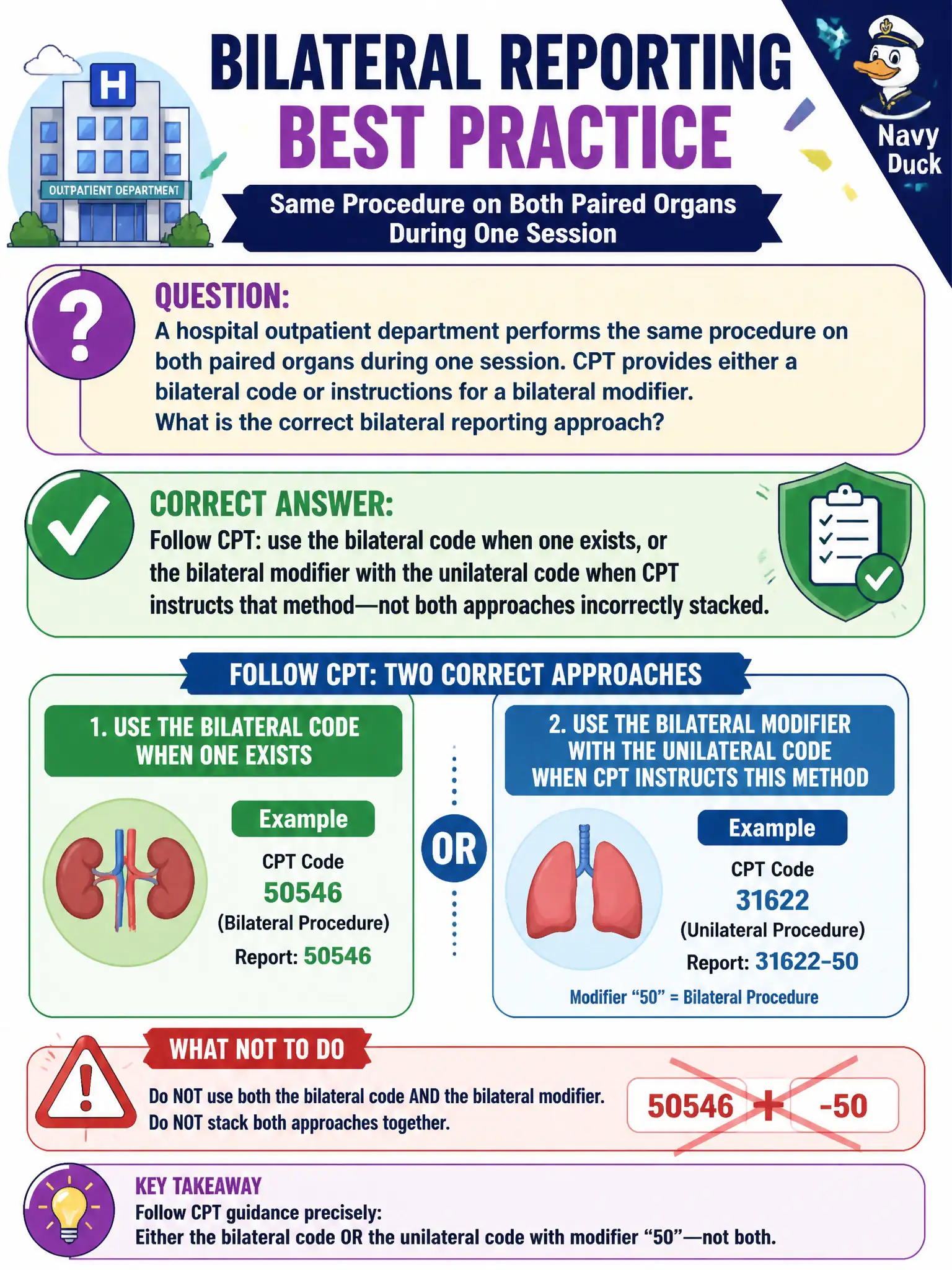
A hospital outpatient department performs the same procedure on both paired organs during one session. CPT provides either a bilateral code or instructions for a bilateral modifier. What is the correct bilateral reporting approach?
Select an answer to reveal the explanation.
Short Explanation
Bilateral outpatient work is a follow-the-CPT-map problem. Some codes already mean both sides; others need the bilateral modifier. Mixing “both sides” tricks on top of each other is how you over-report.
Full Explanation
When the same procedure is performed on both paired organs in one outpatient hospital session, follow CPT: use the bilateral code when one exists, or append the bilateral modifier to the unilateral code when CPT instructs that method—do not incorrectly stack both approaches. Bilateral reporting rules prevent double-dipping and under-reporting alike. Compliant bilateral coding keeps civic ambulatory surgery claims clean under CPT and payer edits.
Always appending a bilateral modifier and also reporting two unilateral codes for the same service fails by concept because it duplicates bilateral reporting. Reporting three units of the unilateral code instead of using bilateral guidance fails—it invents unit math that CPT bilateral instructions do not authorize. Omitting laterality because “outpatient hospital claims cannot describe paired organs” fails; outpatient claims routinely report laterality/bilateral status via codes or modifiers.
Exam caveat: some codes are inherently bilateral; adding a bilateral modifier to an inherent bilateral code is incorrect—read the CPT descriptor. Operational check: check whether a bilateral CPT exists; if yes, use it once; if not, follow CPT bilateral-modifier instructions with the unilateral code; never report bilateral modifier plus two unilateral codes for one bilateral session.