
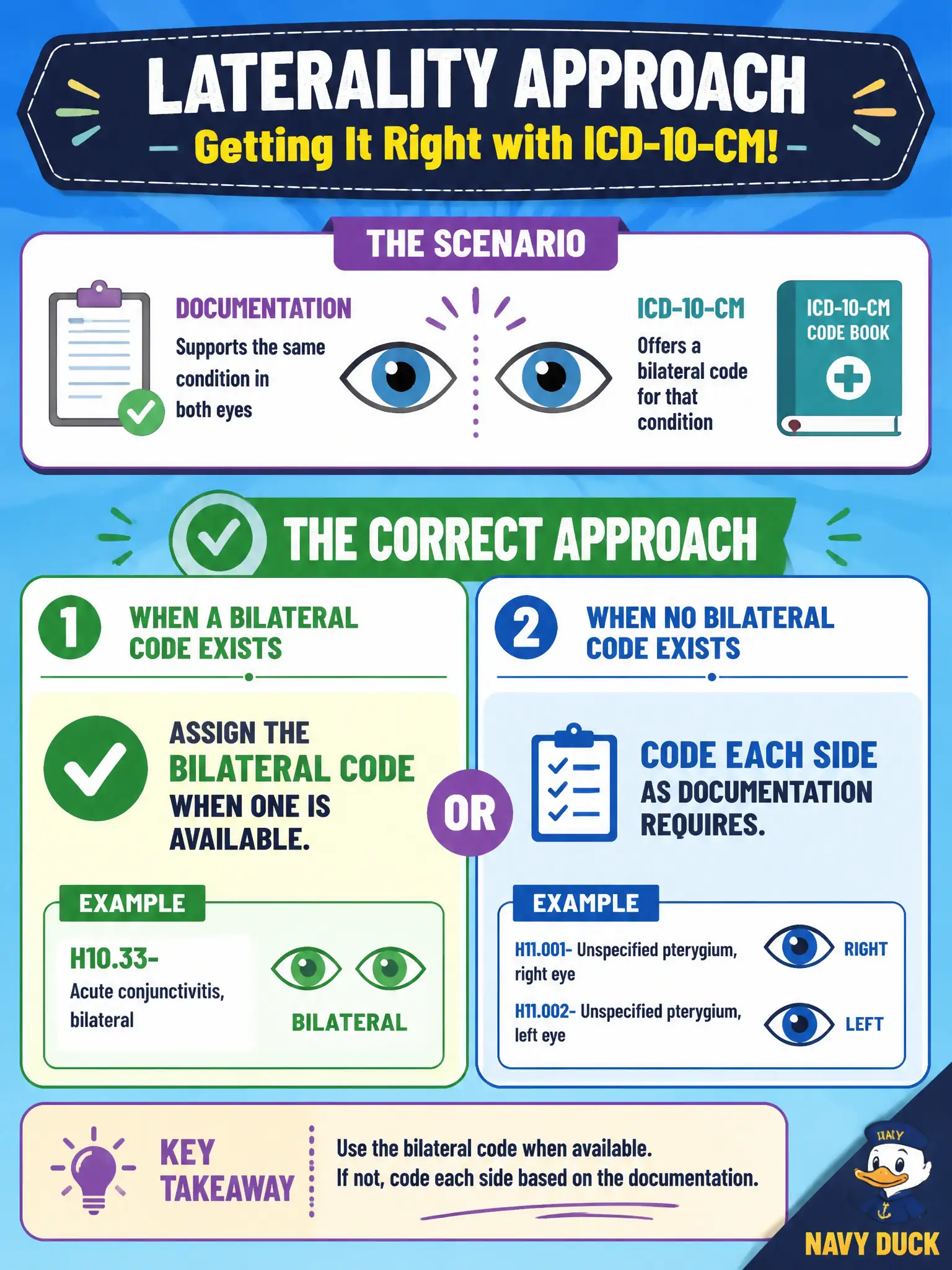
Documentation supports the same condition in both eyes, and ICD-10-CM offers a bilateral code for that condition. What is the correct laterality approach?
Select an answer to reveal the explanation.
Short Explanation
Laterality is basically “which side?” If the codebook already baked in a bilateral option, use that tidy one-code solution. No bilateral code? Then you may need a code for each side the record actually supports.
Full Explanation
When documentation supports the same condition in both eyes and ICD-10-CM offers a bilateral code, assign the bilateral code. Laterality coding prefers the classification’s bilateral option when available rather than artificially splitting into two unilateral codes. If no bilateral code exists, code each side as documentation requires. Correct laterality practice keeps municipal ophthalmology and ENT abstracts precise without gaming secondary-diagnosis counts.
Always reporting two unilateral codes even when a bilateral code exists, to maximize secondary diagnoses, fails by concept because it violates bilateral-code preference and inflates diagnosis counts unethically. Coding only the left side because bilateral conditions “default to the dominant eye” fails—there is no such default that erases documented contralateral disease. Omitting laterality entirely when both sides are involved fails because laterality is required when the classification provides laterality characters or bilateral options.
Exam caveat: some categories have left, right, bilateral, and unspecified choices—unspecified should not be used when laterality is documented; conversely, do not invent laterality without support. Operational check: scan documentation for laterality; if both sides and a bilateral code exist, use bilateral; if no bilateral code, report each side; never dual-unilateral-code solely to increase CC/MCC counts when bilateral is available.