
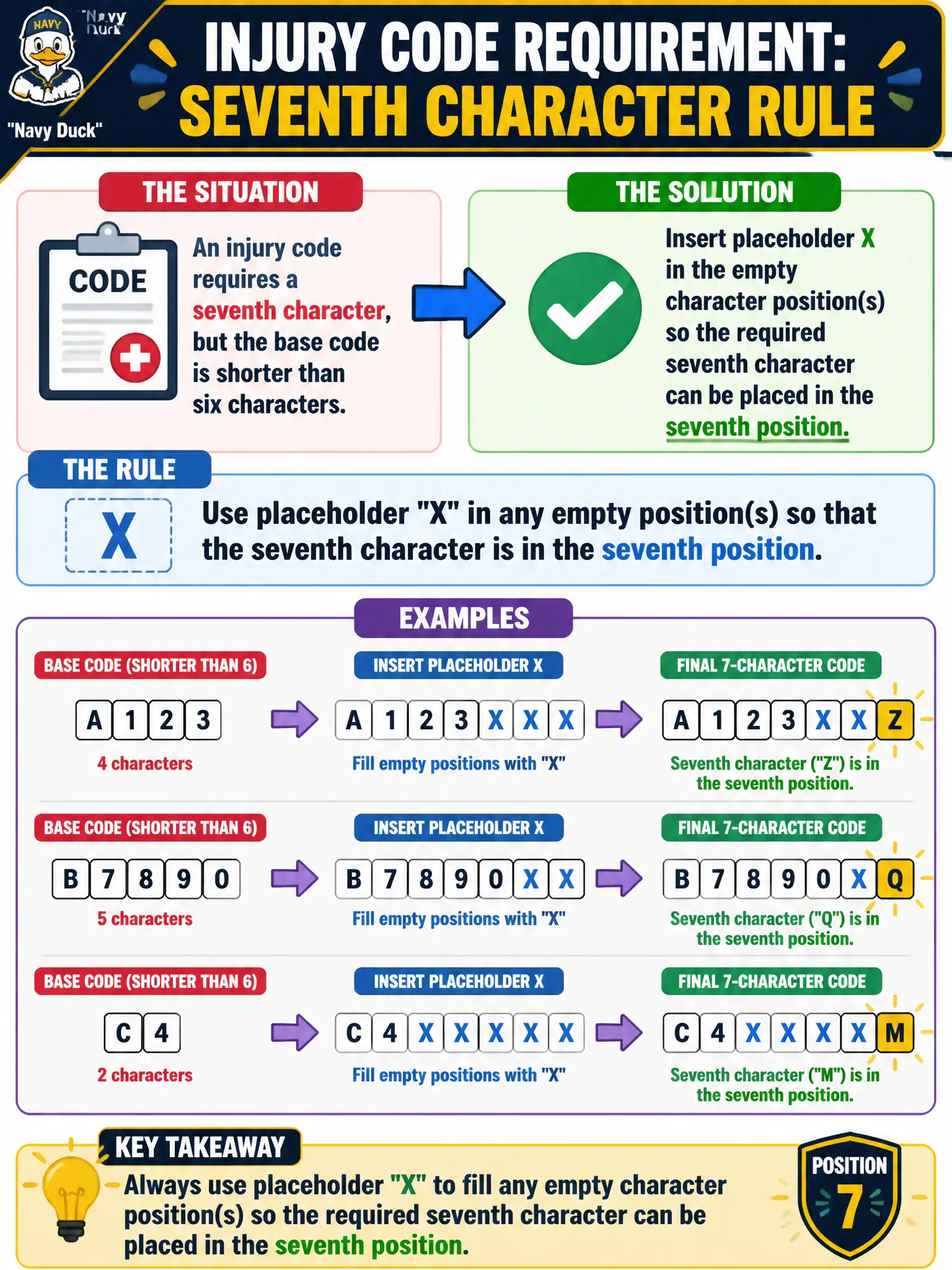
An injury code requires a seventh character, but the base code is shorter than six characters. How should the placeholder character be used?
Select an answer to reveal the explanation.
Short Explanation
ICD-10-CM is picky about seat assignments: the seventh character has to sit in seat seven. If seats in between are empty, you fill them with X so that final character lands where it belongs.
Full Explanation
When an injury code requires a seventh character but the base code is shorter than six characters, insert placeholder X in the empty character position(s) so the seventh character lands in the seventh position. Placeholders exist so extension characters keep a fixed position in the code structure. Correct X placement is fundamental CCS injury coding hygiene for civic trauma reporting.
Stopping at the highest index level and never extending fails by concept when a seventh character is required—incomplete codes are invalid. Appending the seventh character immediately after the last listed character without filling empty positions fails because it misplaces the extension (e.g., creating a fifth- or sixth-position character instead of a true seventh). Replacing missing characters with the present-on-admission indicator fails because POA is a separate claim data element, not a code-character substitute for X.
Exam caveat: not every ICD-10-CM code uses seventh characters—apply X only where the code structure and guidelines require a seventh character and empty slots exist. Operational check: build the code to seven characters with X placeholders as needed; place A/D/S (or other valid seventh characters) in position seven; validate through encoder/grouper edits before finalizing the trauma abstract.