
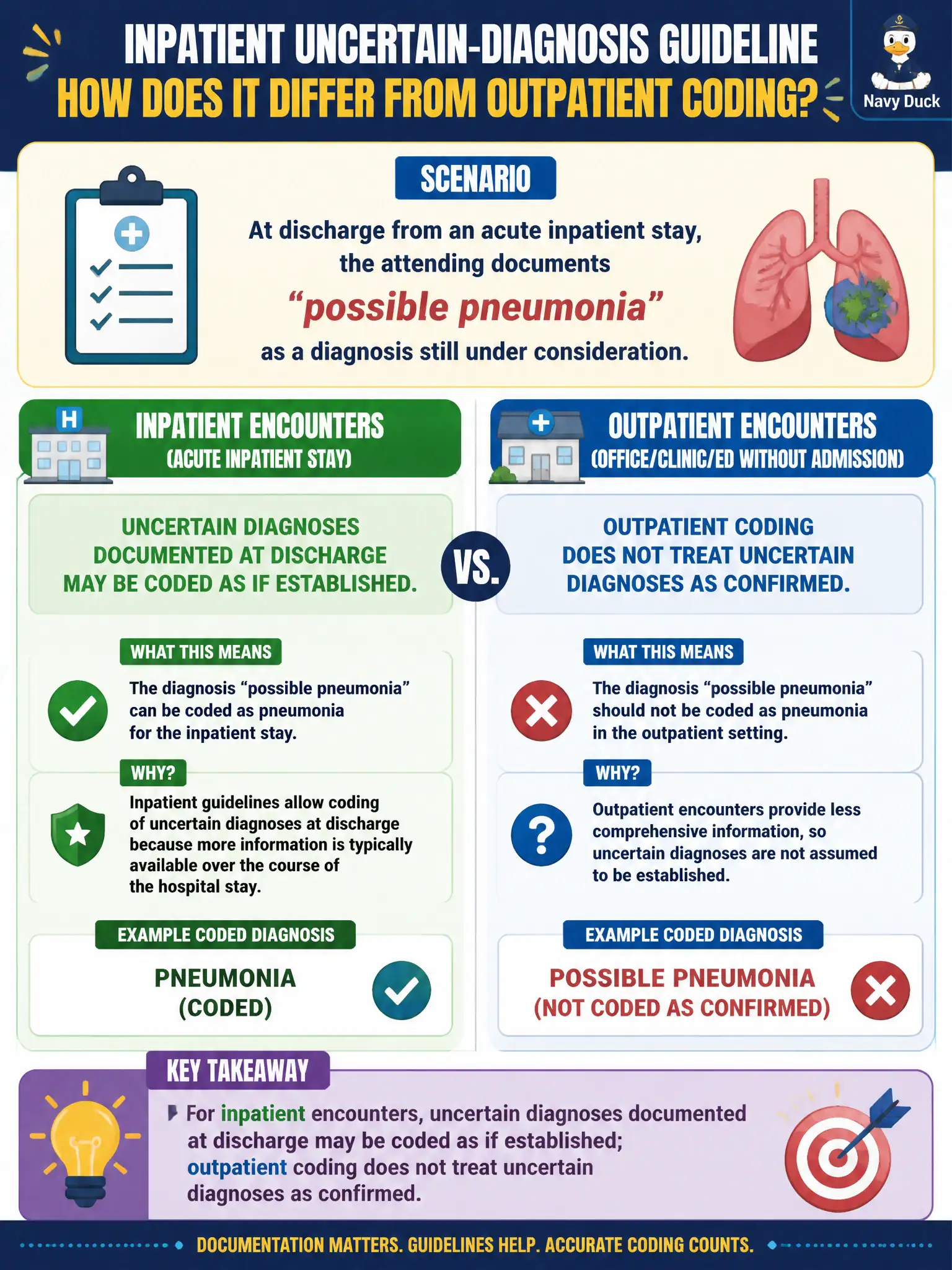
At discharge from an acute inpatient stay, the attending documents “possible pneumonia” as a diagnosis still under consideration. How does the inpatient uncertain-diagnosis guideline differ from outpatient coding?
Select an answer to reveal the explanation.
Short Explanation
Inpatient land gives “possible” and “probable” a hall pass at discharge—you can code them as if they were nailed down. Walk into outpatient or ED coding with the same wording and you hit the brakes: do not treat uncertain diagnoses as confirmed there.
Full Explanation
Inpatient uncertain-diagnosis guideline allows coding of uncertain diagnoses (possible, probable, suspected, etc.) documented at discharge as if established for inpatient encounters; outpatient coding does not treat uncertain diagnoses as confirmed. Thus “possible pneumonia” at inpatient discharge may be coded per inpatient rules, whereas the same wording on an outpatient claim generally would not be coded as confirmed pneumonia. Knowing the setting split prevents both under-coding inpatient severity and over-coding outpatient uncertainty in civic facilities.
Claiming both settings forbid any uncertain diagnosis fails by concept—it erases the inpatient exception. Saying outpatient codes uncertain as confirmed while inpatient never does reverses the actual rule. Asserting uncertain wording affects only POA indicators, not code assignment, fails because uncertain language directly affects whether a diagnosis is coded, with setting-specific rules, and POA is a separate data element.
Exam caveat: the inpatient uncertain rule applies to discharge diagnoses still uncertain at discharge—not to ruled-out or consistently denied conditions; query when documentation conflicts. Operational check: confirm inpatient status and discharge-timing of “possible pneumonia”; apply inpatient uncertain guideline if criteria met; never export that inpatient allowance onto outpatient/ED final coding.