
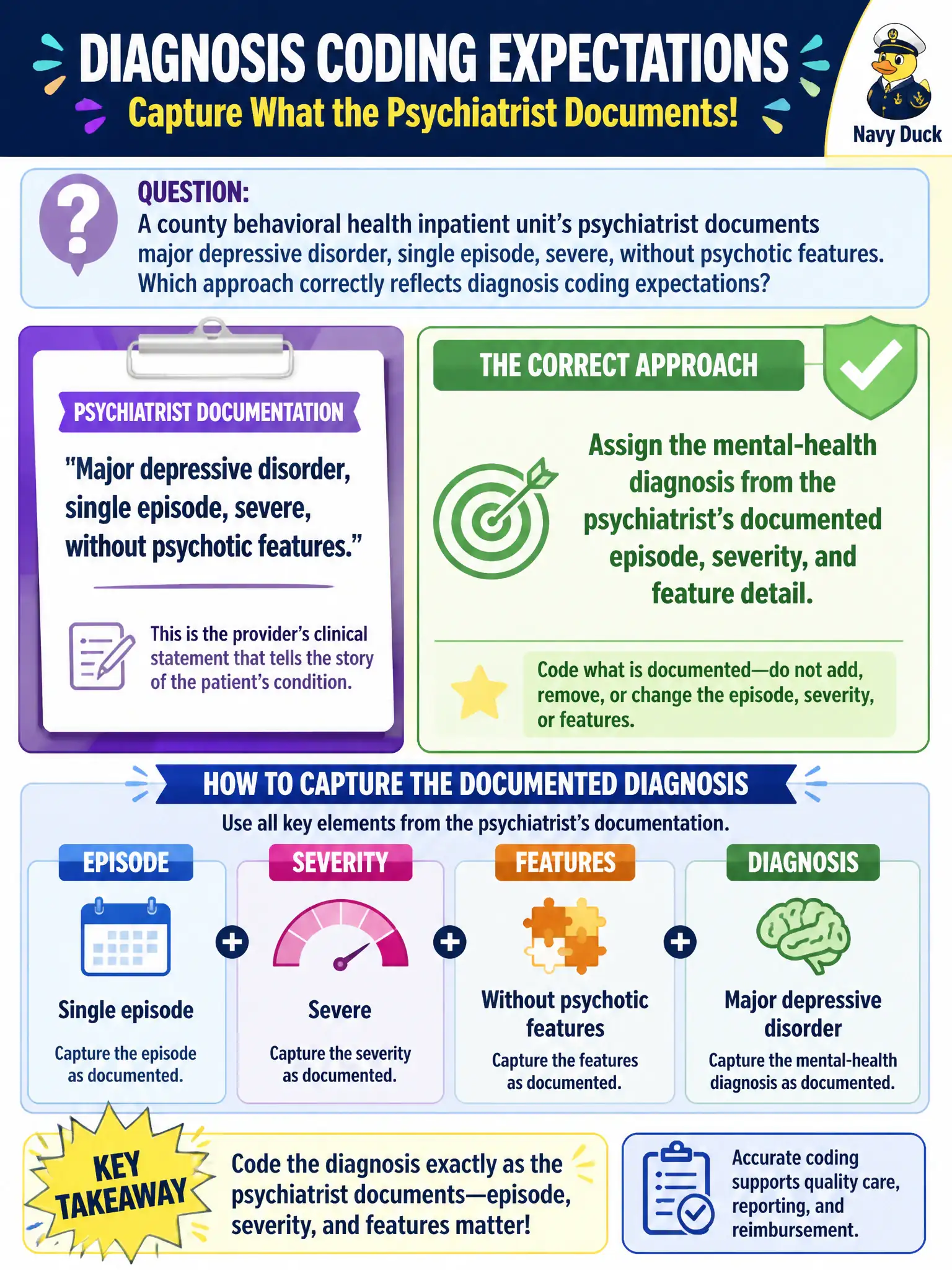
A county behavioral health inpatient unit’s psychiatrist documents major depressive disorder, single episode, severe, without psychotic features. Which approach correctly reflects diagnosis coding expectations?
Select an answer to reveal the explanation.
Short Explanation
Psych notes are picky for a reason—episode, severity, and psychotic features change the code family. When the psychiatrist spelled out single episode, severe, without psychosis, that’s the map. Don’t flatten it to vague “depression.”
Full Explanation
Mental-health diagnosis coding on a county behavioral health inpatient unit follows the psychiatrist’s documented specificity—episode type, severity, and psychotic-feature status—when those elements are stated. Major depressive disorder, single episode, severe, without psychotic features should be coded to reflect that documented detail because ICD-10-CM mental-health categories are built on precisely those axes. Capturing the psychiatrist’s specificity supports appropriate severity reporting for public behavioral-health programs without inventing psychosis or collapsing to unspecified depression.
Coding only “depression, unspecified” because “behavioral health never uses episode or severity detail” fails by concept: the classification expects and rewards documented specificity; discarding it understates clinical severity. Coding schizophrenia whenever depression is severe, even when psychosis is explicitly excluded, fails because severity of depression is not equivalent to a schizophrenia diagnosis and contradicts documented absence of psychotic features. Using the nursing mood score alone to select the ICD-10-CM subcategory fails because standardized nursing scores inform care but are not a substitute for the psychiatrist’s diagnostic statement.
Exam caveat: do not infer psychotic features, recurrent versus single episode, or remission status without provider documentation; likewise, do not ignore specificity the psychiatrist already provided. Operational check: abstract episode, severity, and feature qualifiers exactly from psychiatry documentation; confirm consistency across admission note and discharge summary; query only for missing or conflicting axes that prevent accurate code selection, not to overwrite clear psychiatric documentation.