
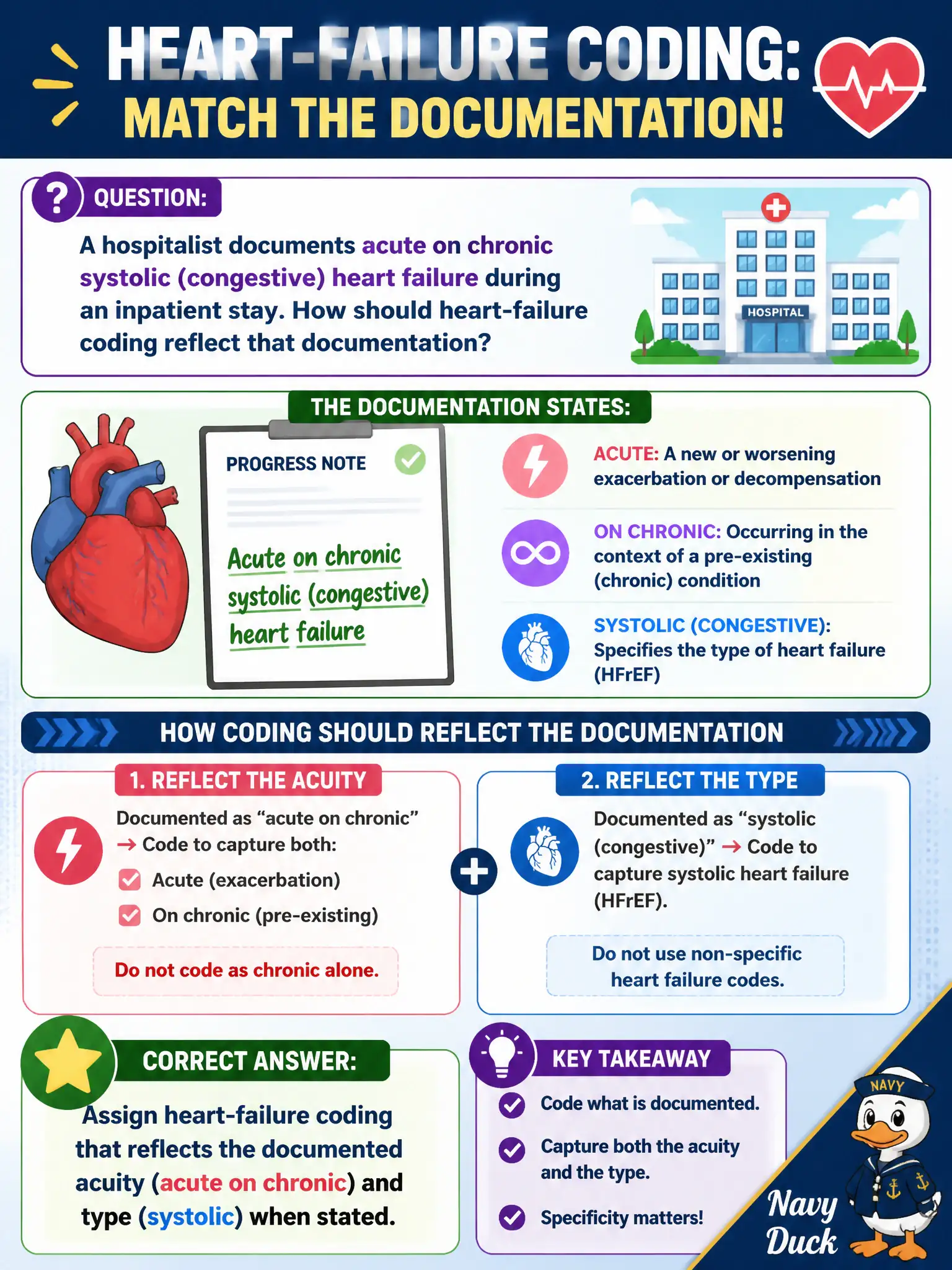
A hospitalist documents acute on chronic systolic (congestive) heart failure during an inpatient stay. How should heart-failure coding reflect that documentation?
Select an answer to reveal the explanation.
Short Explanation
Heart failure codes care about two dials: how hot the flare is (acute, chronic, or acute on chronic) and which pump problem it is (systolic, diastolic, and so on). When the hospitalist sets both dials, code what was written.
Full Explanation
Heart-failure coding must reflect documented acuity and type when the hospitalist states acute on chronic systolic (congestive) heart failure. ICD-10-CM distinguishes acute, chronic, and acute-on-chronic presentations and further distinguishes systolic, diastolic, and combined categories when documented. Assigning codes that capture both the acute-on-chronic acuity and the systolic type honors the provider’s clinical statement and improves fidelity of civic hospital heart-failure cohorts and risk models.
Always coding unspecified heart failure only because “acuity never matters” fails by concept: acuity and type are material axes in the classification when documented. Coding chronic diastolic failure instead because systolic and diastolic “may be interchanged freely” fails because those descriptors are not synonyms; swapping them misrepresents pathophysiology. Omitting heart failure if hypertension is also listed fails because hypertension does not automatically absorb or erase a documented heart-failure diagnosis; combination and sequencing rules must be applied from documentation and guidelines, not by dropping HF.
Exam caveat: “congestive” language alone may not specify systolic versus diastolic; when the provider does specify systolic (or HFrEF-type language per facility coding practice aligned to guidelines), use that specificity—do not down-code to unspecified out of habit. Operational check: capture acuity (acute on chronic) and type (systolic) from hospitalist documentation; apply any related hypertension-with-heart-disease guideline relationships carefully; verify discharge summary consistency before finalizing the DRG-relevant diagnosis set.