
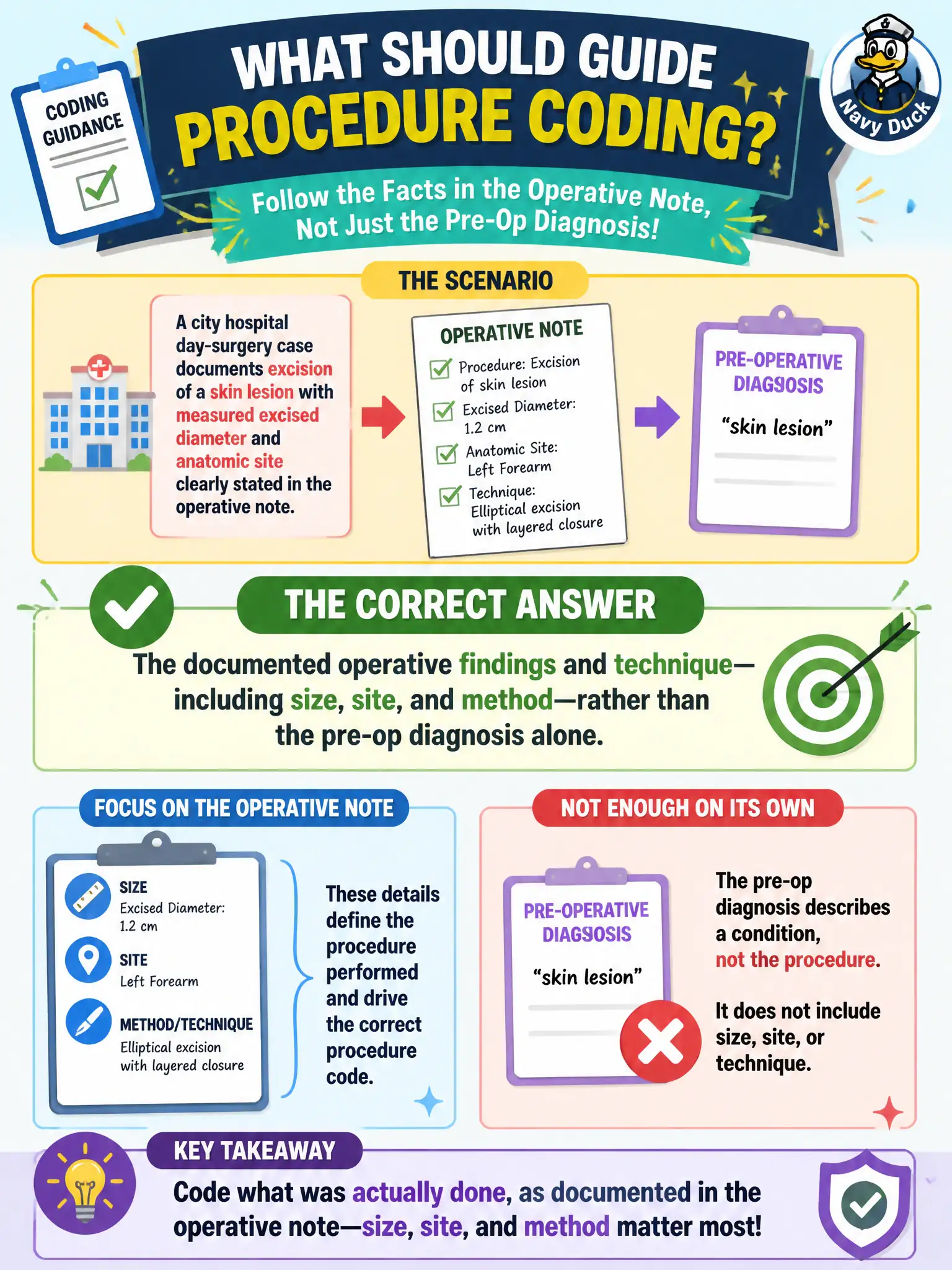
A city hospital day-surgery case documents excision of a skin lesion with measured excised diameter and anatomic site clearly stated in the operative note. The pre-operative diagnosis only said “skin lesion.” What should guide procedure coding?
Select an answer to reveal the explanation.
Short Explanation
Pre-op “skin lesion” is the placeholder sticky note; the op report has the measurements and method. Excision coding lives on size, site, and what was actually done—so read the surgeon’s note, not just the booking diagnosis.
Full Explanation
Day-surgery lesion excision coding at a city hospital is guided by the operative note’s documented findings and technique—including excised diameter, anatomic site, and method—rather than by a vague pre-operative diagnosis of “skin lesion.” CPT selection for excision depends on measured size and site (and related technique details) as recorded by the surgeon for the completed procedure. The pre-op label is a planning placeholder; the operative documentation is the service description that must drive compliant coding and accurate public outpatient procedure statistics.
Using the pre-operative diagnosis alone because scheduling diagnoses “always control CPT” fails by concept: scheduling and pre-op impressions lack the size/site/technique granularity excision codes require and may not match what was performed. Selecting a default lesion-destruction code while ignoring documented size and site fails because destruction and excision are different techniques, and size/site specificity is material to correct code family selection. Using only the pathology accession number without the surgeon’s documented technique fails because accession identifiers track specimens; they do not describe the operative method, margins approach, or excised diameter needed for procedure coding.
Exam caveat: measure rules (excised diameter including margins versus lesion diameter alone) and site laterality/anatomic specificity are frequent CCS traps—follow CPT descriptor requirements and the op note measurements, not memory of the booking sheet. Operational check: extract site, excised diameter, and technique from the operative report; select the excision code that matches those elements; reconcile pathology diagnosis for diagnosis coding separately without letting the accession number substitute for operative detail.