
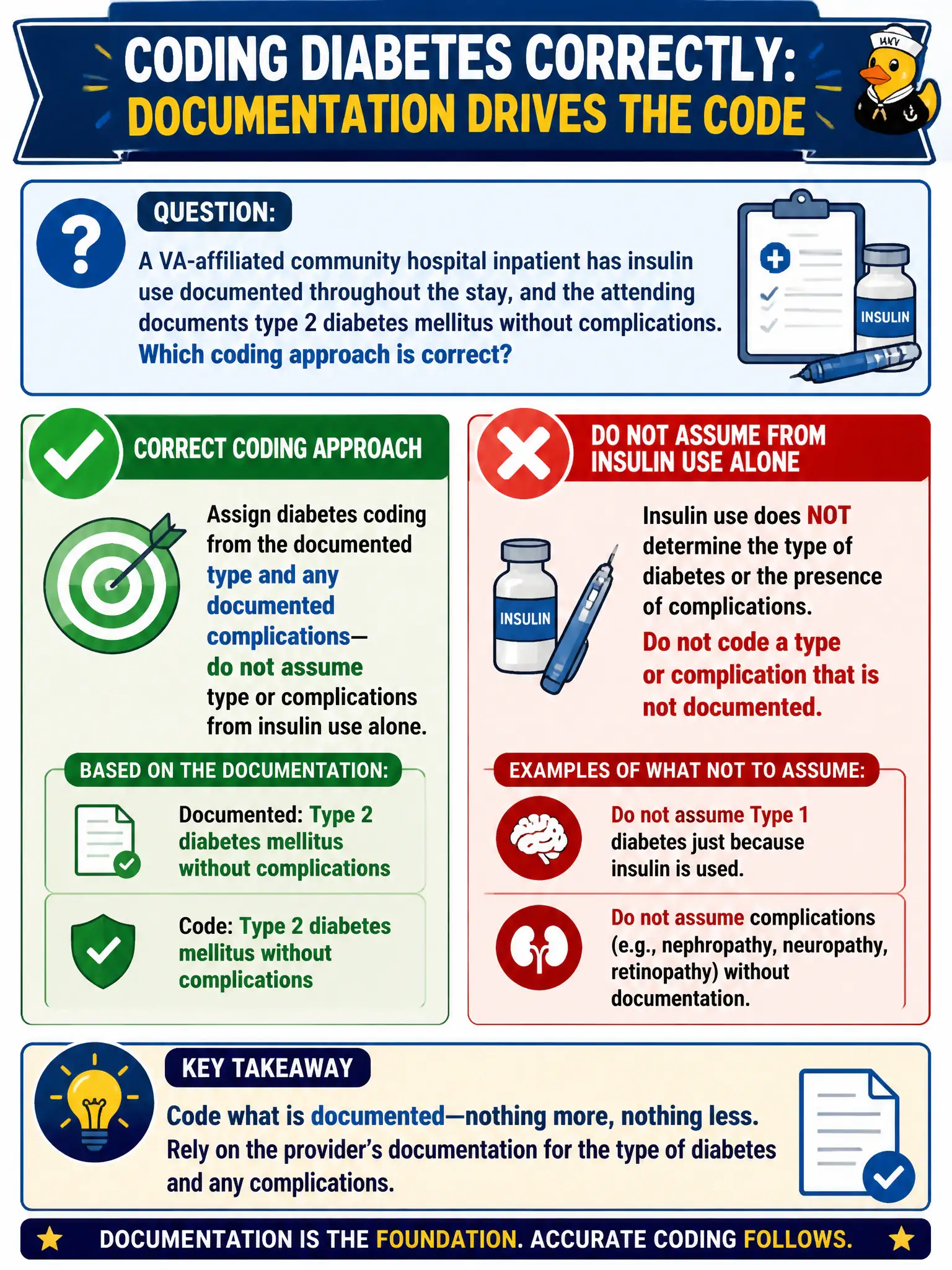
A VA-affiliated community hospital inpatient has insulin use documented throughout the stay, and the attending documents type 2 diabetes mellitus without complications. Which coding approach is correct?
Select an answer to reveal the explanation.
Short Explanation
Insulin on the med list is a tool, not a secret decoder ring for diabetes type. Type 2 patients use insulin all the time. Code the type and complications the provider actually wrote—don’t upgrade the case by assumption.
Full Explanation
Diabetes coding for a VA-affiliated community hospital inpatient must follow the attending’s documented diabetes type and any documented complications—not inferences drawn solely from insulin on the medication list. Type 2 diabetes mellitus without complications can appropriately be treated with insulin; insulin use is a treatment modality, not proof of type 1 disease or of undocumented complications. Correct assignment therefore codes the documented type 2 diabetes without fabricating type changes or complication codes from pharmacy data alone, preserving integrity of civic facility risk adjustment and quality reporting.
Automatically coding type 1 diabetes whenever insulin appears fails by concept because insulin therapy is common in type 2 diabetes and does not redefine etiology or type. Assuming long-term insulin means an undocumented diabetic complication must exist fails because complication codes require provider documentation of the complication (or guideline-directed linkage), not speculation from medication chronicity. Omitting diabetes entirely if insulin is ordered fails because medication orders do not replace diagnosis coding; the documented diabetes remains reportable and clinically relevant regardless of insulin administration.
Exam caveat: long-term (current) insulin use may have a separate status/code-also consideration when documentation supports it, but that adjunct does not convert type 2 to type 1 or invent neuropathy, CKD, or other complications. Operational check: abstract diabetes type exactly as the provider documented; scan for explicitly documented complications or manifestations; add long-term insulin use coding only when documentation/guidelines support it; never “upgrade” diabetes from the MAR alone.