
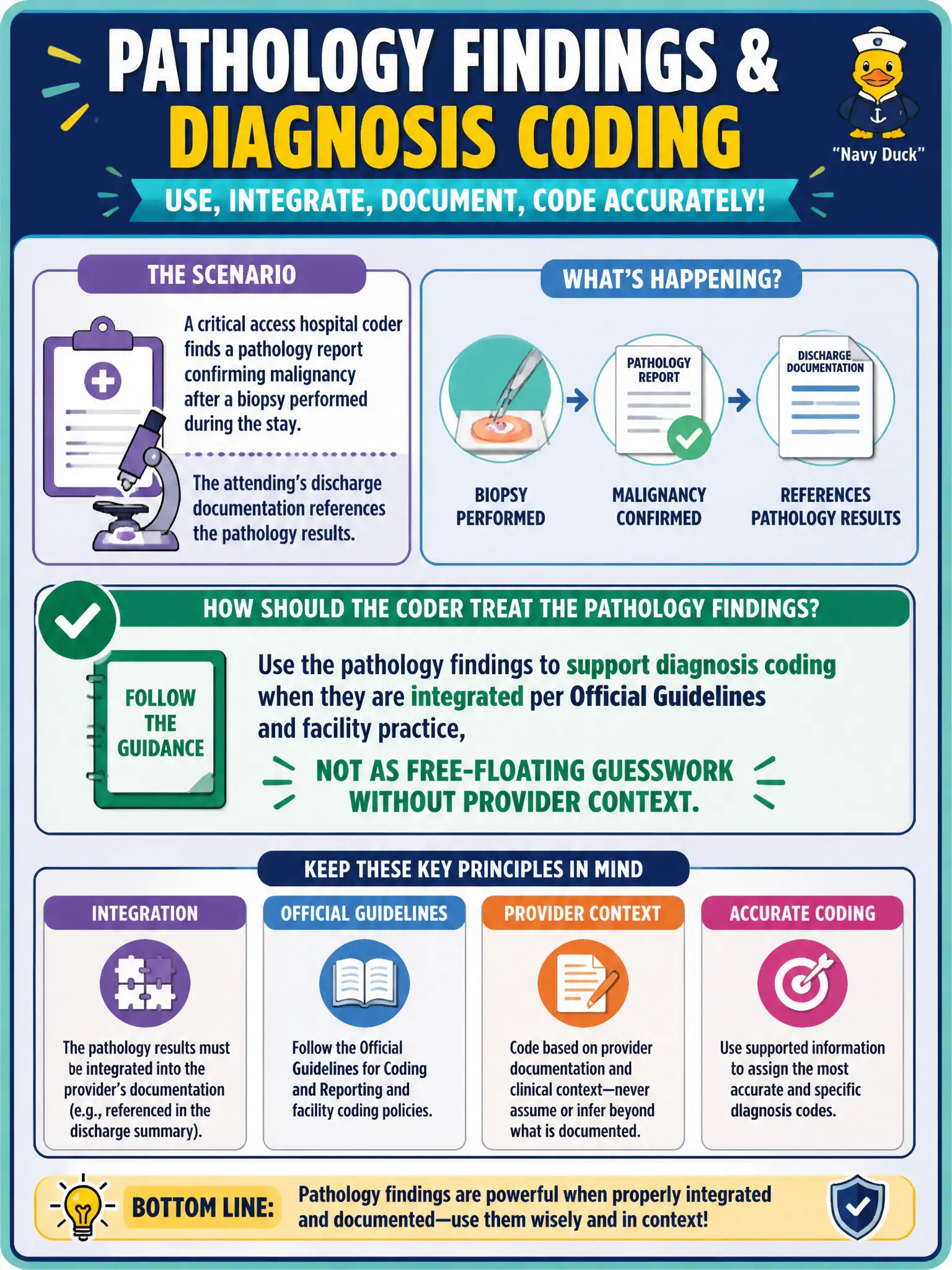
A critical access hospital coder finds a pathology report confirming malignancy after a biopsy performed during the stay. The attending’s discharge documentation references the pathology results. How should the coder treat the pathology findings for diagnosis assignment?
Select an answer to reveal the explanation.
Short Explanation
Pathology is lab truth with a white coat—but it still has to connect to the attending’s story. When the path report confirms cancer and the provider integrates it, that supports coding. Random path trivia nobody owned does not.
Full Explanation
Pathology findings can support diagnosis coding for a critical access hospital stay when they confirm or refine a condition and are used consistently with Official Guidelines and facility practice—especially when the attending’s discharge documentation references the pathology results. A biopsy performed during the stay with a path report confirming malignancy, integrated by the treating provider’s documentation, appropriately informs code assignment. Pathology is not free-floating authority to invent diagnoses divorced from the clinical record, nor is it ignorable laboratory noise when the provider clearly incorporates it.
Ignoring pathology entirely because “only the admission diagnosis may ever be coded” fails by concept: diagnoses may be established after study during the stay, and pathology is a classic after-study source when linked to the encounter. Coding every incidental microscopic finding whether or not any provider addresses it fails because incidental histologic trivia without clinical significance or provider integration is not automatically reportable. Replacing the attending’s clinical diagnoses with the pathologist’s wording in all cases without reviewing the remainder of the record fails because coding requires synthesis of the complete provider record; pathology supplements, it does not blindly overwrite, clinical context.
Exam caveat: Official Guidelines address use of pathology (and other diagnostic reports) for code assignment; integration and clinical significance matter, and uncertain neoplasm language must be handled per guideline rules for inpatient uncertain diagnoses versus outpatient. Operational check: confirm the path report belongs to this stay’s specimen, note whether the attending referenced or relied on the malignancy finding, assign codes consistent with that integrated documentation, and query if malignancy status or behavior remains ambiguous in provider documentation despite path results.