
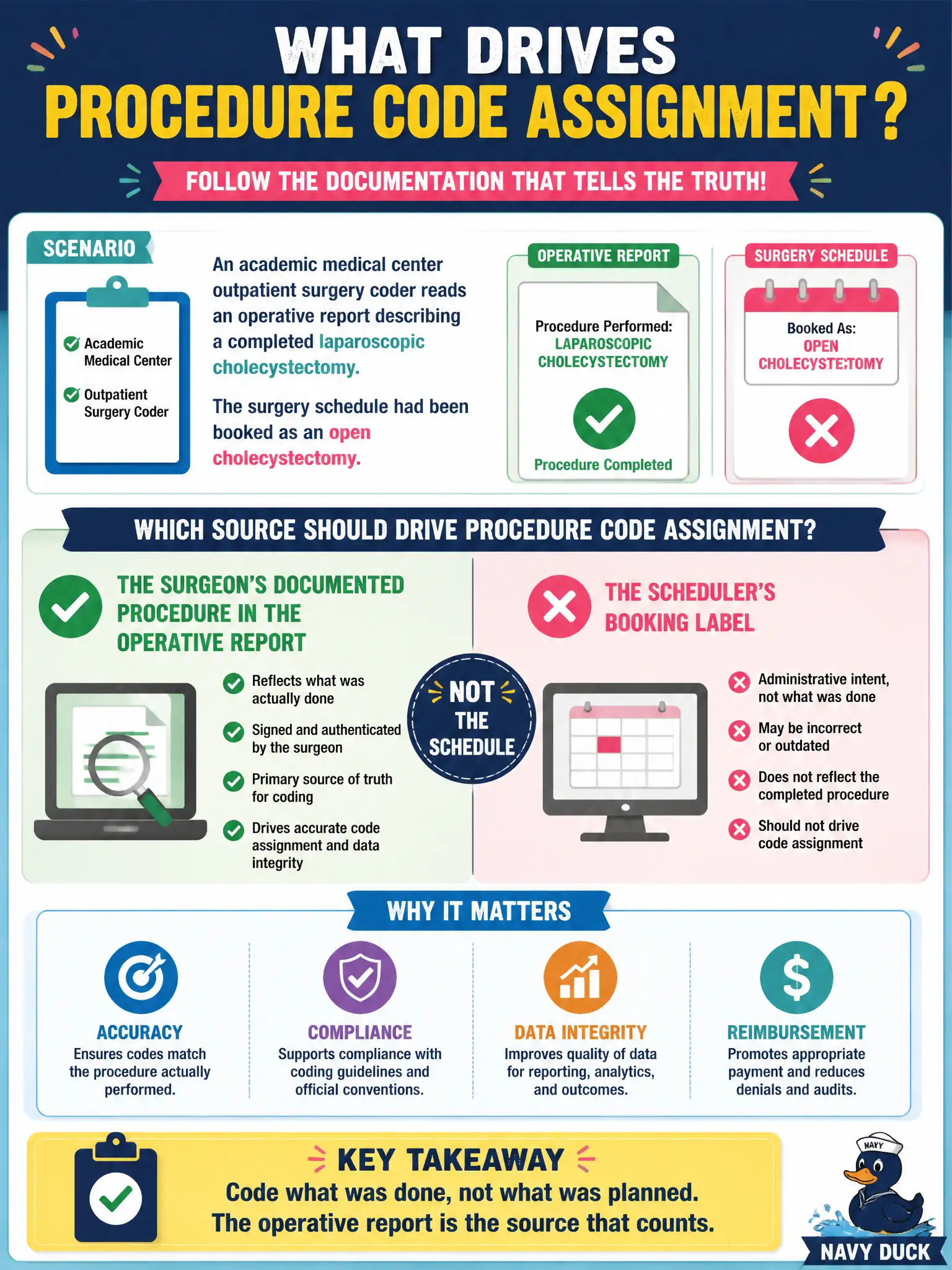
An academic medical center outpatient surgery coder reads an operative report describing a completed laparoscopic cholecystectomy. The surgery schedule had been booked as an open cholecystectomy. Which source should drive procedure code assignment?
Select an answer to reveal the explanation.
Short Explanation
The schedule is just the reservation card—what the surgeon actually wrote in the op report is the meal that got served. Code the laparoscopic cholecystectomy that was performed and documented, not the open case that was booked by mistake.
Full Explanation
Procedure code assignment for outpatient surgery at an academic medical center is driven by what the surgeon documents as performed in the operative report, not by how the case was booked on the schedule. A schedule may list an open cholecystectomy for planning, room setup, or historical habit, yet the completed operative narrative may describe a laparoscopic cholecystectomy. Coding follows the documented procedure that was actually performed—approach, technique, and findings in the op report—because CPT/ICD-10-PCS selection reflects services rendered and recorded by the operating surgeon, not the reservation label.
Relying on the scheduler’s booking label as the official procedure fails by concept because scheduling text is administrative intake, not operative documentation of the completed service. Using the preauthorization CPT string alone even when the surgeon documented a different approach fails because payer authorization strings may be provisional, outdated, or mismatched to the final technique; coding ethics still require reporting what was done and documented. Preferring whatever procedure title appears first in the anesthesia record fails because anesthesia documentation supports peri-operative care and may echo the booked case or abbreviated titles; it does not override the surgeon’s operative narrative as the primary source for procedure coding.
Exam caveat: when schedule, auth, anesthesia, and op report disagree, CCS-level facility coding privileges the operative report (and other surgeon procedure documentation) for what was performed, then reconciles authorization or billing edits separately without falsifying codes. Operational check: compare OR booking versus operative report before abstracting; if laparoscopic technique is clearly documented, assign the laparoscopic procedure codes, document the discrepancy for revenue-cycle follow-up if needed, and never “code the schedule” to avoid a change.