
A municipal ED coder abstracts an encounter in which the patient presented with chest pain that was evaluated and ruled out as cardiac; the ED physician’s final impression is gastroesophageal reflux disease (GERD). Which diagnosis assignment approach is correct?
Select an answer to reveal the explanation.
Short Explanation
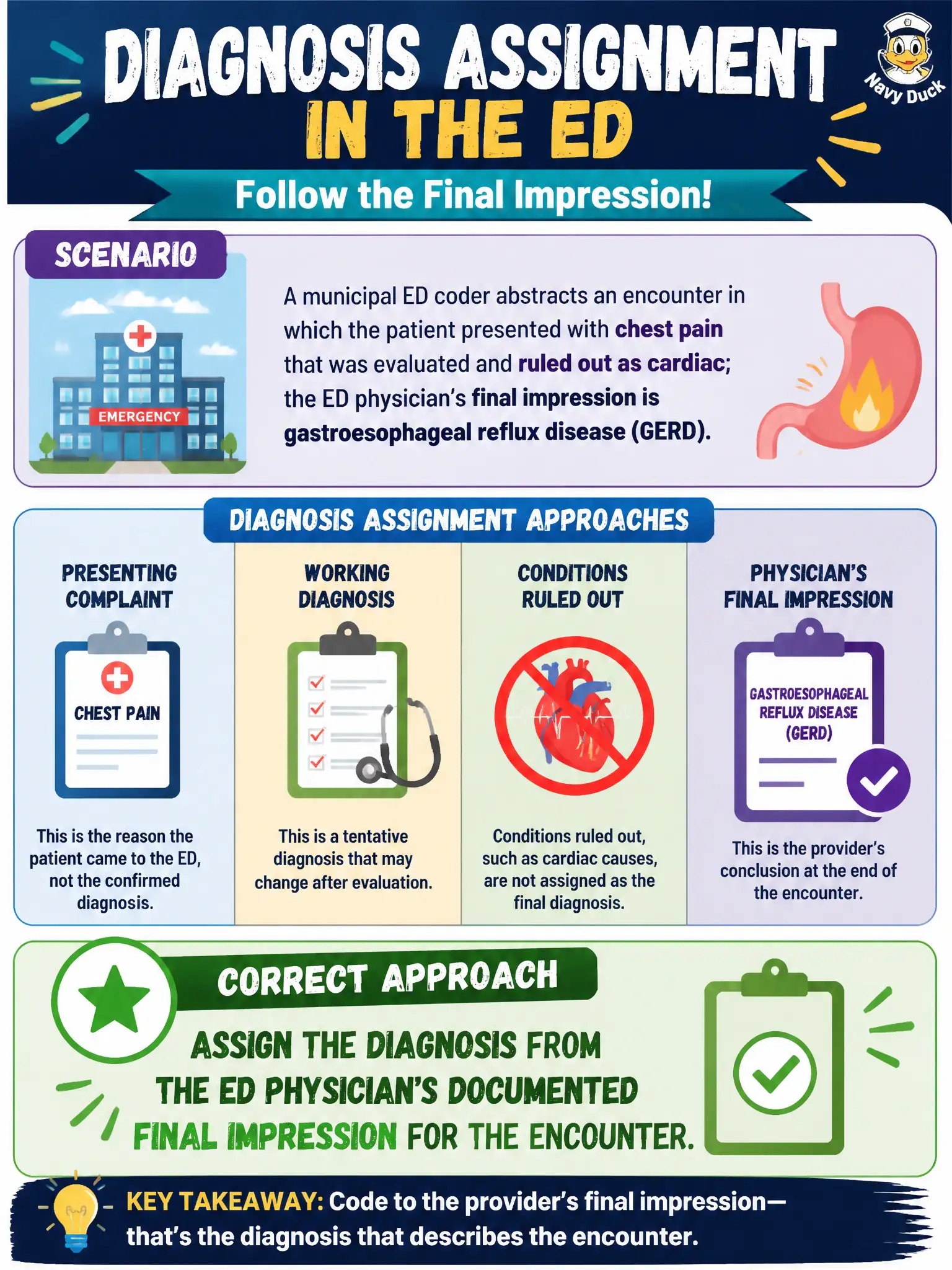
Chief complaint is the doorbell ring; the ED physician’s final impression is what the visit actually was. When chest pain is worked up and the final call is GERD, you code that documented impression—not forever-chest-pain just because that’s how they walked in.
Full Explanation
For a municipal ED encounter, first-listed or encounter diagnosis assignment follows the ED physician’s documented final impression after evaluation, not the chief complaint alone. Chest pain may drive triage and workup, yet when cardiac causes are ruled out and the ED physician’s final impression is GERD, coding reflects that final clinical determination for the visit. This aligns outpatient/ED coding practice with the condition that, after study of the encounter, explains the services and the physician’s conclusion—protecting accurate civic ED quality and utilization reporting.
Always coding unspecified chest pain as first-listed because it was the arrival chief complaint fails by concept: chief complaint initiates evaluation but does not automatically remain the coded diagnosis once a more definitive final impression is documented. Coding acute myocardial infarction whenever chest pain is mentioned, even if ruled out, fails because ruled-out conditions are not reported as confirmed diagnoses; coding AMI without support fabricates severity and misstates the encounter. Using only the triage nurse’s differential and ignoring the ED physician’s final impression fails because triage differentials are working hypotheses, not the treating physician’s final diagnostic statement for coding.
Exam caveat: distinguish “rule out” and ruled-out language carefully; do not code unconfirmed rule-outs as if confirmed, and do not keep a nonspecific symptom as first-listed when the ED physician documents a more precise final impression that meets reporting criteria. Operational check: read the ED physician’s MDM/final impression section last before abstracting; code the documented final impression (here GERD), retain symptom codes only when guidelines and documentation support them as additional or when no more definitive diagnosis is established, and never invent AMI from chest pain alone.