
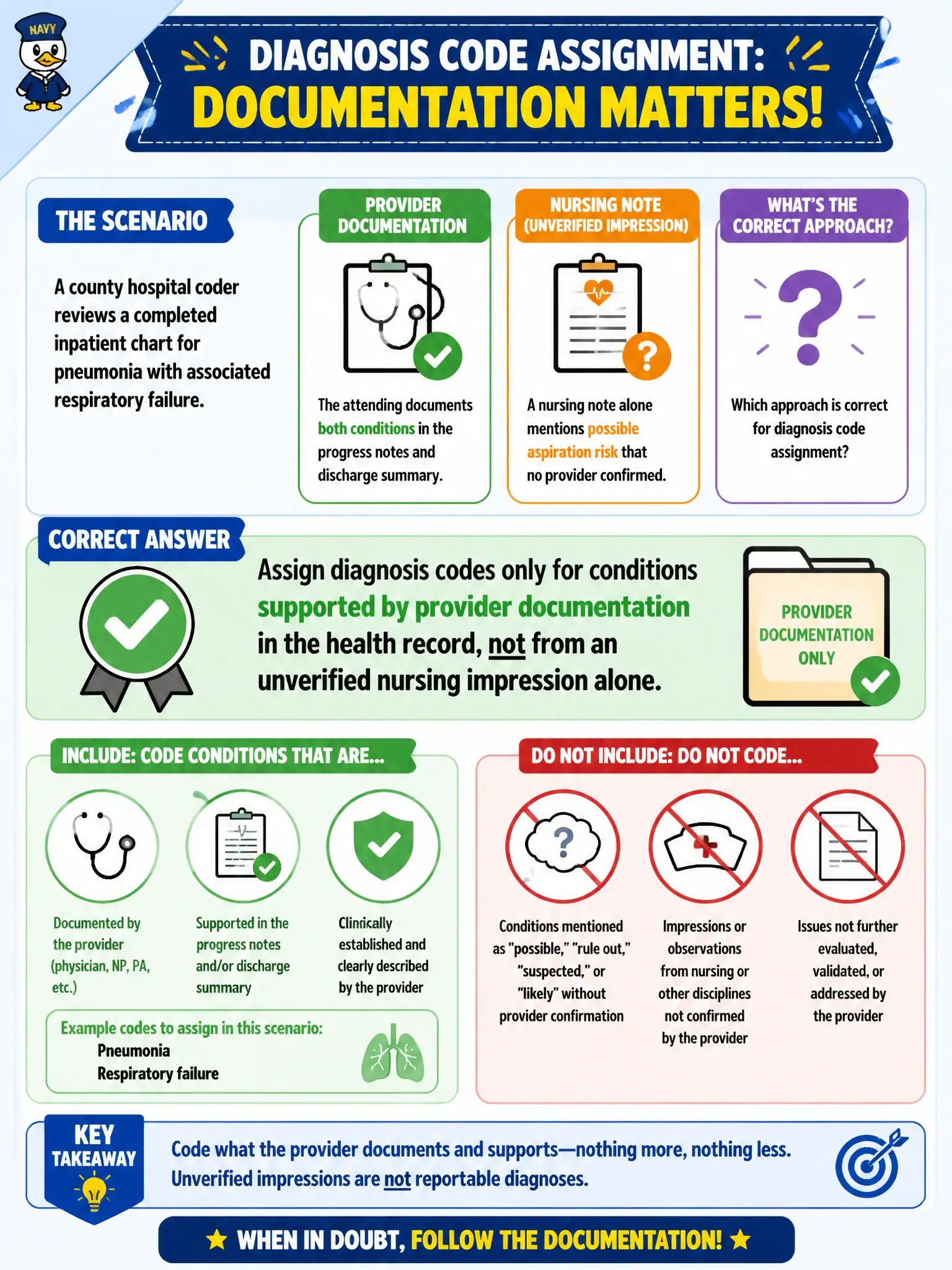
A county hospital coder reviews a completed inpatient chart for pneumonia with associated respiratory failure. The attending documents both conditions in the progress notes and discharge summary, while a nursing note alone mentions possible aspiration risk that no provider confirmed. Which approach is correct for diagnosis code assignment?
Select an answer to reveal the explanation.
Short Explanation
Think of the chart like a court case—the attending’s documentation is the sworn testimony. Nursing notes can be useful clues, but they don’t get coded as diagnoses unless a provider owns them. Stick to what the physician or other treating provider actually documented.
Full Explanation
In facility coding for a county hospital inpatient stay, ICD-10-CM diagnosis assignment rests on provider documentation in the health record—not on every clinical-sounding phrase written by any discipline. The attending’s progress notes and discharge summary establish pneumonia and respiratory failure as reportable diagnoses because a treating provider owns those conditions. An unverified nursing note that mentions possible aspiration risk does not, by itself, create a codeable diagnosis; nursing impressions may cue a compliant query when clarification is needed, but they do not substitute for provider confirmation. Correct practice therefore assigns codes only for conditions supported by provider documentation and withholds coding of the nursing-only aspiration risk until a provider integrates it.
Coding aspiration risk from any note that uses clinical language fails by concept because it treats all chart language as equivalent documentation authority, collapsing the provider-support rule that protects public reporting integrity. Coding only the facesheet problem list while ignoring the attending’s narrative fails because the facesheet is an administrative snapshot, not the definitive clinical story when narrative documentation is richer and more specific. Asserting that a query is never needed because nursing notes alone establish reportable diagnoses fails because it invents a false rule: nursing documentation can support care and can trigger clarification, but it does not independently establish ICD-10-CM diagnoses for facility coding.
Exam caveat: CCS expects Official Guidelines and UHDDS-aligned provider documentation as the coding source of truth; ancillary notes are clues, not automatic code generators. Operational check in civic facilities: before finalizing the abstract, confirm each coded diagnosis has provider support in progress notes, H&P, discharge summary, or another treating-provider entry; if nursing alone suggests a clinically significant condition that would affect quality, severity, or reimbursement reporting, initiate a compliant, non-leading query rather than coding from the nursing impression.