
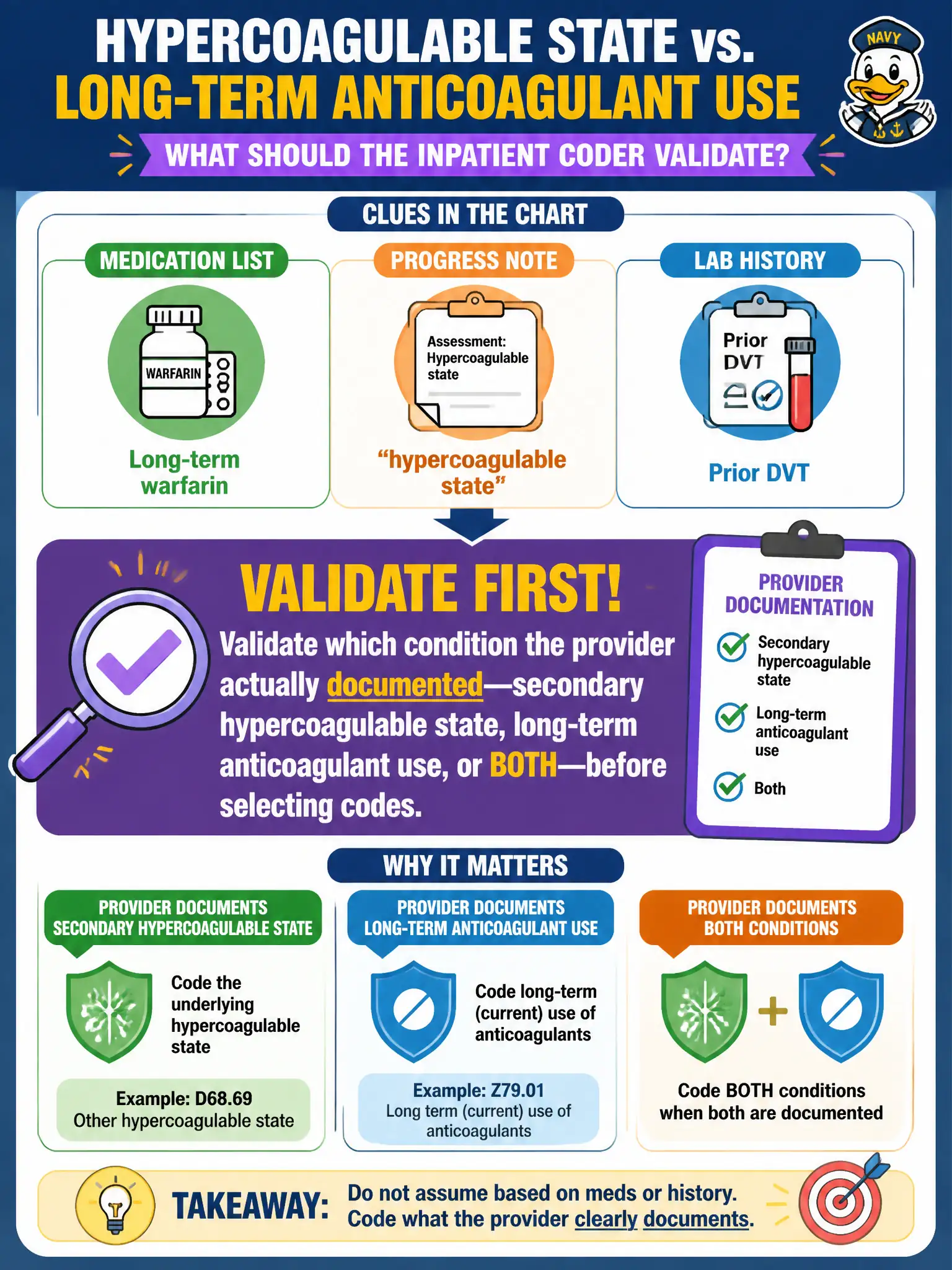
The medication list shows long-term warfarin, and a progress note mentions “hypercoagulable state.” Lab history shows prior DVT. Before assigning a secondary hypercoagulable-state diagnosis versus a long-term anticoagulant-use code, what should the inpatient coder validate?
Select an answer to reveal the explanation.
Short Explanation
Warfarin on the list and “hypercoagulable” in a note are cousins, not twins. Validate the exact concept the provider named. Guessing from the med list alone mixes long-term drug use with a thrombophilia diagnosis.
Full Explanation
Long-term anticoagulant use and secondary hypercoagulable-state diagnoses are related but not interchangeable. When the medication list shows long-term warfarin and a progress note mentions "hypercoagulable state" with prior DVT in the laboratory history, the inpatient coder must validate which condition the provider actually documented—secondary hypercoagulable state, long-term anticoagulant use, or both—before selecting codes. Always coding secondary hypercoagulable state whenever any anticoagulant appears overdiagnoses thrombophilia from medication alone. Coding only long-term anticoagulant use and never reporting thrombophilia-related diagnoses when the provider documented a hypercoagulable state underreports that diagnosis. Replacing the warfarin listing with a history-of-DVT code and skipping further validation discards both the documented therapy status and the hypercoagulable wording without resolution. Exam caveat: primary versus secondary hypercoagulable codes, long-term drug-use Z codes, and history-of thrombosis codes have distinct index paths—do not collapse them into one convenient label. Operational check: harvest exact provider diagnostic phrases, correlate with anticoagulation indication, query if "hypercoagulable state" is vague, then assign only supported codes on the civic hospital abstract.