
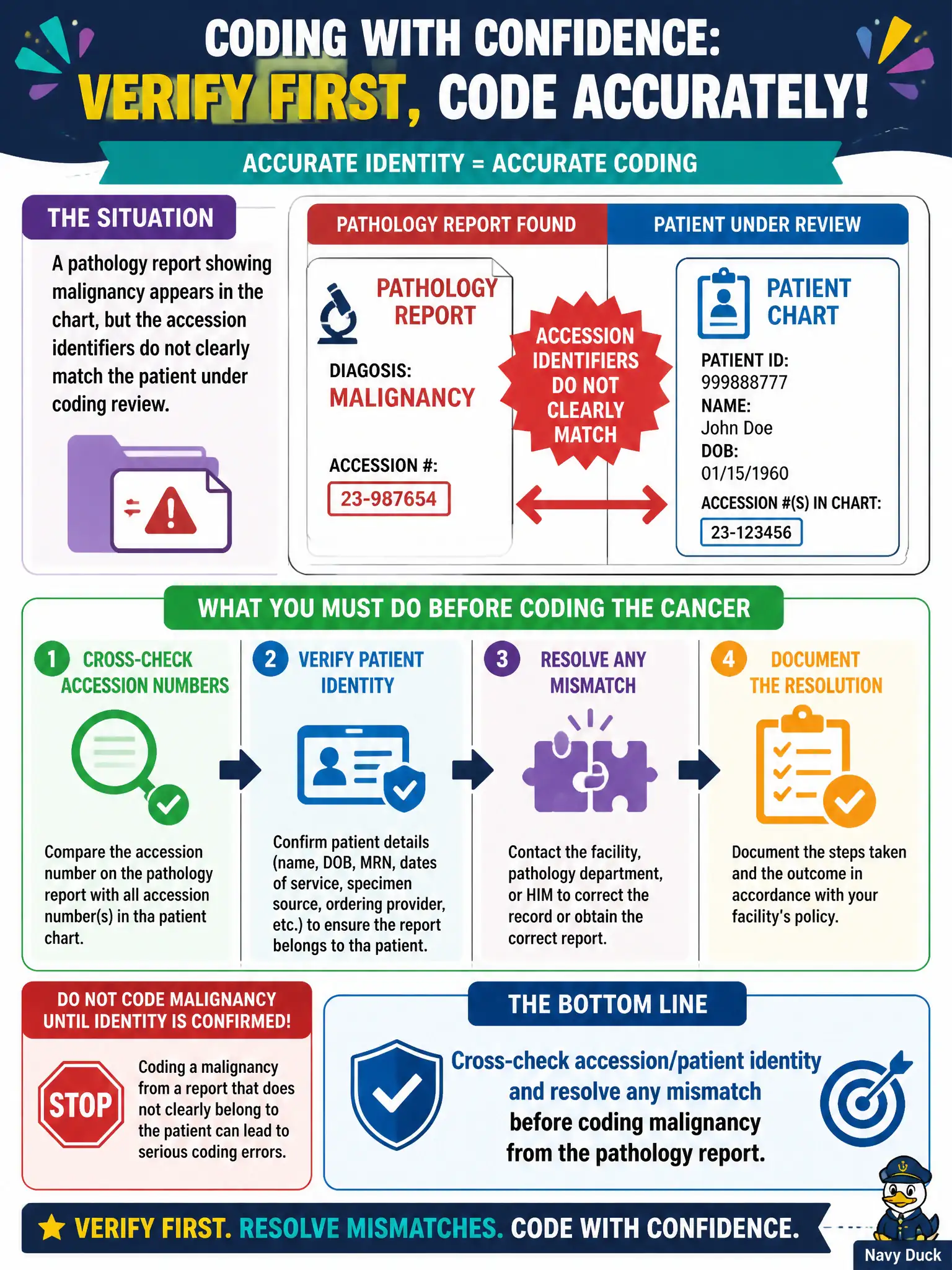
A pathology report showing malignancy appears in the chart, but the accession identifiers do not clearly match the patient under coding review. What must the coder do before coding the cancer?
Select an answer to reveal the explanation.
Short Explanation
Wrong-patient pathology is a nightmare scenario — verify the accession against the patient before you code cancer. A mismatched report is a stop sign, not a coding hint. Identity first, diagnosis second.
Full Explanation
Pathology reports drive malignancy coding only when identity linkage to the patient under review is reliable. If accession identifiers do not clearly match the patient, the coder must cross-check accession and patient identity and resolve any mismatch before coding cancer from that report. Coding malignancy immediately to protect oncology quality metrics prioritizes scorecards over patient safety and record integrity and may attribute another person's disease to the wrong chart. Coding a benign neoplasm as a compromise invents histology and still uses a potentially wrong-patient report. Relying on a scanned PDF filename as identity proof is insufficient when accession and demographic identifiers conflict inside the electronic record. Exam caveat: wrong-patient pathology is a serious patient-safety event; coding must wait for identity resolution through proper amendment and specimen-reconciliation workflows rather than guessing or splitting the difference. Operational check for county oncology abstracts: verify name, medical record number, date of birth, specimen site, and accession against the surgical episode; escalate mismatches to pathology and HIM before any neoplasm code is finalized on the civic hospital claim.