
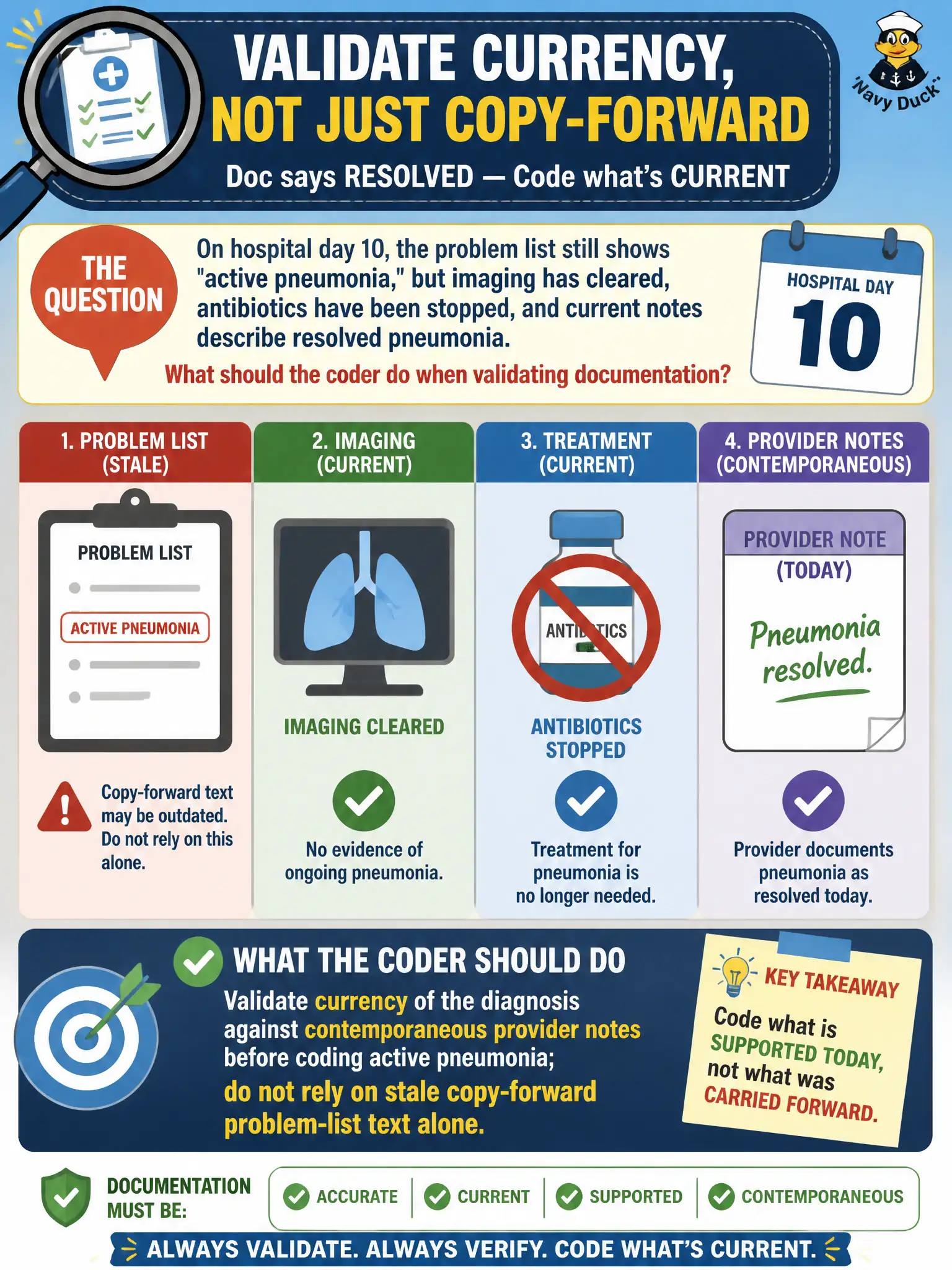
On hospital day 10, the problem list still shows 'active pneumonia,' but imaging has cleared, antibiotics have been stopped, and current notes describe resolved pneumonia. What should the coder do when validating documentation?
Select an answer to reveal the explanation.
Short Explanation
Copy-forward problem lists can be zombies — old problems that keep walking after the patient got better. Match today's notes and treatment reality before you code 'active' anything. Stale text is not current clinical truth.
Full Explanation
Problem lists and copy-forward EHR text frequently retain outdated 'active' labels after a condition has resolved. On hospital day 10, when imaging has cleared, antibiotics have stopped, and contemporaneous notes describe resolved pneumonia while the problem list still shows 'active pneumonia,' the coder must validate currency against current provider notes rather than coding active disease from stale problem-list text alone. Treating the problem list as an automatic legal diagnosis ignores the need for encounter-specific, current diagnostic statements. Substituting sepsis as a 'safer' severity code without documentation is fabrication. Ignoring all problem-list entries for the entire stay overcorrects and may discard useful cues that still require validation against notes. Exam caveat: resolved, history-of, and active disease distinctions affect POA, CC/MCC capture, and quality metrics—code the clinical status supported for this stay. Operational check in civic inpatient coding: compare problem-list pneumonia status with the latest progress notes, treatment stop dates, and discharge summary wording; code active pneumonia only if current authenticated documentation supports active disease.