
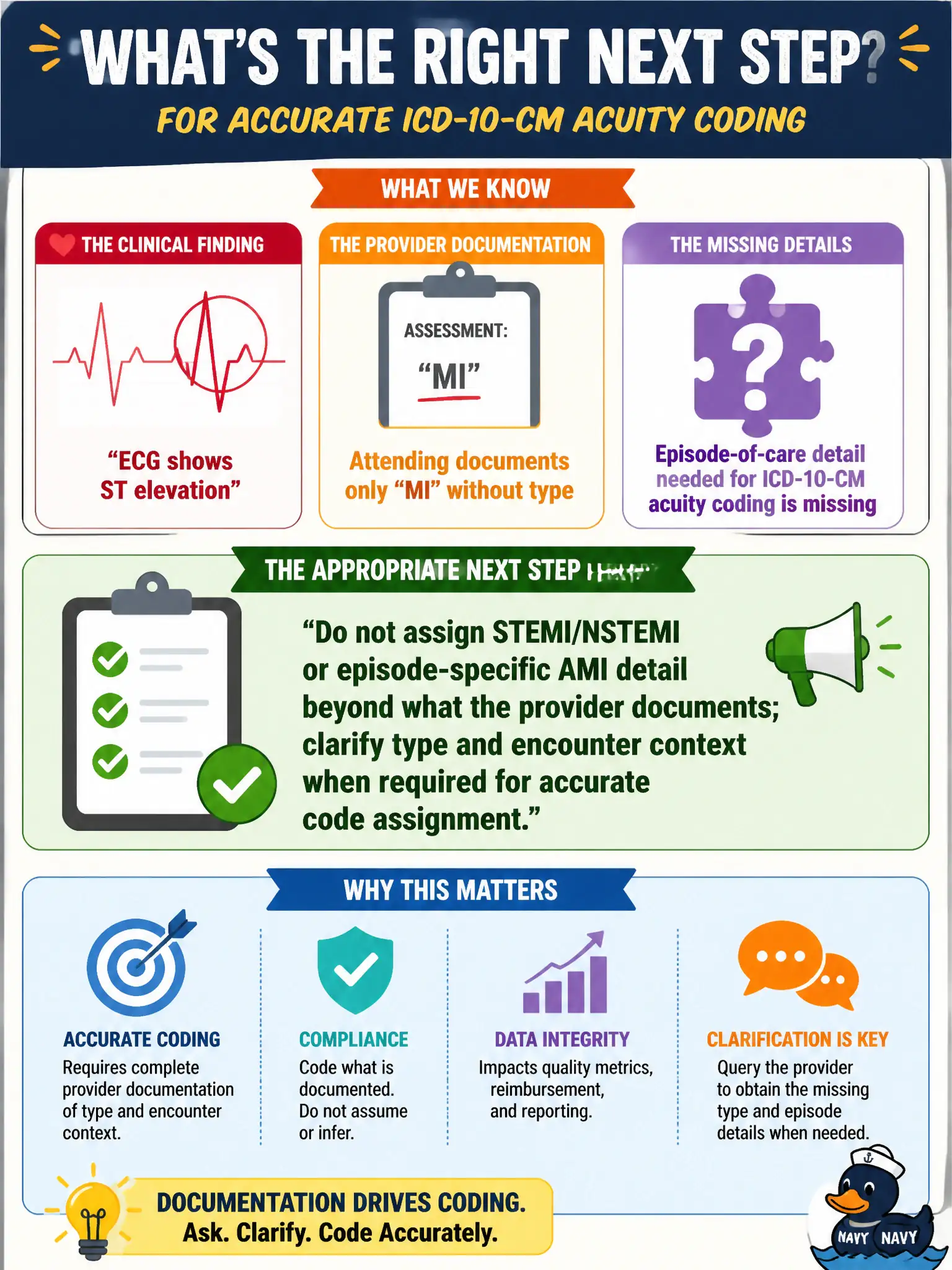
An ECG shows ST elevation, but the attending documents only 'MI' without type, and episode-of-care detail needed for ICD-10-CM acuity coding is missing. What is the appropriate next step for the hospital coder?
Select an answer to reveal the explanation.
Short Explanation
The ECG can scream ST elevation, but coding still follows the provider's diagnostic statement. If the chart only says 'MI,' you do not promote it to STEMI yourself. Ask for type and encounter detail when the code set needs it.
Full Explanation
Acute myocardial infarction coding in ICD-10-CM requires provider diagnostic statements that support type (for example STEMI versus NSTEMI) and episode-of-care concepts when those axes are needed for a complete code. An ECG showing ST elevation is important clinical data, but it does not independently authorize the coder to upgrade a nonspecific 'MI' diagnosis to STEMI. The appropriate step is to avoid assigning STEMI/NSTEMI or episode-specific AMI detail beyond what the provider documents and to clarify type and encounter context when required for accurate assignment. Coding STEMI from the tracing alone substitutes diagnostic interpretation for the provider's authenticated statement. Defaulting to NSTEMI because it seems safer for quality metrics is assumption coding driven by scorecards rather than documentation. Coding 'history of MI' when an acute event is being evaluated underreports current disease and misuses personal-history conventions. Exam caveat: subsequent versus initial encounter, type 1 versus other MI types, and old MI codes are high-yield distinctions—follow Official Guidelines for the discharge date. Operational check in a county hospital cardiac stay: compare ECG/cath findings with the attending's diagnostic wording; if type or episode detail required by the code set is missing, query before locking AMI acuity codes.