
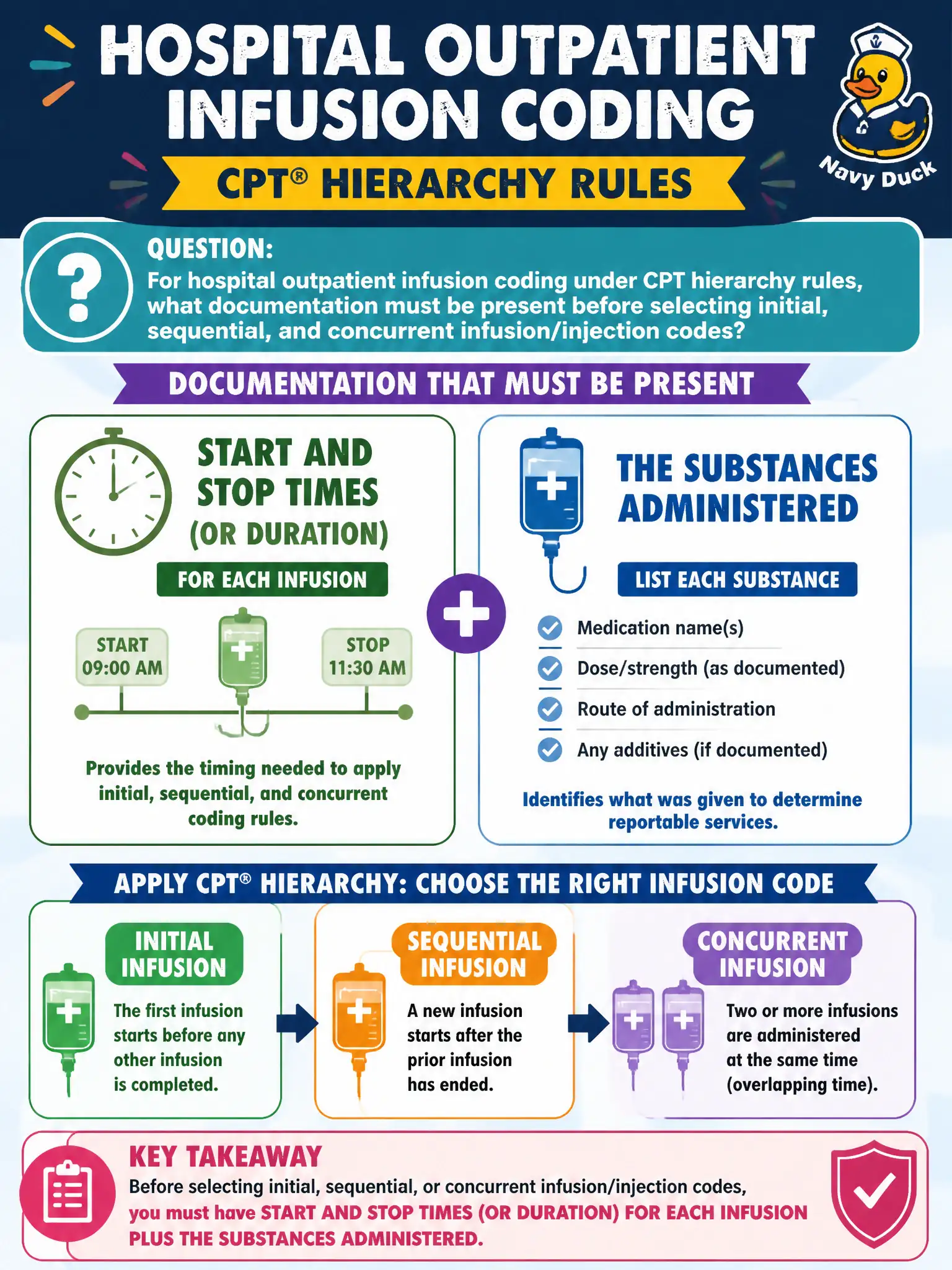
For hospital outpatient infusion coding under CPT hierarchy rules, what documentation must be present before selecting initial, sequential, and concurrent infusion/injection codes?
Select an answer to reveal the explanation.
Short Explanation
Infusion CPT is a timing sport. Without start/stop (or clear duration) and what was hung, you cannot tell initial from sequential from a push. Get the nursing infusion record complete before you pick the hierarchy.
Full Explanation
Hospital outpatient infusion and injection CPT reporting follows a hierarchy that distinguishes initial, sequential, and concurrent services using timed administration documentation and the substances given. Start and stop times—or clear duration—for each infusion, plus identification of what was administered, are the documentation foundation for selecting the correct initial versus sequential versus concurrent codes and for separating infusions from pushes. A pharmacy label that names a drug without timed nursing administration detail cannot establish which hierarchy code applies. A dehydration diagnosis without medication and timing detail supports medical necessity discussion at best, not infusion hierarchy selection. An insurance authorization number is an administrative coverage artifact and never substitutes for clinical timing documentation. Exam caveat: facility versus professional reporting, hydration versus therapeutic infusion definitions, and concurrent rules are frequently tested—apply current CPT hierarchy guidance rather than charge-router defaults. Operational check on municipal outpatient infusion units: verify each substance, route, and start/stop (or duration) on the nursing infusion record; reconcile against pharmacy orders; then assign hierarchy codes only to what the timed record supports.