
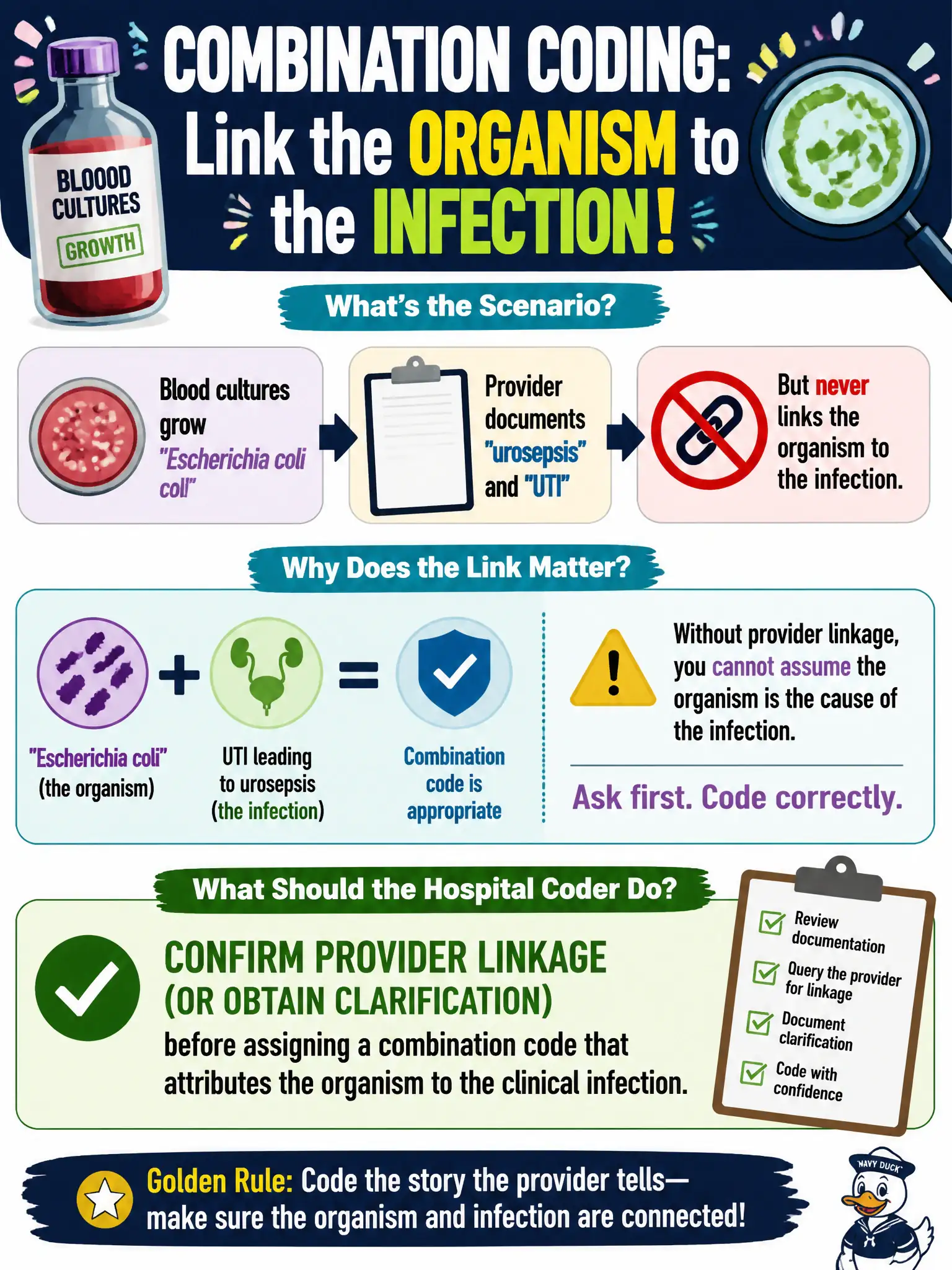
Blood cultures grow Escherichia coli, and the provider documents 'urosepsis' and 'UTI' but never links the organism to the infection. For combination coding of the infection with the organism, what should the hospital coder do?
Select an answer to reveal the explanation.
Short Explanation
A culture result is lab data — it is not automatically the doctor's diagnosis statement. Combination coding that ties an organism to an infection usually needs the provider to connect those dots. If the link is missing, clarify instead of assuming.
Full Explanation
Combination coding that links an organism to a clinical infection generally requires a provider connection between the culture result and the diagnosed infection, not the laboratory finding alone. Blood cultures growing Escherichia coli with documentation of 'urosepsis' and 'UTI' still leave a linkage gap if the provider never attributes the organism to that infection. Confirming linkage—or obtaining clarification—before assigning a combination code that ties E. coli to the UTI protects the integrity of organism-infection reporting used in hospital quality and public-health surveillance. Automatically combining the organism with the UTI solely because a culture is positive treats lab data as a diagnostic statement and can overstate etiology. Coding only the organism as principal diagnosis while ignoring the UTI missequences the reason for care and misapplies principal diagnosis rules. Dropping both infection and organism codes until pathology countersigns the culture invents a barrier that is not a universal coding requirement and may underreport documented infection. Exam caveat: sepsis, bacteremia, and organism coding pathways are nuanced; apply Official Guidelines for uncertain diagnoses, combination coding, and sepsis definitions current to the discharge date. Operational check: locate an explicit provider link (or query response) between organism and infection site/condition before releasing the combination code on the inpatient abstract.