
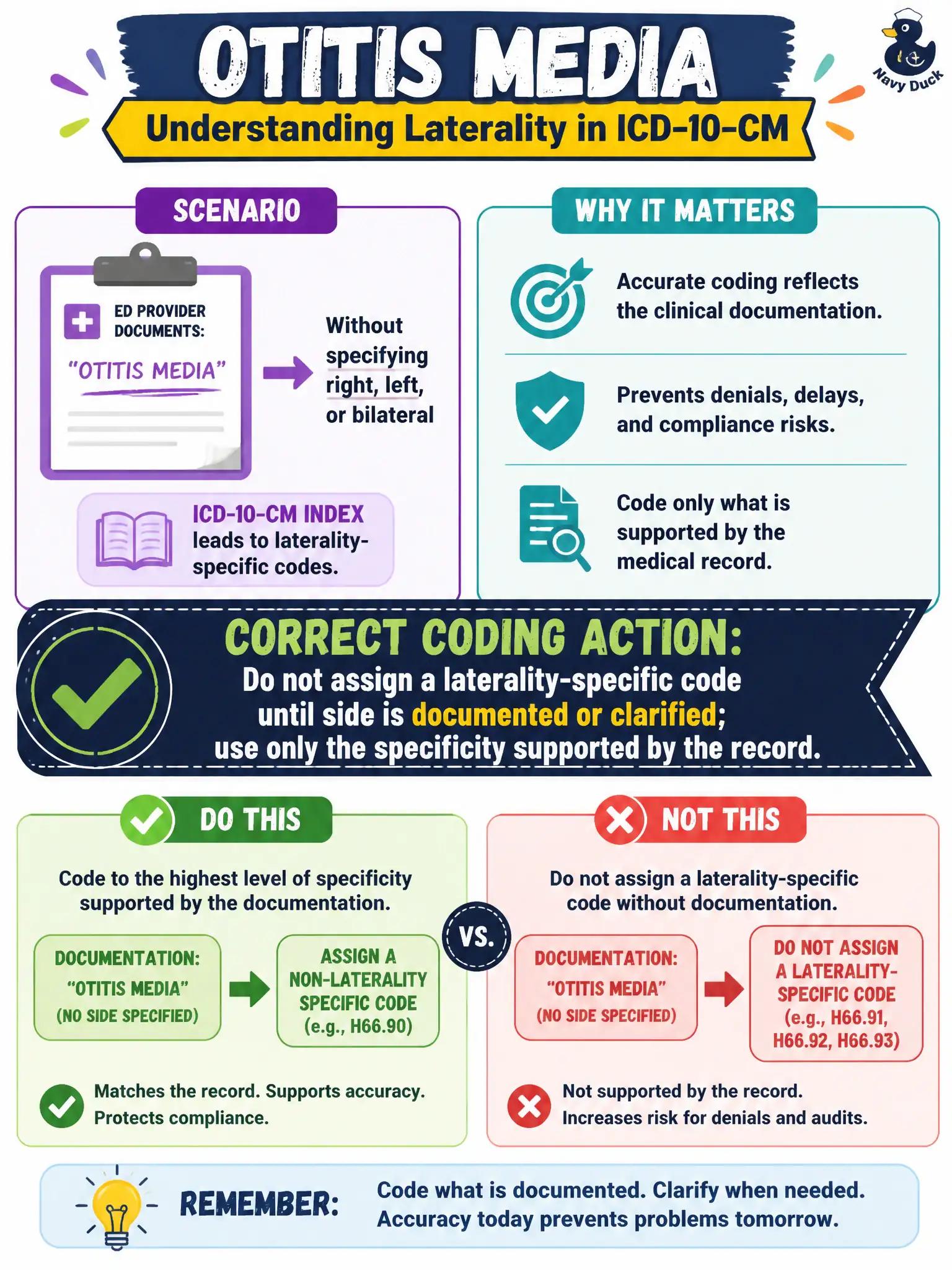
An ED provider documents 'otitis media' without specifying right, left, or bilateral, and the ICD-10-CM index leads to laterality-specific codes. What is the correct coding action?
Select an answer to reveal the explanation.
Short Explanation
Laterality is like labeling left and right shoes — if nobody wrote which ear, you do not guess. When the code set expects a side, missing side means you stay at the documented level or get clarification. Common patterns and encoder folklore are not documentation.
Full Explanation
Laterality is a required axis for many ICD-10-CM ear and other site-specific diagnosis codes. When an ED provider documents only 'otitis media' without right, left, or bilateral detail, the coder may not invent laterality to reach a more specific code. The correct action is to code only at the specificity supported by the record—often an unspecified laterality code when that is what documentation and the classification allow—or to query for side when greater specificity is required for accurate reporting. Defaulting to bilateral because ear infections are often bilateral substitutes epidemiology for documentation and is noncompliant. Choosing left because an encoder tip says left is most common similarly replaces the legal record with a statistical guess. Adding an external-cause code for 'unknown side' does not repair missing laterality on the infection code and misuses external-cause classification. Exam caveat: some conditions have valid unspecified codes while others become incomplete without side; know when to stay unspecified versus when to query. Operational check in a municipal ED abstract: search the note, nursing assessment, and discharge instructions for any documented side; if absent, assign only what is supported or initiate a compliant laterality clarification before locking a side-specific code.