
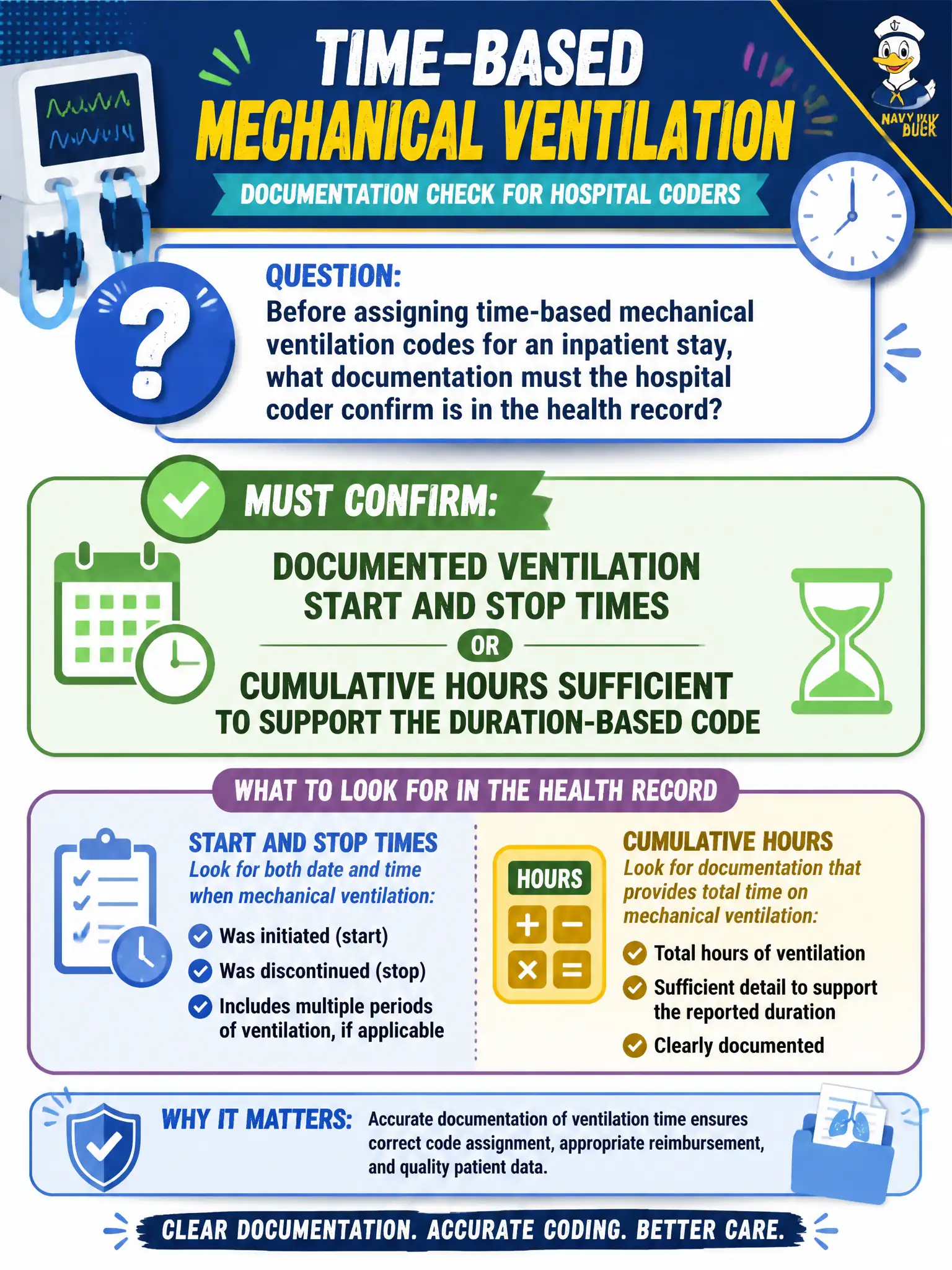
Before assigning time-based mechanical ventilation codes for an inpatient stay, what documentation must the hospital coder confirm is in the health record?
Select an answer to reveal the explanation.
Short Explanation
Ventilator duration codes are like billing for a rental — the clock matters. If the chart never shows when support started and stopped (or total hours), you cannot honestly pick the time-based code. Dig for timed RT notes or flowsheets before you code the hours.
Full Explanation
Time-based mechanical ventilation reporting for hospital inpatients depends on documented duration that maps to ICD-10-PCS and related inpatient classification categories. Coders must confirm start and stop times or cumulative ventilated hours in respiratory therapy notes, ventilator flowsheets, or other timed clinical documentation before selecting the duration-based code. Imaging that merely shows an endotracheal tube proves airway presence, not hours of support, so a chest radiograph alone cannot drive the time-based procedure code. Informal verbal handoffs that the patient was on the ventilator overnight are not authenticated timed documentation and cannot support duration selection. An unsigned respiratory therapy template without recorded times likewise fails completeness and authentication standards for duration coding. Exam caveat: weaning trials, intermittent support, and noninvasive versus invasive modalities may affect how hours are counted under current PCS and facility guidance—do not assume every hour the device was in the room counts the same way. Operational check for civic hospital coding desks: pull the timed ventilation record, reconcile start/stop or cumulative hours to the code's duration threshold, resolve conflicts with a clarification when needed, and only then finalize the ventilation procedure code.