
A hospital inpatient coder finds a case-management note describing housing instability, but the attending progress notes and discharge summary never mention social determinants. Per current ICD-10-CM guidance on reporting SDOH Z codes, what should the coder do?
Select an answer to reveal the explanation.
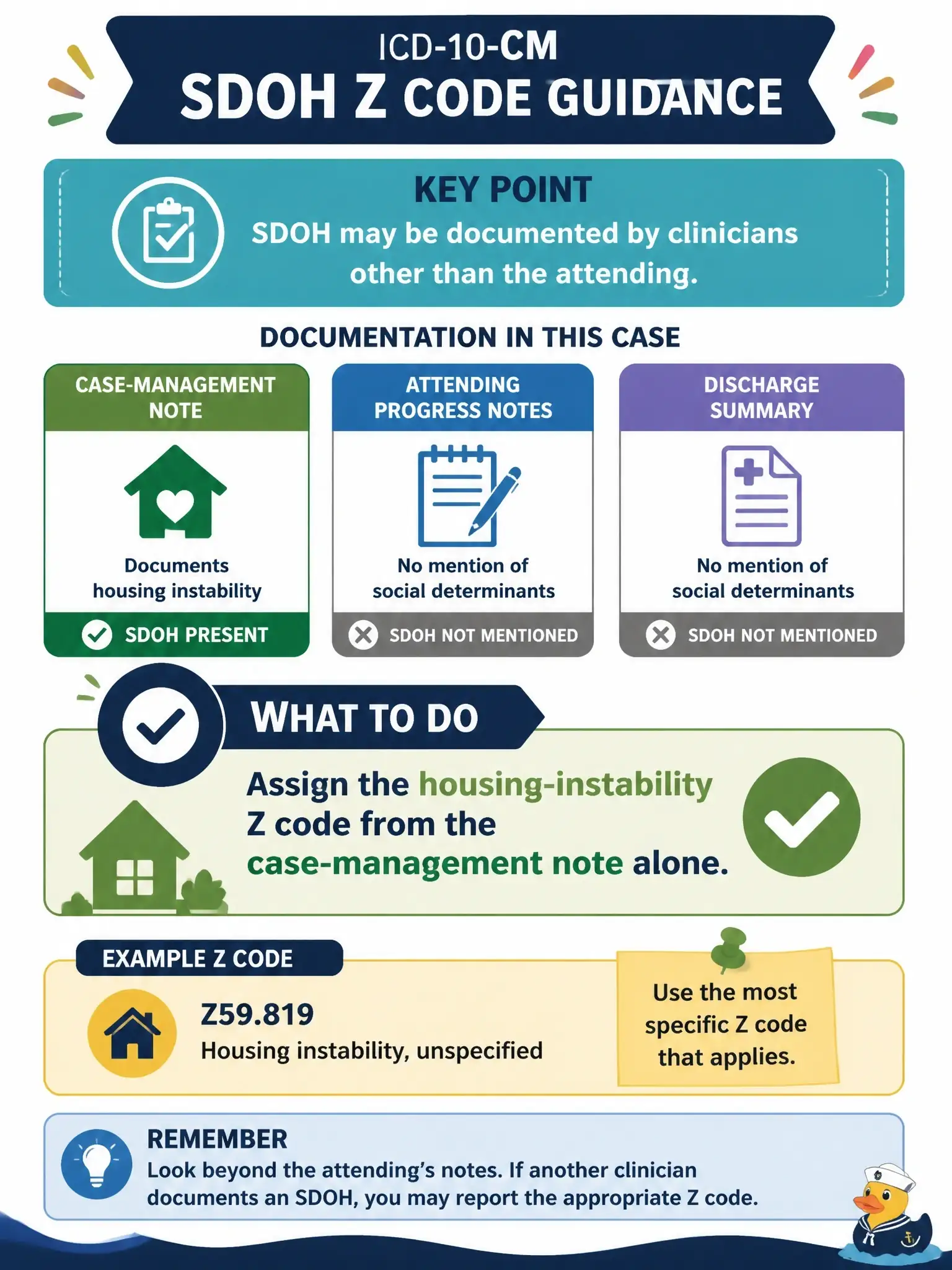
Short Explanation
Here's the good news: SDOH codes are the one place where you don't need the attending to say it first. Social risk is social information, not a medical diagnosis, so a case manager's note in the official record is enough to support the housing-instability Z code. You don't have to wait for the doctor to echo it.
Full Explanation
The ICD-10-CM Official Guidelines list social determinants of health classified to Chapter 21 among the explicit exceptions to the rule that code assignment rests on the documentation of the patient's provider. Section I.B.14 allows those codes to be based on documentation from clinicians involved in the patient's care who are not the patient's provider, because the content is social information rather than a medical diagnosis. The Chapter 21 SDOH guideline names social workers, community health workers, case managers and nurses as examples, provided their documentation is included in the official medical record. A case-management note describing housing instability therefore supports the Z code on its own, even when the attending never mentions it. Querying the attending first misreads the guideline, because SDOH is an explicit exception to the provider-documentation rule; the case-management note already is a permitted source, and waiting on a query leaves a documented social risk unreported. Verbal confirmation from a utilization-review nurse is not documentation in the record and adds nothing that the written note does not already provide. Inferring social risk from a ZIP-code poverty rate invents information that no clinician documented and is never a valid coding basis. Exam caveat: SDOH codes are reported only as secondary diagnoses, and any associated medical diagnosis still requires the provider's documentation. Operational check: confirm the case-management note is part of the official medical record, match the described housing problem to the correct Z59 code in the Index and Tabular, and sequence it as secondary.