
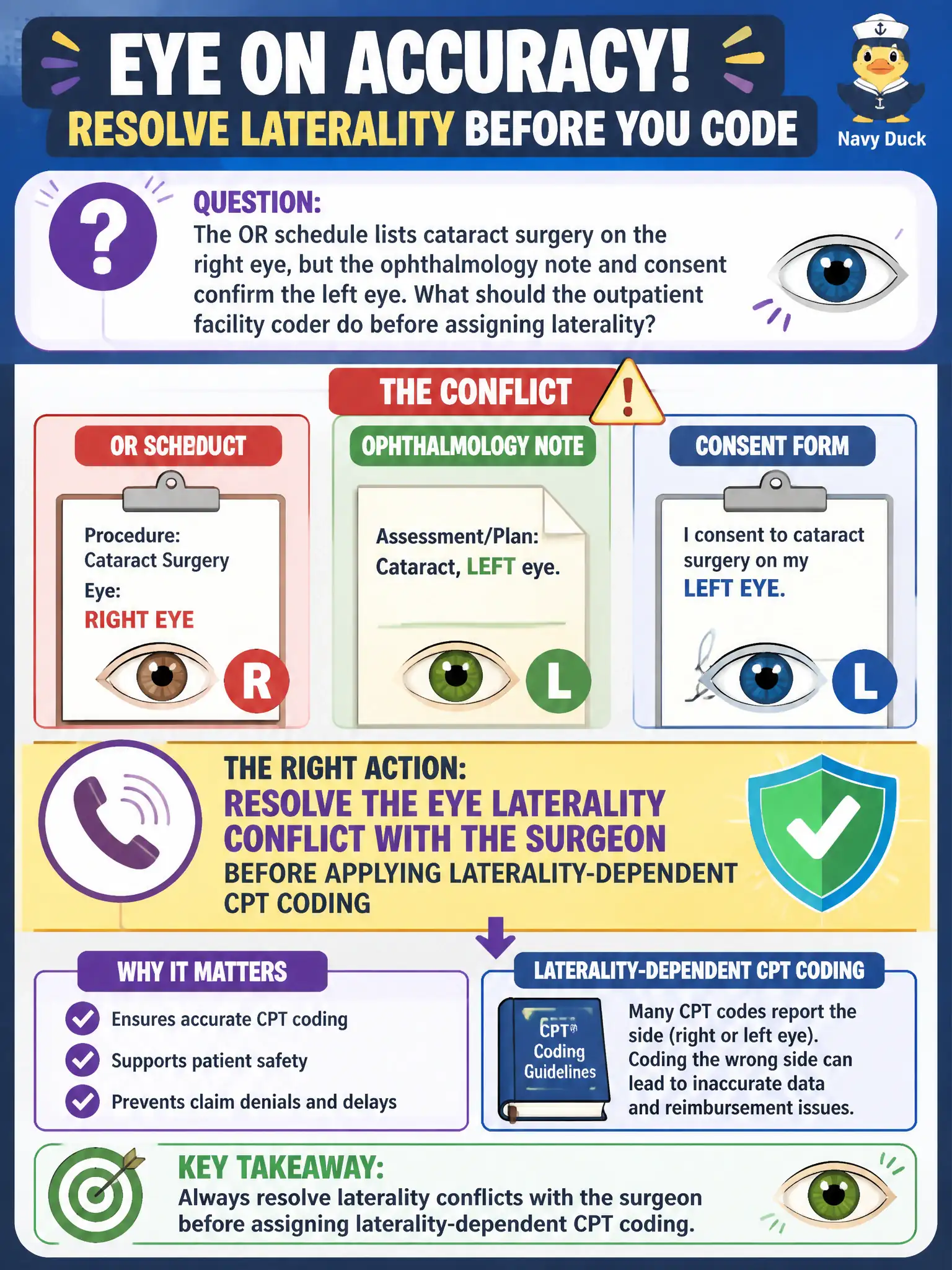
The OR schedule lists cataract surgery on the right eye, but the ophthalmology note and consent confirm the left eye. What should the outpatient facility coder do before assigning laterality?
Select an answer to reveal the explanation.
Short Explanation
Eyes are not interchangeable inventory bins. If the schedule says right and the note says left, stop and fix laterality with the surgeon before you hang a CPT laterality modifier on the claim.
Full Explanation
When the OR schedule lists cataract surgery on the right eye but the ophthalmology note and consent confirm the left eye, the outpatient facility coder should resolve the eye laterality conflict with the surgeon before applying laterality-dependent CPT coding. Wrong-eye coding is a serious patient-safety and compliance failure for civic ambulatory surgery. Coding the right eye because the OR schedule is the billing source of truth fails when clinical documentation and consent contradict the schedule. Omitting laterality modifiers and coding a generic cataract procedure without site fails when laterality is required and known-but-conflicting. Coding both eyes to avoid missing either scheduled or consented laterality fails without documentation of bilateral surgery. Exam caveat: resolve laterality conflicts before site-dependent outpatient procedure coding; schedules do not outrank consent and clinical notes. Operational check: stop the municipal eye-surgery abstract, clarify with the surgeon, correct the schedule if needed, then assign laterality-specific CPT and modifiers. Escalate recurring schedule-versus-consent mismatches to perioperative safety for public ambulatory surgery quality.