
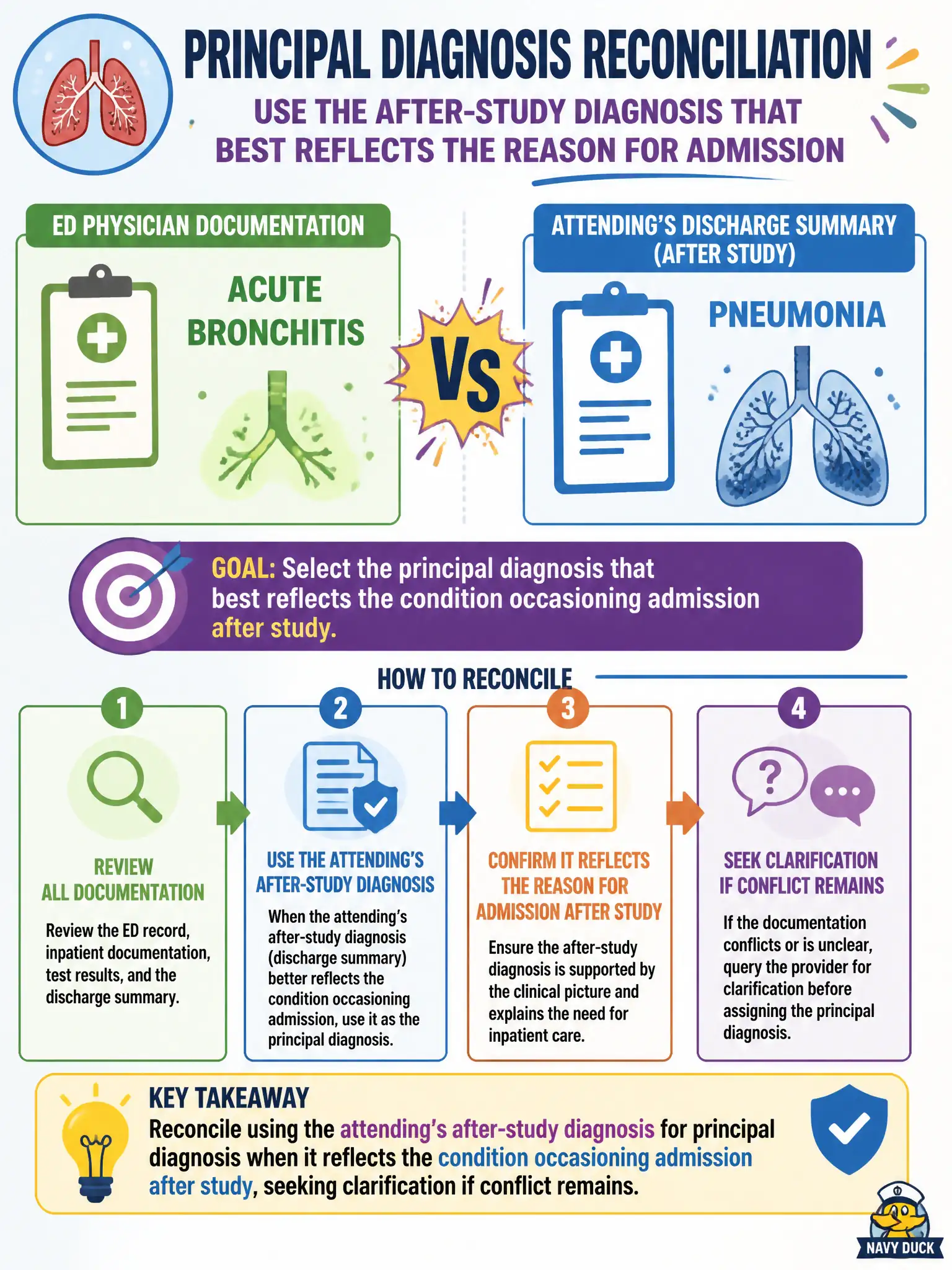
The ED physician documents acute bronchitis, but after study the attending’s discharge summary documents pneumonia as the inpatient diagnosis. How should the coder reconcile this for principal diagnosis selection?
Select an answer to reveal the explanation.
Short Explanation
The ED shot from the doorway; the attending finished the workup. For inpatient principal diagnosis, after-study clarity from the responsible provider usually wins—clarifying if the chart still argues with itself.
Full Explanation
When the ED physician documents acute bronchitis but after study the attending’s discharge summary documents pneumonia as the inpatient diagnosis, the coder should reconcile using the attending’s after-study diagnosis for principal diagnosis when it reflects the condition occasioning admission after study, seeking clarification if conflict remains. Civic inpatient principal diagnosis follows UHDDS after-study logic, not first-written ED impressions alone. Always keeping the ED diagnosis as principal because it was written first fails chronological freeze that ignores after-study findings. Coding bronchitis and pneumonia as co-principal diagnoses without clarification fails because inpatient claims have one principal diagnosis. Ignoring the discharge summary whenever it differs from the ED note fails complete-record abstraction. Exam caveat: principal diagnosis is the condition established after study, often clarified in the discharge summary. Operational check: compare ED, H&P, progress notes, and discharge summary on the municipal account; select the after-study condition chiefly responsible for admission; query unresolved conflicts; and document the rationale. Educate that ED impressions may be provisional in public hospital inpatient stays.