
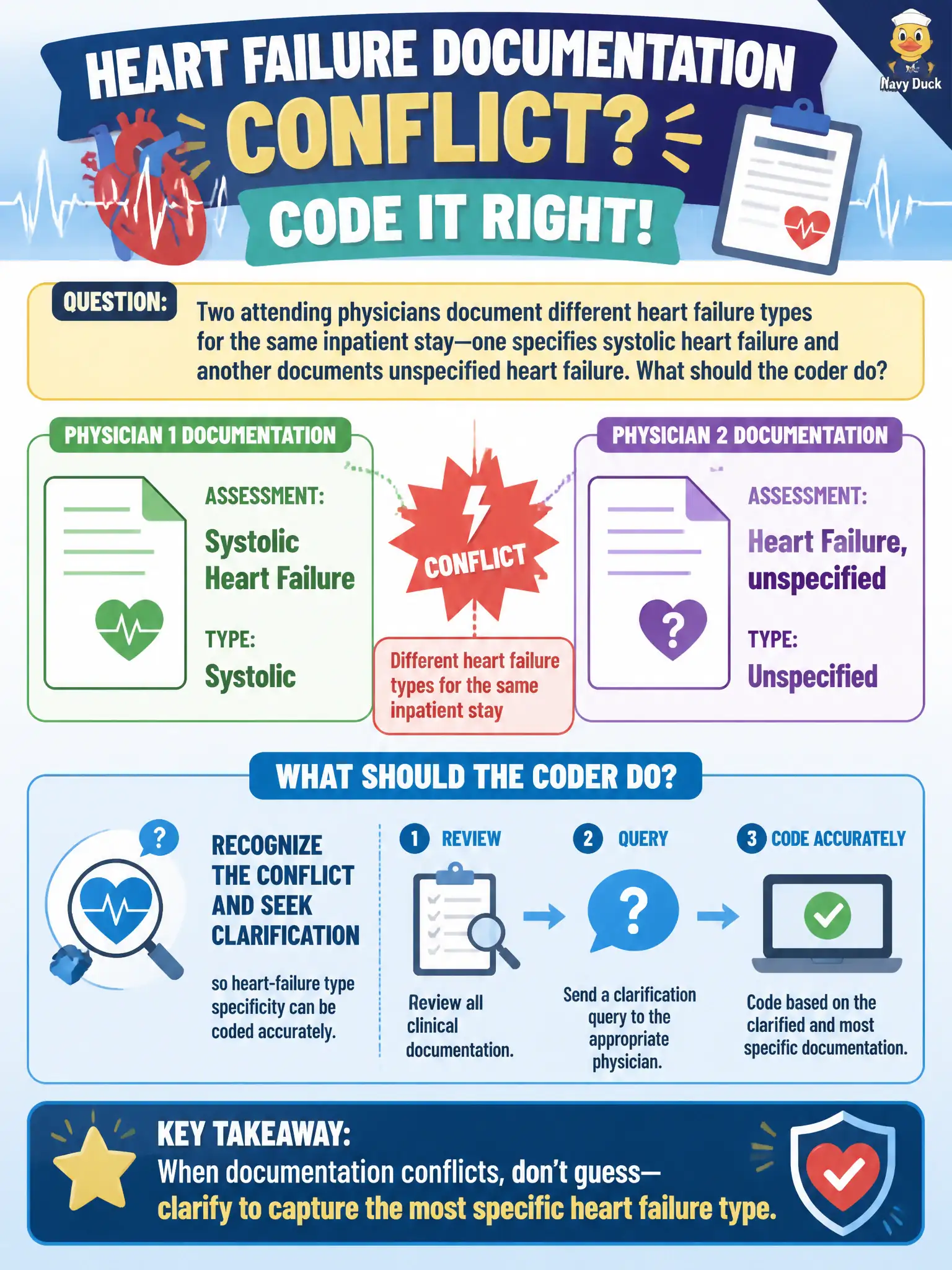
Two attending physicians document different heart failure types for the same inpatient stay—one specifies systolic heart failure and another documents unspecified heart failure. What should the coder do?
Select an answer to reveal the explanation.
Short Explanation
Systolic in one note, unspecified in another—that is mixed signals on a high-stakes diagnosis. Ask for a clean type rather than blending or double-coding your way out of it.
Full Explanation
When two attending physicians document different heart failure types for the same inpatient stay—one specifies systolic heart failure and another documents unspecified heart failure—the coder should recognize the conflict and seek clarification so heart-failure type specificity can be coded accurately. Specificity affects clinical data quality and may affect severity grouping for civic inpatients. Averaging the two descriptions into a single unspecified code without review fails resolution and may under-specify a documented type. Coding both systolic and diastolic heart failure to cover every possibility fails when diastolic disease is unsupported. Selecting the unspecified code always because it requires less query work fails coding quality standards. Exam caveat: conflicting HF type documentation needs clarification, not averaging, dual phenotypes, or lazy unspecified defaults. Operational check: identify the responsible provider for the county stay, issue a non-leading query on HF type, code the authenticated specificity, and align problem lists afterward. Use CDI collaboration when recurrent HF-type conflicts appear across teaching service notes. In municipal and county facility practice, record the rationale for the chosen coding path and the rejected alternatives in the abstract notes so auditors and future coders understand the clinical and compliance basis. Re-check the decision if new authenticated documentation arrives before final bill drop, and escalate persistent documentation gaps to CDI or compliance rather than normalizing unsupported shortcuts that would distort civic claims, quality metrics, or case-mix reporting.