
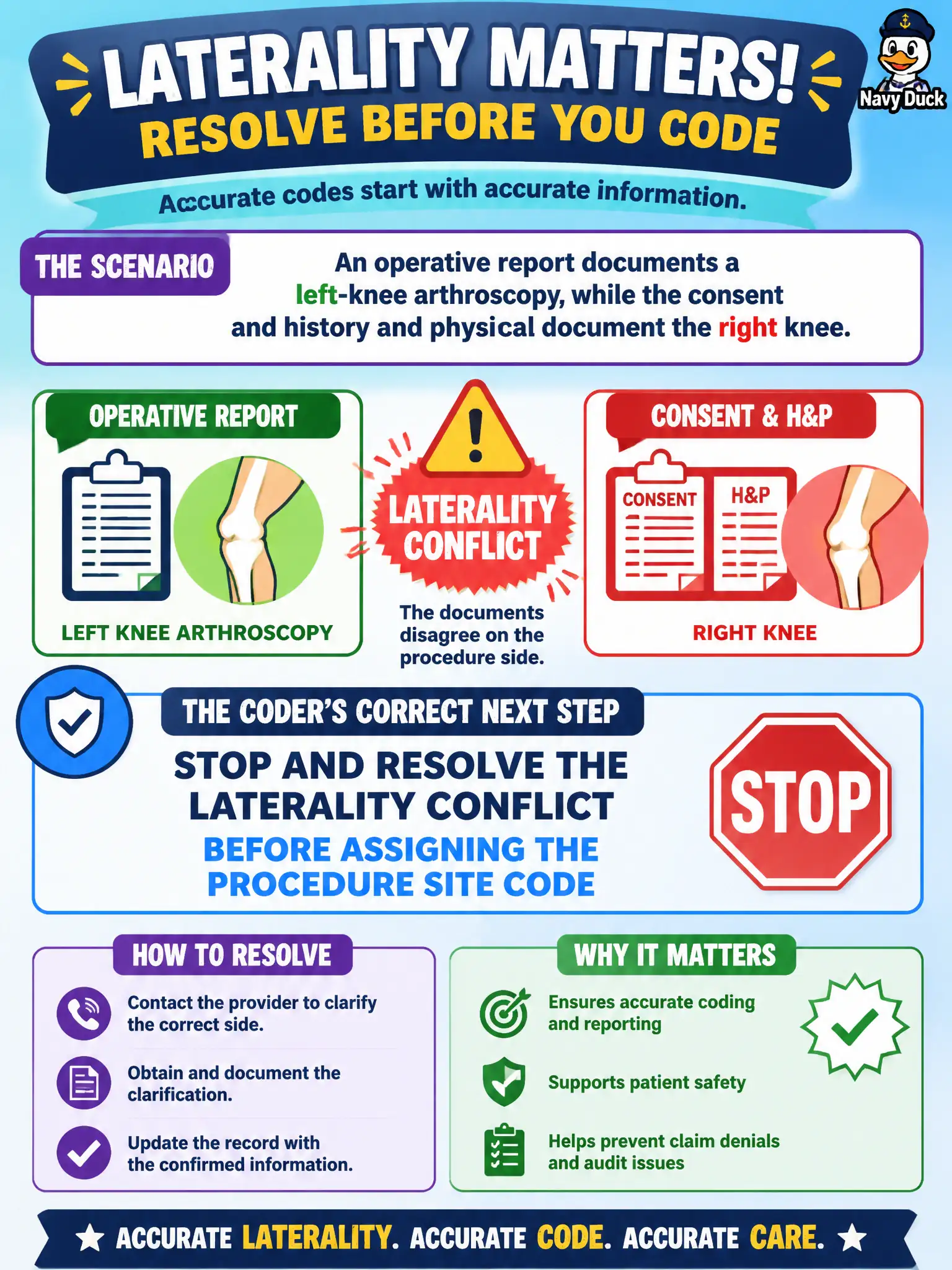
An operative report documents a left-knee arthroscopy, while the consent and history and physical document the right knee. What is the coder’s correct next step?
Select an answer to reveal the explanation.
Short Explanation
Left in the op note, right on the consent and H&P—hit the brakes. Site of surgery is too important to guess. Clarify the laterality, then code.
Full Explanation
When an operative report documents a left-knee arthroscopy while consent and history and physical document the right knee, the coder’s correct next step is to stop and resolve the laterality conflict before assigning the procedure site code. Wrong-site coding risk is unacceptable in public surgical services. Coding the left knee because the operative report is always final without review fails when other authenticated documents conflict—clarification is required. Coding the right knee because consent forms outrank operative documentation fails as a rigid hierarchy that skips resolution. Reporting unspecified laterality to avoid choosing a side fails when conflicting specific sides are documented; unspecified is not a conflict workaround. Exam caveat: laterality conflicts among consent, H&P, and operative notes must be reconciled before site-dependent coding. Operational check: query the surgeon at the civic facility, confirm the correct operative site, ensure the record is corrected or clarified, then assign laterality-dependent CPT/PCS and diagnosis codes. Escalate pattern mismatches to perioperative safety leadership for county OR quality. In municipal and county facility practice, record the rationale for the chosen coding path and the rejected alternatives in the abstract notes so auditors and future coders understand the clinical and compliance basis. Re-check the decision if new authenticated documentation arrives before final bill drop, and escalate persistent documentation gaps to CDI or compliance rather than normalizing unsupported shortcuts that would distort civic claims, quality metrics, or case-mix reporting.