
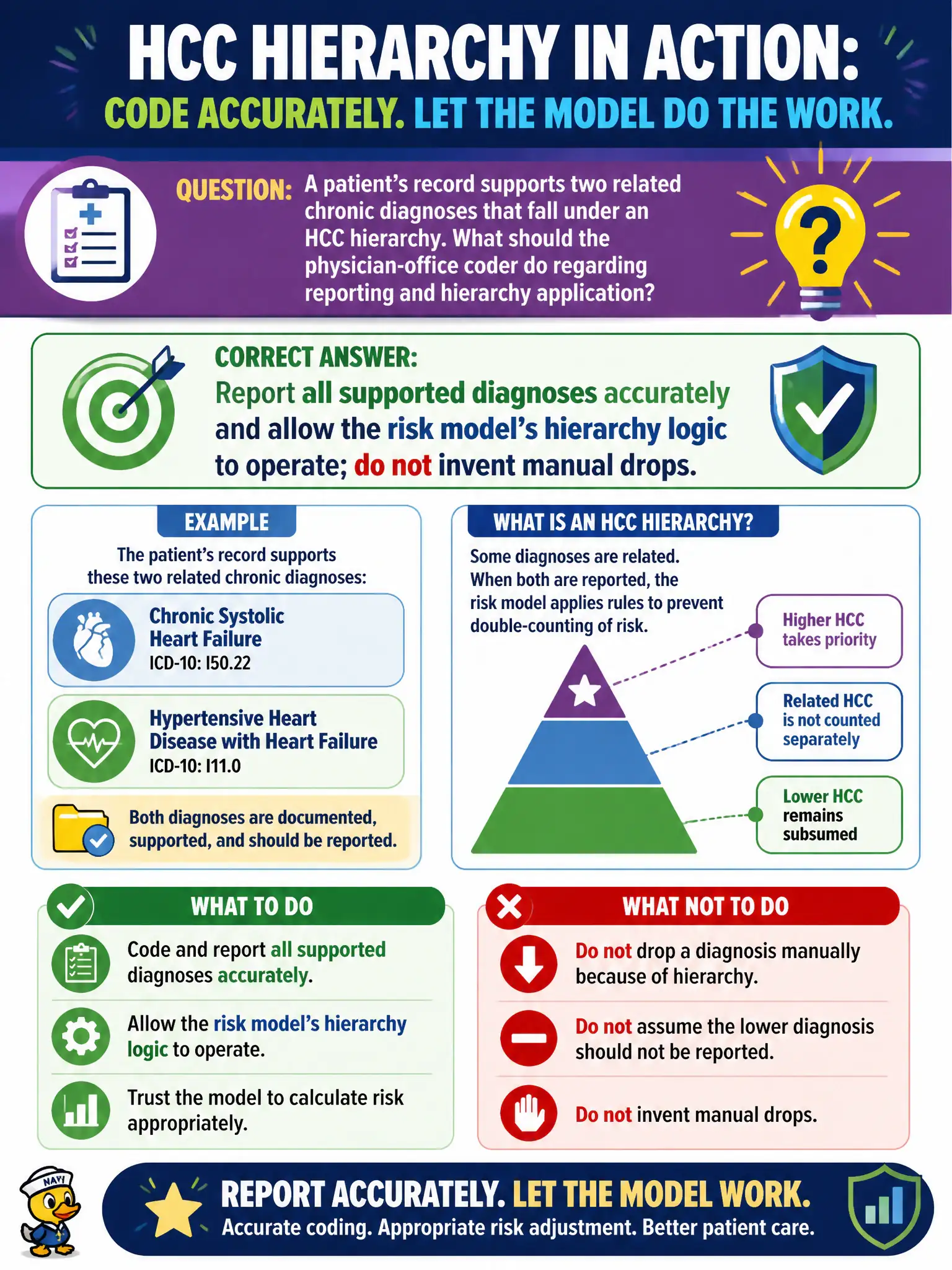
A patient’s record supports two related chronic diagnoses that fall under an HCC hierarchy. What should the physician-office coder do regarding reporting and hierarchy application?
Select an answer to reveal the explanation.
Short Explanation
Your job is to code what the doctor documented—not to play traffic cop for the HCC hierarchy. Report the supported diagnoses and let the model apply hierarchy rules. Hand-dropping codes “to look clean” creates a false chart.
Full Explanation
When a patient’s record supports two related chronic diagnoses that fall under an HCC hierarchy, the physician-office coder should report all supported diagnoses accurately and allow the risk model’s hierarchy logic to operate—not invent manual drops. Coding what the clinician documented preserves chart truth; the CMS-HCC software applies demotion rules. Civic clinics should not “pre-scrub” milder related diagnoses out of encounters to make hierarchy “look clean.”
Silently dropping the less severe diagnosis from the claim so the hierarchy looks clean fails by concept because it falsifies the documented clinical picture. Reporting only the less severe diagnosis to avoid hierarchy software edits fails because it withholds the more severe supported condition and misunderstands hierarchy purpose. Submitting duplicate claims—one per related diagnosis—to force separate HCC payments fails because claim splitting to evade hierarchy is an integrity violation.
Exam caveat: unsupported diagnoses should still be omitted; hierarchy guidance applies to supported related pairs, not to coding fiction. Operational check: code both related conditions when documented with MEAT, educate providers that hierarchy is applied downstream, and audit for improper manual suppression of milder related codes.