
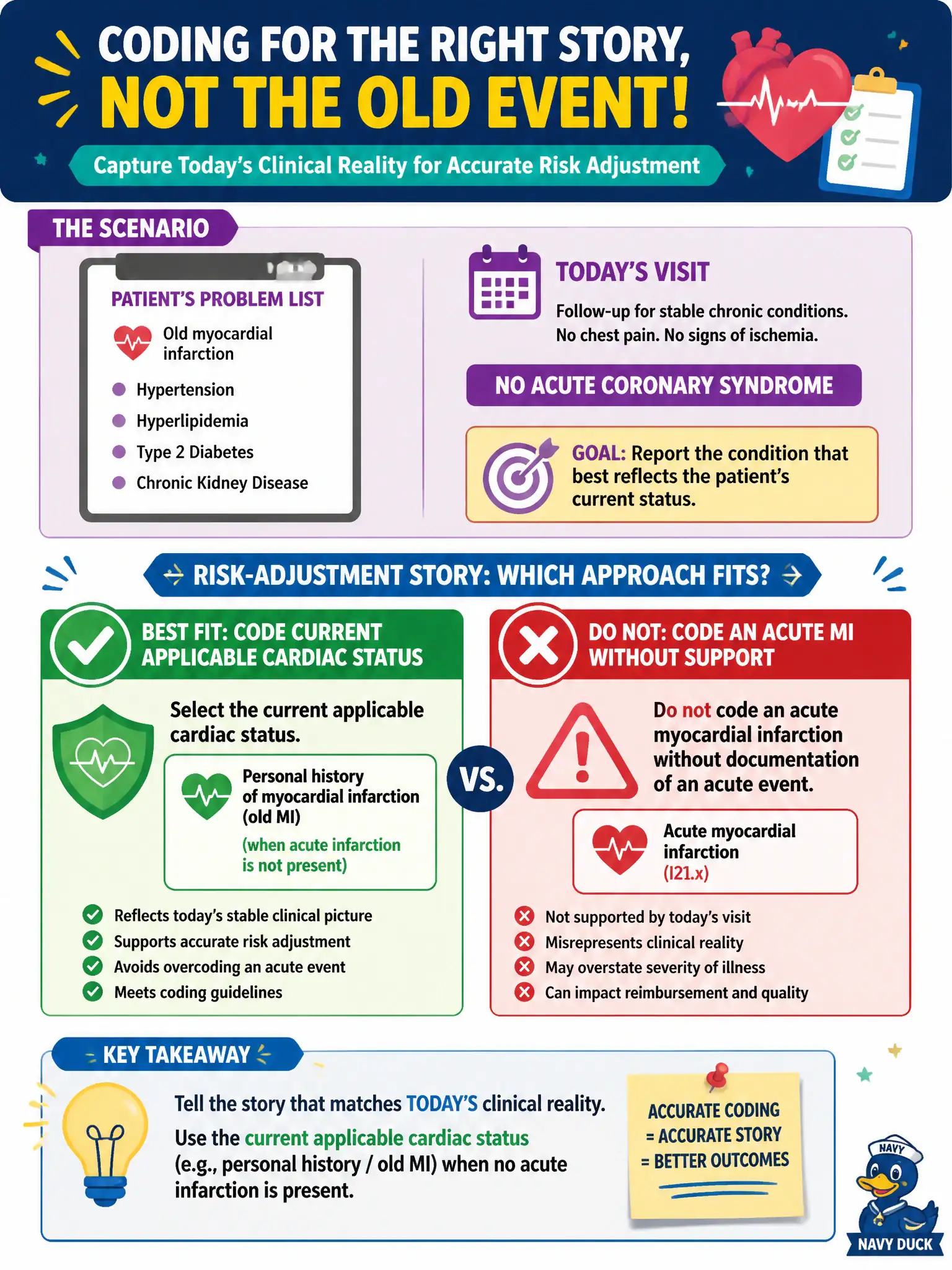
A patient’s problem list shows an old myocardial infarction, and today’s visit addresses stable chronic conditions with no acute coronary syndrome. Which coding approach best fits the encounter’s risk-adjustment story?
Select an answer to reveal the explanation.
Short Explanation
An old heart attack on the list is history—not today’s STEMI. Code the status that matches this encounter. Inventing an acute MI for HCC points is the wrong kind of creativity.
Full Explanation
When a patient’s problem list shows an old myocardial infarction and today’s visit addresses stable chronic conditions without acute coronary syndrome, select the current applicable cardiac status—such as personal history or old MI when acute infarction is not present—rather than coding an acute MI without support. Matching acuity to the encounter protects risk-adjustment integrity in civic cardiology and primary-care panels and avoids inventing STEMI-level acuity for RAF points.
Always coding an acute MI if any historical MI appears on the problem list fails by concept because history is not acute infarction. Coding acute MI and old MI together on every visit for maximum HCC credit fails because it fabricates acuity and misuses hierarchy/payment incentives. Omitting all cardiac history because risk adjustment ignores ischemic heart disease fails because ischemic disease families are often risk-relevant when accurately current.
Exam caveat: if the patient truly has an acute MI this encounter, acute codes are appropriate—this stem lacks acute support. Operational check: distinguish “old MI/history” language from acute ACS documentation before finalizing cardiac ICD-10-CM on MA-relevant visits, and query when problem-list acuity conflicts with the assessment.