
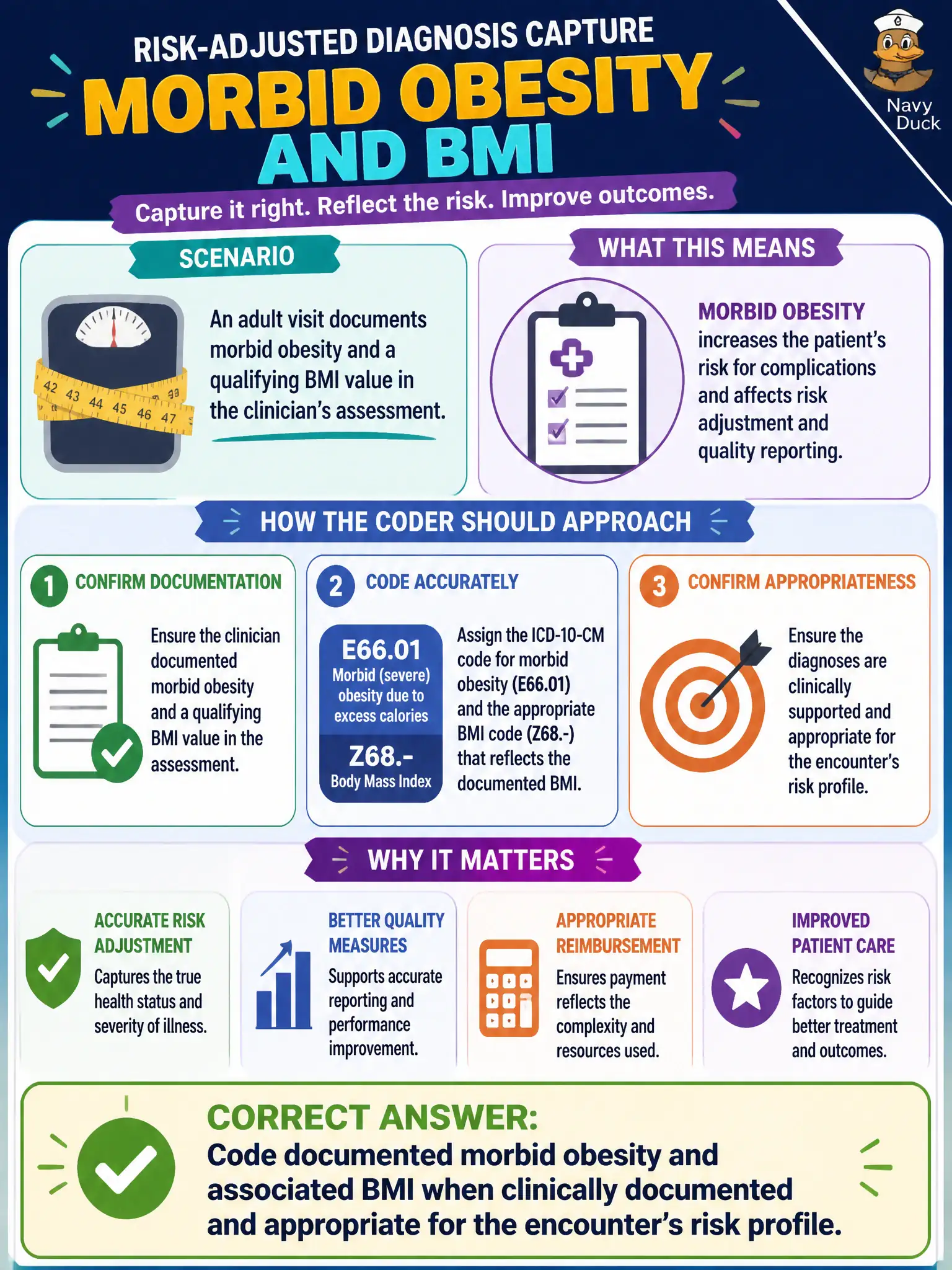
An adult visit documents morbid obesity and a qualifying BMI value in the clinician’s assessment. How should the coder approach risk-adjusted diagnosis capture?
Select an answer to reveal the explanation.
Short Explanation
When the clinician documents morbid obesity and BMI, those details can belong in the coded story—not swept under the rug as “cosmetic.” Capture what is documented and relevant. Skipping supported obesity/BMI leaves risk capture incomplete.
Full Explanation
When an adult visit documents morbid obesity and a qualifying BMI value in the clinician’s assessment, the coder should code documented morbid obesity and associated BMI when clinically documented and appropriate for the encounter’s risk profile. These are clinical status details—not cosmetic trivia—and capturing them supports accurate ambulatory risk adjustment in community practices when the note owns the diagnoses.
Never coding obesity or BMI because they are always considered cosmetic fails by concept because morbid obesity and BMI are clinical diagnoses/status when documented. Coding BMI alone while prohibiting any obesity diagnosis even when morbid obesity is stated fails because it discards explicit clinician diagnosis language. Reporting obesity only when a CPT bariatric surgery code appears fails because obesity diagnosis capture is not limited to operative claims.
Exam caveat: payer and risk-model relevance can vary; still code what is documented and clinically appropriate rather than suppressing supported obesity/BMI by habit. Operational check: ensure BMI values documented in the assessment flow to coded BMI ICD-10-CM when thresholds and documentation support morbid obesity capture.