
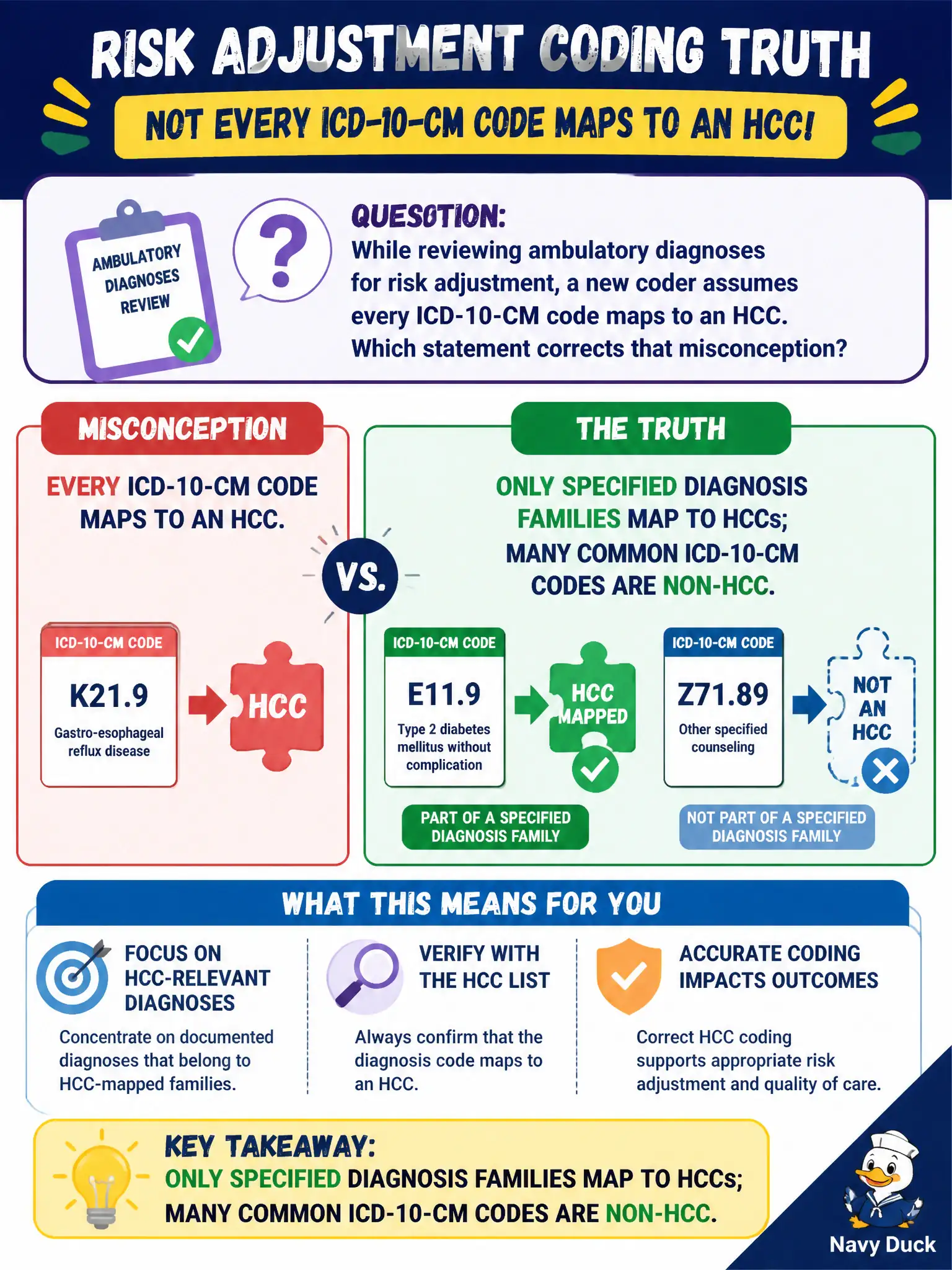
While reviewing ambulatory diagnoses for risk adjustment, a new coder assumes every ICD-10-CM code maps to an HCC. Which statement corrects that misconception?
Select an answer to reveal the explanation.
Short Explanation
Not every diagnosis gets an HCC jersey. Plenty of everyday codes never enter a risk category. Learn which families are HCC-relevant instead of assuming the whole ICD book pays risk.
Full Explanation
While reviewing ambulatory diagnoses for risk adjustment, coders must understand that only specified diagnosis families map to HCCs; many common ICD-10-CM codes are non-HCC. Correcting the misconception that every code maps prevents false confidence and wasted chart-chase effort in civic Medicare Advantage clinics. Learn which families are risk-relevant instead of treating the entire ICD book as a risk ledger for public-program population payment.
Claiming every ICD-10-CM code maps to exactly one HCC in all model versions fails by concept because mappings are selective and version-specific. Asserting only symptom R-codes map while chronic disease codes never do fails because many chronic disease families are core HCC drivers and many symptoms are not. Claiming HCCs map exclusively from CPT Category II codes, not ICD-10-CM, fails because CMS-HCC mapping is diagnosis-based.
Exam caveat: model updates can move codes into or out of HCC relevance; refresh crosswalks when CMS publishes a new version. Operational check: train new coders with examples of high-volume non-HCC codes versus HCC-mapped chronic families, and validate suspect “everything is HCC” assumptions against the current crosswalk before prioritizing outreach.