
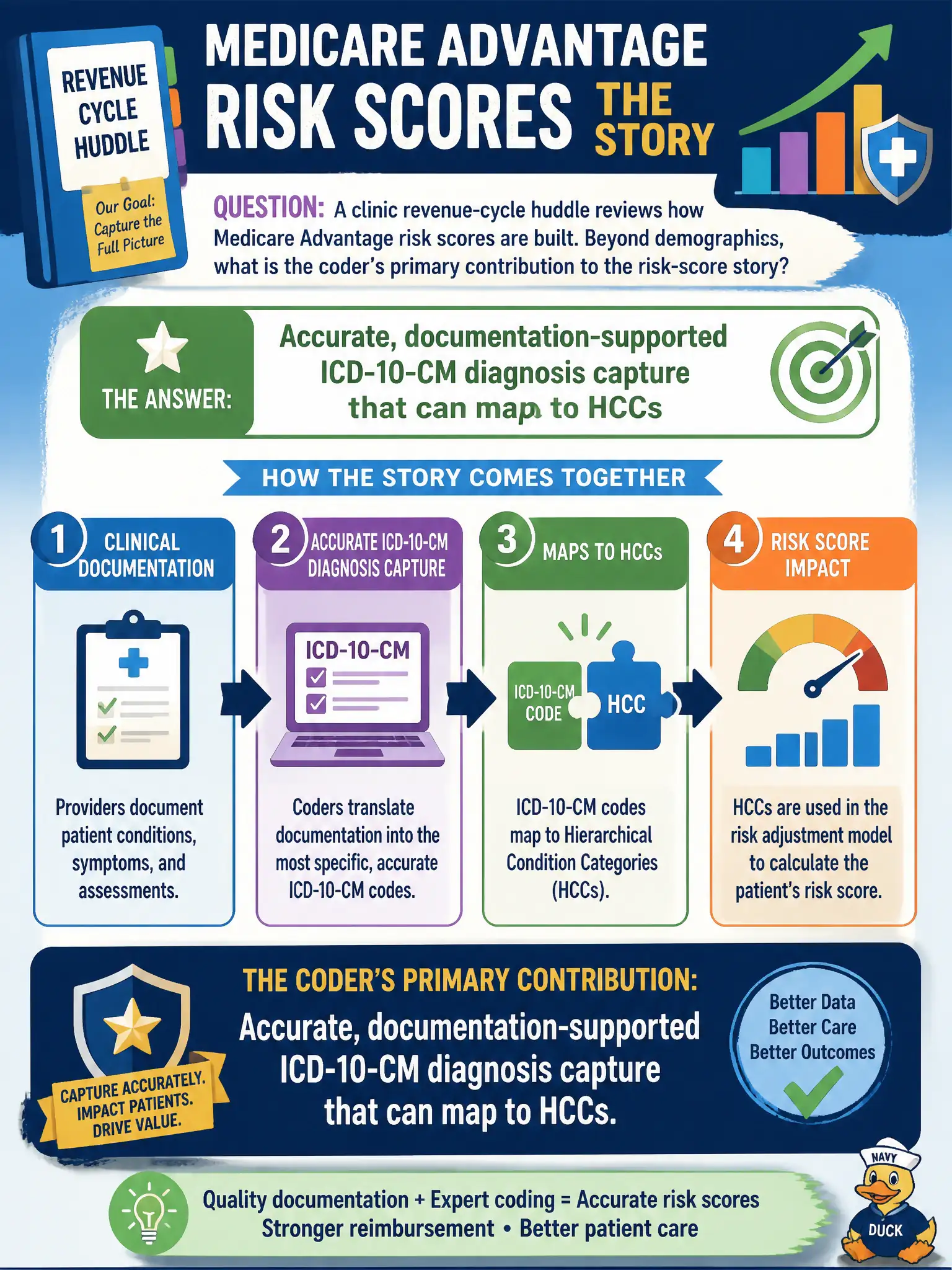
A clinic revenue-cycle huddle reviews how Medicare Advantage risk scores are built. Beyond demographics, what is the coder’s primary contribution to the risk-score story?
Select an answer to reveal the explanation.
Short Explanation
Demographics set the baseline; diagnoses fill in how complex the patient is. The coder’s job is accurate, supported ICD-10-CM—not inventing CPT tricks or POS games to juice a risk score. Get the diagnoses right and the model can do its mapping.
Full Explanation
Beyond demographics, the coder’s primary contribution to the Medicare Advantage risk-score story is accurate, documentation-supported ICD-10-CM diagnosis capture that can map to HCCs. Demographics set baseline factors; diagnoses convey clinical complexity for the population payment model. Civic clinic revenue-cycle huddles should keep that lane clear: diagnosis integrity—not CPT, POS, or modifier tricks—drives the coder’s role in stewarding public MA risk adjustment.
Selecting RVU-weighted CPT codes that directly set the HCC coefficient fails by concept because HCCs are diagnosis-mapped categories, not CPT-RVU coefficients. Entering place-of-service 21 on every claim to increase risk scores fails because place-of-service games do not create HCC factors and misstate setting. Appending modifier 25 to all E/M services to unlock demographic factors fails because modifiers do not unlock demographic risk factors and blanket 25 use is a compliance problem.
Exam caveat: procedure coding remains essential for fee-for-service professional payment but is not the HCC mapping source of truth. Operational check: measure risk-adjustment quality by supported ICD capture rates and chart MEAT reviews, and reject workflows that try to juice RAF through CPT upcoding or POS defaults.