
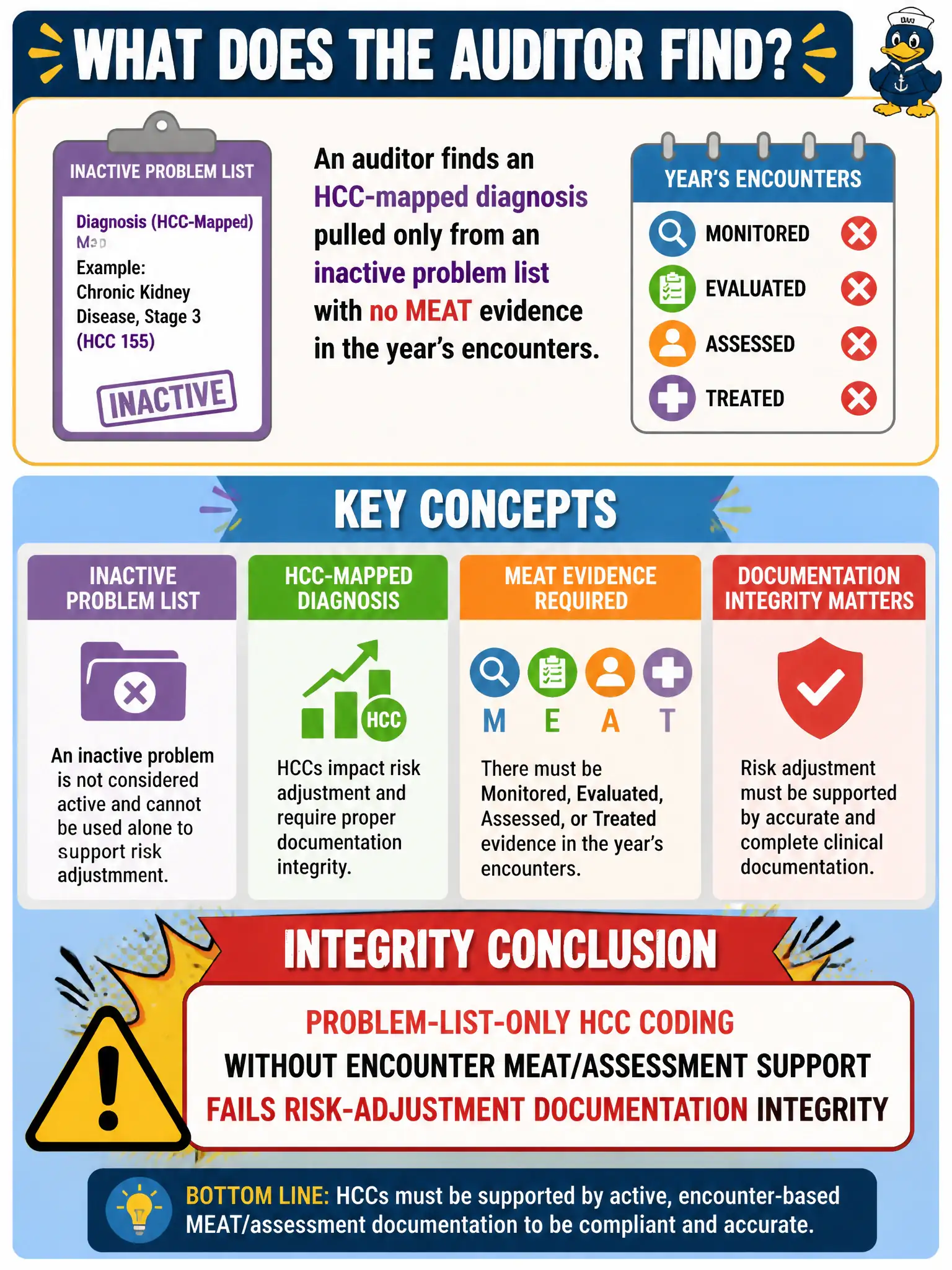
An auditor finds an HCC-mapped diagnosis pulled only from an inactive problem list with no MEAT (monitored, evaluated, assessed, or treated) evidence in the year’s encounters. What integrity conclusion is most accurate?
Select an answer to reveal the explanation.
Short Explanation
A dusty problem-list line is not the same as “we dealt with it this visit.” Risk-adjustment integrity wants evidence the condition was monitored, evaluated, assessed, or treated. No MEAT in the encounter notes means that HCC claim is on thin ice.
Full Explanation
An HCC-mapped diagnosis pulled only from an inactive problem list without MEAT—monitored, evaluated, assessed, or treated—evidence in the year’s encounters fails risk-adjustment documentation integrity. Auditors in physician-office MA programs look for encounter-level support, not dusty list lines. Civic clinics protect public trust by refusing problem-list-only HCC coding when the year’s notes never address the condition.
Claiming inactive problem-list diagnoses always qualify if they once mapped historically fails by concept because historical presence is not current-year support. Saying MEAT is required only for CPT procedures, never for risk-adjusted diagnoses, fails because risk-adjustment integrity centers on diagnosis support. Asserting any ICD-10-CM code on a claim automatically satisfies MA audit standards fails because unsupported codes are classic audit vulnerabilities.
Exam caveat: MEAT is a teaching mnemonic, not a statute; the underlying requirement is clinically credible encounter documentation of the condition. Operational check: before finalizing HCC-candidate diagnoses, confirm the year’s note shows monitoring, evaluation, assessment, or treatment, and query or omit when only an inactive list entry exists.