
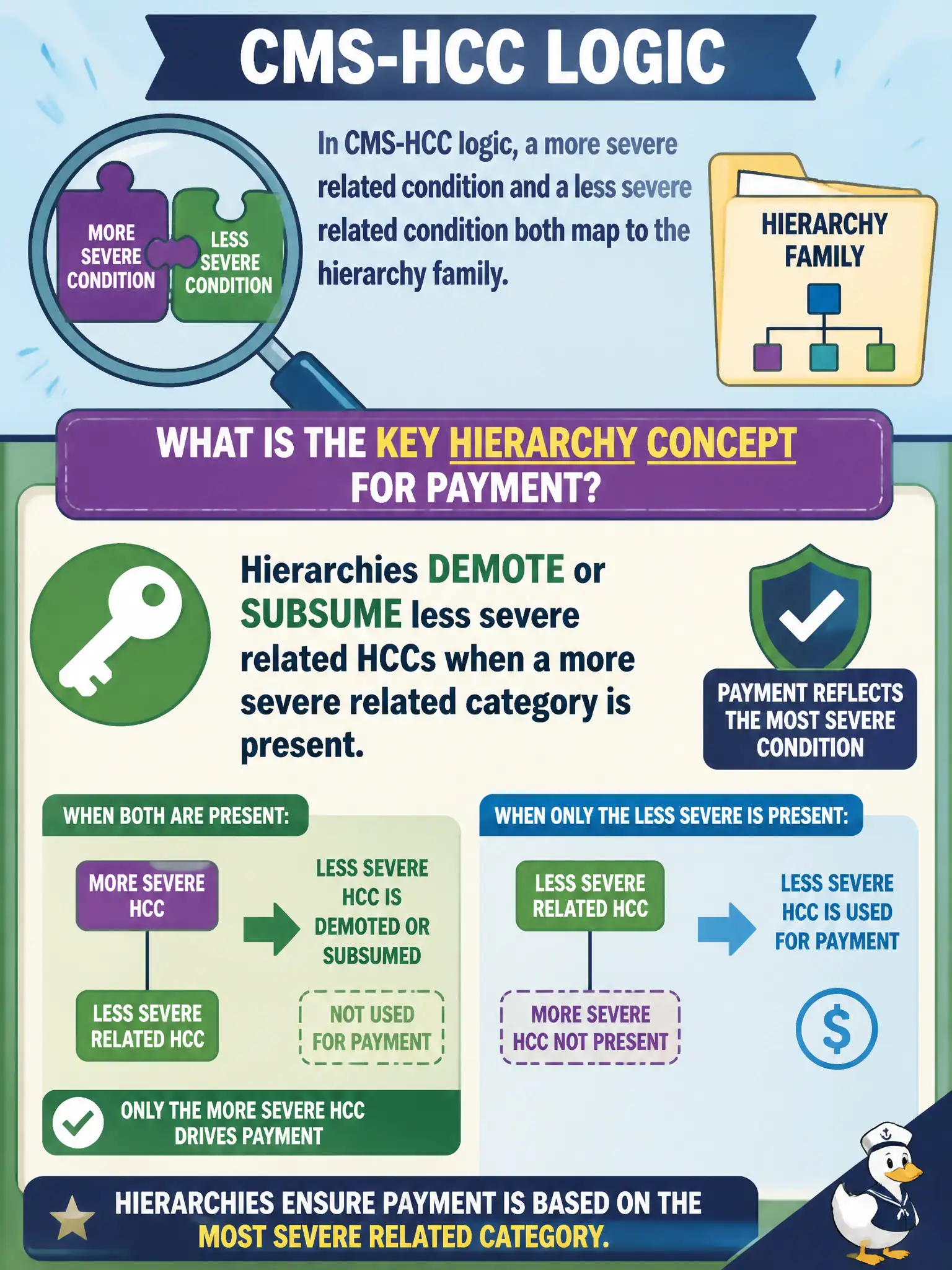
In CMS-HCC logic, a more severe related condition and a less severe related condition both map to the hierarchy family. What is the key hierarchy concept for payment?
Select an answer to reveal the explanation.
Short Explanation
Picture a ladder of severity—once the top rung is coded, the lower related rungs do not each collect a full separate risk credit. Hierarchies keep the more severe related category in play and demote the milder related one. The chart still gets coded accurately; the model applies the hierarchy.
Full Explanation
In CMS-HCC logic, when a more severe related condition and a less severe related condition both map to the same hierarchy family, hierarchies demote or subsume the less severe related HCC when the more severe related category is present. The chart should still be coded accurately; the model applies hierarchy for payment/risk credit. Civic clinic risk-adjustment teams should explain hierarchy as severity logic, not as permission to invent or delete diagnoses.
Expecting both related HCCs always to pay at full separate rates with no interaction fails by concept because hierarchy exists to prevent double counting related severity. Claiming the less severe related HCC always overrides the more severe category fails because it reverses hierarchy direction. Asserting hierarchies delete ICD-10-CM codes from the claim before submission fails because hierarchy operates in the risk model after coding; it is not a claim scrub that strips diagnoses.
Exam caveat: hierarchy families are model-defined; not every pair of diagnoses interacts. Operational check: report all supported related diagnoses, then review RAF output to see hierarchy demotion rather than manually suppressing milder related codes from the encounter.