
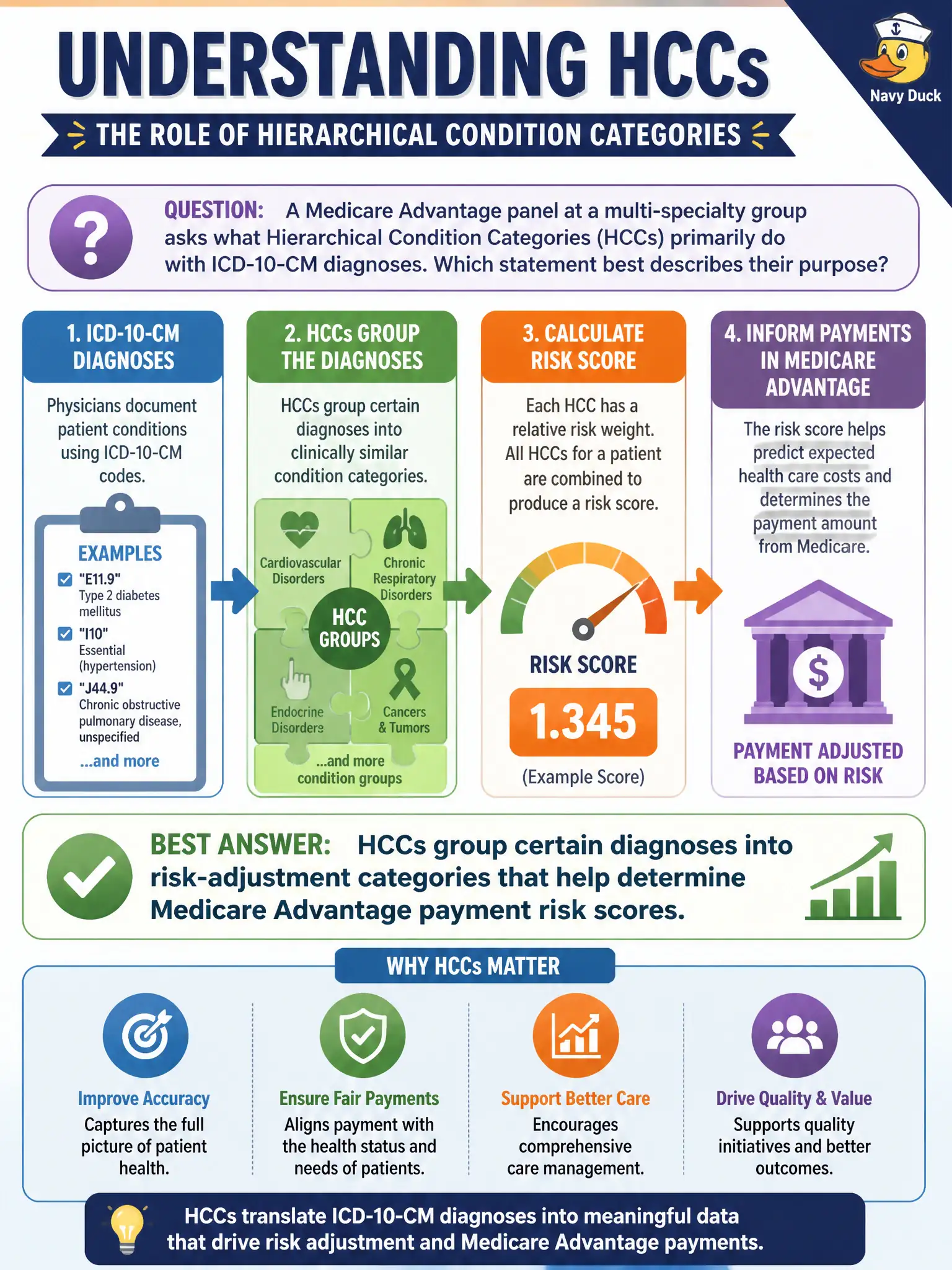
A Medicare Advantage panel at a multi-specialty group asks what Hierarchical Condition Categories (HCCs) primarily do with ICD-10-CM diagnoses. Which statement best describes their purpose?
Select an answer to reveal the explanation.
Short Explanation
HCCs are buckets that gather related diagnoses so payors can score how sick a population is. For Medicare Advantage, those buckets feed risk adjustment—not CPT replacement or NCCI overrides. Coders still report real ICD-10-CM; the model maps eligible codes into categories.
Full Explanation
Hierarchical Condition Categories group certain ICD-10-CM diagnoses into risk-adjustment categories that help determine Medicare Advantage payment risk scores. In a multi-specialty civic group, coders still report clinically accurate diagnoses; the HCC model then maps eligible codes into categories that, with demographics, drive risk scores. Understanding that purpose prevents confusing HCCs with CPT, DRG, or modifier mechanisms.
Claiming HCCs replace CPT codes so professional claims no longer need procedure coding fails by concept because HCCs are diagnosis risk categories, not procedure substitutes. Calling HCCs hospital DRG relatives used only for inpatient facility payment fails because CMS-HCC risk adjustment is a distinct MA population-payment model, not inpatient MS-DRG grouping. Treating HCCs as modifier sets that override NCCI edits fails because they do not function as claim modifiers or NCCI overrides.
Exam caveat: different HCC model versions and programs (for example, CMS-HCC versus other risk models) vary in mappings; know which model the plan uses. Operational check: educate MA panels that accurate supported ICD-10-CM capture—not CPT gaming—is the coder’s contribution to risk adjustment.